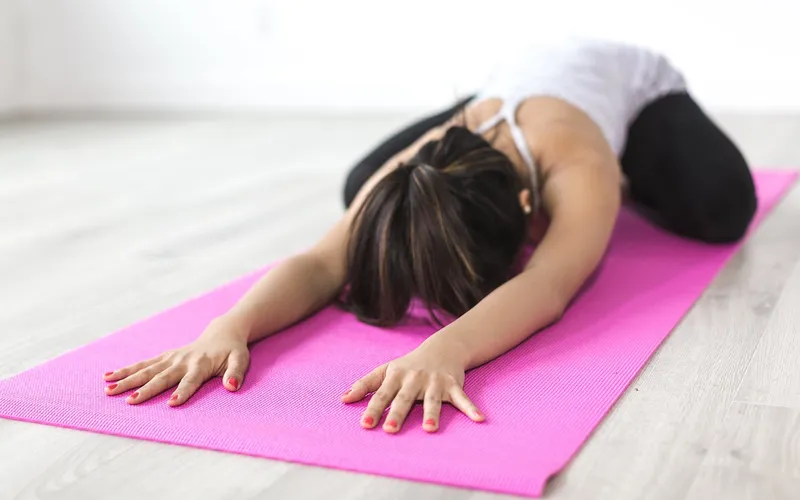
A good routine for long-term lower back pain combines a short walk, gentle core work like the dead bug and side plank, and strength exercises where the back is supported, such as the glute bridge and a chest-supported row. Do it two or three times a week and build up slowly.
On this page
Before you start
This routine is for the common, long-term kind of lower back ache. If your pain came on after a fall, is spreading down a leg, or comes with numbness, weakness, fever, or changes in bladder or bowel control, see a doctor before doing any of it. If you are not sure, ask a physiotherapist to look at the routine with you.
The rule for every exercise below: some discomfort, up to about 3 out of 10, is fine if it settles within a day. If your back is clearly worse the next morning, use the easier version next time.
All the exercises are ones Amble rates 0 or 1 out of 3 for lower back stress. You need a mat, a pair of dumbbells or a kettlebell, and a bench or a sturdy chair. A cable machine is optional.
The routine
| # | Exercise | Sets x reps | Rest |
|---|---|---|---|
| 1 | Walk | 5 to 8 minutes | |
| 2 | Lying glute stretch | 2 x 30 seconds each side | |
| 3 | Dead bug | 2 x 6 each side | 45 s |
| 4 | Glute bridge | 2 x 12 | 45 s |
| 5 | Side plank | 2 x 15 to 20 seconds each side | 45 s |
| 6 | Chest-supported row | 2 x 10 | 60 s |
| 7 | Goblet squat to a box | 2 x 8 | 60 s |
Total time: about 25 minutes.
1. Walk
Five to eight minutes at an easy pace, outside or on a treadmill. This warms you up and, for many people, eases a stiff back on its own.
2. Lying glute stretch
Lie on your back and draw one knee across your body, keeping both shoulders on the floor. Breathe out and let the hip relax. Thirty seconds each side. See the lying glute stretch.
3. Dead bug
Lie on your back with your arms pointing up and your knees bent at 90 degrees over your hips. Press your lower back gently into the floor. Slowly lower one arm and the opposite leg, then bring them back and switch. Breathe out as you lower. See the dead bug.
Easier: move only the legs, and only lower the heel to tap the floor.
4. Glute bridge
Feet flat, close to your hips. Push through your heels and lift your hips. Squeeze at the top without arching your back, then lower slowly. See the glute bridge.
Easier: lift only halfway.
5. Side plank
On your forearm with the elbow under your shoulder, lift your hips so your body makes a straight line. Hold and breathe. See the side plank.
Easier: keep your knees bent and on the floor, so you pivot from the knees, not the feet.
6. Chest-supported row
Lie face down on an incline bench with a dumbbell in each hand. Row the dumbbells toward your hips, squeezing your shoulder blades together, then lower until your arms are straight. Your chest stays on the bench, so your back does not have to hold you up. See the chest-supported row.
No bench? Kneel with one hand on a sturdy chair and row with the other arm.
7. Goblet squat to a box
Hold one dumbbell or kettlebell against your chest with your elbows pointing down. Sit back to a box or chair, touch lightly, and stand. Keeping the weight at the chest helps you stay upright. See the goblet squat.
Easier: no weight, and a higher seat.
Swap-in once this feels easy
After three or four weeks, add a Pallof press after the side plank: stand side-on to a cable or band, hold the handle at your chest, press it straight out and resist the pull. 2 sets of 10 each side. It trains your trunk to resist twisting while you stand.
Then build in this order: a third set of the exercises that feel best, then a little more weight on the row and squat, then a longer walk.
How often
Two or three times a week, on days that are not back to back. Walk on the other days if you can.
Why this kind of routine
A Cochrane review of 249 trials found that exercise therapy probably reduces pain and improves function in chronic low back pain compared with no treatment, usual care or placebo. The effects were small to moderate 1. So expect it to help, slowly, rather than to fix everything. We go through the review in more detail in does exercise help chronic low back pain?
UK guidance suggests considering a group exercise programme for low back pain, which can be strength-based, aerobic, mind-body or a mix, and encourages people to keep up their normal activities 2. This routine is strength-based with a walk. If you would rather do yoga, Pilates or a class, that fits the guidance too. If you would enjoy training with others, ask your doctor or physiotherapist about group classes for back pain near you.
For the wider picture, including a flare-up plan, see our guide to training with back pain.
Sources
- Hayden JA, Ellis J, Ogilvie R, Malmivaara A, van Tulder MW. Exercise therapy for chronic low back pain. Cochrane Database of Systematic Reviews, 2021;2021(10). doi:10.1002/14651858.CD009790.pub2 · PubMed
- NICE. Low back pain and sciatica in over 16s: assessment and management (NG59). Accessed 23 October 2026.