Your running pace and race times
Pace is time divided by distance: a 10K in 50:00 is 5:00 per km, or 8:03 per mile. Enter a distance and your time to get your pace per kilometre and per mile, and what that effort suggests for a 5K, 10K, half marathon and marathon. The pace chart below the calculator gives the finish time for every pace. Nothing you type leaves this page.
A narrow strip with times at every kilometre, to cut out and wear on your wrist.
An estimate from published formulas, not a measurement. Real needs vary from person to person.
Your pace, planned toward a race
Your number from the calculator, carried into the plan Ami writes.
Fill in the calculator above and your number appears here.
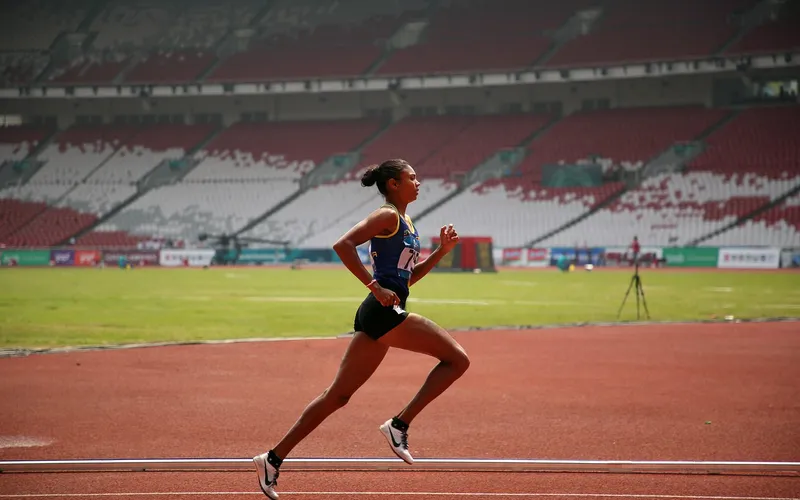
Running pace chart
Finish times at an even pace, from 3:30 to 8:00 per km and from 6:00 to 13:00 per mile. Find your pace in the left column and read across. The 5K, 10K, half marathon and marathon charts go into each distance with splits.
5K and 10K times by pace per km
| Pace per km | Pace per mile | 5K | 10K |
|---|---|---|---|
| 3:30 | 5:38 | 17:30 | 35:00 |
| 3:45 | 6:02 | 18:45 | 37:30 |
| 4:00 | 6:26 | 20:00 | 40:00 |
| 4:15 | 6:50 | 21:15 | 42:30 |
| 4:30 | 7:15 | 22:30 | 45:00 |
| 4:45 | 7:39 | 23:45 | 47:30 |
| 5:00 | 8:03 | 25:00 | 50:00 |
| 5:15 | 8:27 | 26:15 | 52:30 |
| 5:30 | 8:51 | 27:30 | 55:00 |
| 5:45 | 9:15 | 28:45 | 57:30 |
| 6:00 | 9:39 | 30:00 | 1:00:00 |
| 6:15 | 10:04 | 31:15 | 1:02:30 |
| 6:30 | 10:28 | 32:30 | 1:05:00 |
| 6:45 | 10:52 | 33:45 | 1:07:30 |
| 7:00 | 11:16 | 35:00 | 1:10:00 |
| 7:15 | 11:40 | 36:15 | 1:12:30 |
| 7:30 | 12:04 | 37:30 | 1:15:00 |
| 7:45 | 12:28 | 38:45 | 1:17:30 |
| 8:00 | 12:52 | 40:00 | 1:20:00 |
Half marathon and marathon times by pace per km
| Pace per km | Speed (km/h) | Half marathon | Marathon |
|---|---|---|---|
| 3:30 | 17.1 | 1:13:50 | 2:27:41 |
| 3:45 | 16.0 | 1:19:07 | 2:38:14 |
| 4:00 | 15.0 | 1:24:23 | 2:48:47 |
| 4:15 | 14.1 | 1:29:40 | 2:59:20 |
| 4:30 | 13.3 | 1:34:56 | 3:09:53 |
| 4:45 | 12.6 | 1:40:13 | 3:20:26 |
| 5:00 | 12.0 | 1:45:29 | 3:30:59 |
| 5:15 | 11.4 | 1:50:46 | 3:41:31 |
| 5:30 | 10.9 | 1:56:02 | 3:52:04 |
| 5:45 | 10.4 | 2:01:19 | 4:02:37 |
| 6:00 | 10.0 | 2:06:35 | 4:13:10 |
| 6:15 | 9.6 | 2:11:52 | 4:23:43 |
| 6:30 | 9.2 | 2:17:08 | 4:34:16 |
| 6:45 | 8.9 | 2:22:24 | 4:44:49 |
| 7:00 | 8.6 | 2:27:41 | 4:55:22 |
| 7:15 | 8.3 | 2:32:57 | 5:05:55 |
| 7:30 | 8.0 | 2:38:14 | 5:16:28 |
| 7:45 | 7.7 | 2:43:30 | 5:27:01 |
| 8:00 | 7.5 | 2:48:47 | 5:37:34 |
Times by pace per mile
| Pace per mile | 5K | Half marathon | Marathon |
|---|---|---|---|
| 6:00 | 18:38 | 1:18:39 | 2:37:19 |
| 6:30 | 20:12 | 1:25:13 | 2:50:25 |
| 7:00 | 21:45 | 1:31:46 | 3:03:32 |
| 7:30 | 23:18 | 1:38:19 | 3:16:38 |
| 8:00 | 24:51 | 1:44:53 | 3:29:45 |
| 8:30 | 26:24 | 1:51:26 | 3:42:52 |
| 9:00 | 27:58 | 1:57:59 | 3:55:58 |
| 9:30 | 29:31 | 2:04:32 | 4:09:05 |
| 10:00 | 31:04 | 2:11:06 | 4:22:11 |
| 10:30 | 32:37 | 2:17:39 | 4:35:18 |
| 11:00 | 34:11 | 2:24:12 | 4:48:24 |
| 11:30 | 35:44 | 2:30:45 | 5:01:31 |
| 12:00 | 37:17 | 2:37:19 | 5:14:38 |
| 12:30 | 38:50 | 2:43:52 | 5:27:44 |
| 13:00 | 40:23 | 2:50:25 | 5:40:51 |
Which pace for which run
Race pace comes from the calculator. Easy runs go on feel: slow enough to talk but not sing, the talk test for moderate effort1. The long run is easy too. For a full schedule, see Couch to 5K, the half marathon training plan and the marathon training plan. In Amble you add a race as a challenge with its date: the runs in your plan build toward it next to your strength training, and the coach adjusts the week from what you log.
How this works
Pace is time divided by distance. The calculator divides your time by the distance for pace per kilometre, multiplies by 1.609344 for pace per mile (the exact number of kilometres in a mile), and gives your speed in km/h as well.
Race predictions use the Riegel formula: new time = known time × (new distance ÷ known distance)^1.062. Peter Riegel fitted the exponent to athletic records and found that time grows a little faster than distance, so doubling the distance more than doubles the time. 1.06 is the figure most online predictors use.
Limits. The formula assumes you are equally trained for the longer distance. It is a good guide up to the half marathon, but in a survey of 2,303 recreational runners it gave marathon times at least 10 minutes too fast for half of them3. Treat the marathon line as a best case. Hills, heat and headwind are not in the model, and a prediction from a hard race run fresh on flat ground is better than one from a training run.
Worked example
You run 10 km in 50:00, which is 3,000 seconds. Pace: 3,000 ÷ 10 = 300 seconds, 5:00 per km. Per mile: 300 × 1.609344 = 482.8 seconds, 8:03. Speed is 12.0 km/h. Prediction for 5 km: 3,000 × 0.5^1.06 = 1,439 seconds, 23:59. Half marathon: 3,000 × (21.0975 ÷ 10)^1.06 = 6,619 seconds, 1:50:19. Marathon: 3:50:01.
Questions
How do I convert pace per km to pace per mile?
Multiply the pace per km by 1.609344. 5:00 per km is 300 seconds, and 300 × 1.609344 = 482.8 seconds, which is 8:03 per mile. To go the other way, divide: 10:00 per mile is 600 ÷ 1.609344 = 372.8 seconds, which is 6:13 per km.
How do I work out my running pace?
Turn your time into seconds and divide by the distance. A 5K in 27:30 is 1,650 seconds, and 1,650 ÷ 5 = 330 seconds, which is 5:30 per km. The chart above does it for every pace from 3:30 to 8:00 per km.
What pace should my easy runs be?
Slow enough that you can talk but not sing, the talk test for moderate effort1. That is usually well slower than race pace. Use the calculator for race pace and run easy days on feel.
What is a good running pace?
It depends on the distance, your age and how long you have trained, so the most useful comparison is with your own last race. The guides to a good 5K time, a good half marathon time and a good marathon time put finish times in context.
Why is my 5 km prediction not exactly half my 10 km time?
Pace gets slower as the distance grows, so half the distance is run faster than half the time. With the example above, 5 km comes out at 23:59 rather than 25:00.
Which race should I enter?
A recent race or a hard time trial of 5 to 15 km, ideally on flat ground. An easy training run says too little about what you can do in a race.
Does it work for walking or cycling?
The pace maths works for any movement, but the predictions are built for running.
Can I trust the marathon time?
Treat it as a best case. In studies, marathon predictions have come out too fast for many runners, and the marathon needs long runs in training that the formula cannot see.
Sources
- Centers for Disease Control and Prevention. Measuring physical activity intensity. Accessed 12 November 2026.
- Riegel PS. Athletic records and human endurance. American Scientist, 1981, 69(3):285-290. Find in a library.
- Vickers AJ, Vertosick EA. An empirical study of race times in recreational endurance runners. BMC Sports Science, Medicine and Rehabilitation, 2016;8:26. doi:10.1186/s13102-016-0052-y · PubMed