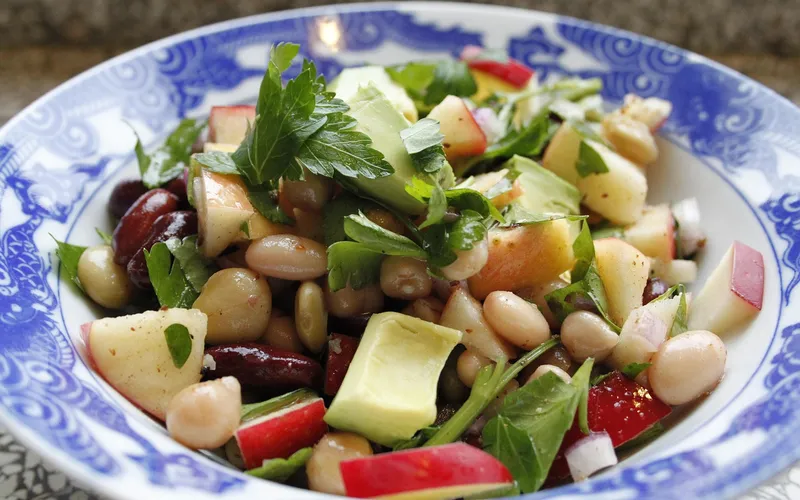
You can reach the 1.4 to 2.0 g per kg that supports training on a vegetarian or vegan diet, but it takes a little more planning. Build each meal around a clear protein food: dairy, eggs, tofu, tempeh, lentils, beans or chickpeas. Vegans usually find soy foods the easiest way to close the gap.
On this page
The good news first
Eating mostly plants is exactly what the official advice in Sweden and the other Nordic countries points towards. The Nordic Nutrition Recommendations favour a mainly plant-based diet with vegetables, fruit, legumes, whole grains, fish and nuts, and limited red and processed meat 1. Livsmedelsverket says much the same: more legumes and whole grains, less red and processed meat 2. So if you are vegetarian, you are already doing a lot right.
The one thing to watch is protein, especially if you are strength training or losing weight. For people who exercise, 1.4 to 2.0 g per kg of body weight a day is sufficient to build and keep muscle 3. Plant foods often carry less protein per bite than meat or dairy, so you need to be a bit more deliberate.
Vegetarian (with dairy and eggs)
This is the easier version. Kvarg, keso, skyr, eggs and milk do a lot of the work, and beans and lentils fill in the rest.
A day for someone around 70 kg, aiming for about 100 g. Values are approximate and vary by product, so check labels; Livsmedelsverket's food database lists values for foods sold in Sweden 4.
| Meal | Food | Protein, about |
|---|---|---|
| Breakfast | 200 g plain kvarg, berries, a little muesli | 24 g |
| Lunch | 2 eggs, 2 slices wholegrain bread, 2 slices cheese | 24 g |
| Snack | 150 g keso with tomato | 18 g |
| Dinner | Bean and red lentil chilli with rice | 28 g |
| Evening | A glass of milk | 7 g |
| Total | about 100 g |
Vegan
Without dairy and eggs, soy is your best friend. Tofu, tempeh, edamame and soy drink carry more protein than most other plant foods, and they are easy to find in Swedish shops now.
A day for someone around 70 kg:
| Meal | Food | Protein, about |
|---|---|---|
| Breakfast | Oats cooked with 3 dl soy drink, 1 tablespoon peanut butter | 18 g |
| Lunch | Wrap with 150 g firm tofu, hummus and salad | 27 g |
| Snack | 150 g edamame beans | 16 g |
| Dinner | Lentil and chickpea curry with rice | 24 g |
| Evening | 2 dl plain soy yoghurt | 8 g |
| Total | about 93 g |
That is solid, though a little short of 1.6 g/kg for a 70 kg person. To close the gap: a bigger portion of tofu at dinner, a second snack of roasted chickpeas, or a scoop of pea or soy protein.
Where plant diets tend to fall short
Breakfast. Toast with jam or oats with oat drink has very little protein. Fix this first.
Pasta and rice meals. A vegetable pasta can be almost protein-free. Add lentils, beans, tofu or a soy mince to anything that is mostly grain.
Volume. Beans and lentils are filling, and 30 g of protein from lentils is a big bowl. If you are not a big eater, lean more on tofu, tempeh and, if you eat them, dairy and eggs, which pack more into less space.
Does plant protein work as well for muscle?
Training matters far more than the protein source. In a large meta-analysis, protein added modestly to the gains from resistance training, and training itself was the much bigger driver 5. If you hit your daily total from a variety of plant foods and train consistently, you have the important parts covered.
How Amble handles vegan plans
When you tell Amble you eat vegan, it sets your protein target a little lower than for other plans: 1.6 g per kg or a quarter of your calories from protein, whichever is less. That keeps the number realistic from plant foods alone. For the full picture of how much you need, see how much protein you need, and for a longer food list, high-protein foods.
Questions
Do I need to combine proteins at every meal?
No. Eating a variety of plant proteins over the day is what counts. Rice with beans, or bread with hummus, are fine combinations, but you do not need to match them meal by meal.
Is pea or soy protein powder worth it?
It can help vegans reach a higher target on busy days, the same way whey helps others. It is a convenience, not a requirement. Check the label for protein per portion and added sugar.
Sources
- Blomhoff R, Andersen R, Arnesen EK, Christensen JJ, Eneroth H, Erkkola M et al.. Nordic Nutrition Recommendations 2023. Nordic Council of Ministers, 2023. doi:10.6027/nord2023-003
- Livsmedelsverket. Kostråd (dietary advice). Accessed 23 October 2026.
- Jäger R, Kerksick CM, Campbell BI, Cribb PJ, Wells SD, Skwiat TM et al.. International Society of Sports Nutrition Position Stand: protein and exercise. Journal of the International Society of Sports Nutrition, 2017;14(1). doi:10.1186/s12970-017-0177-8 · PubMed
- Livsmedelsverket. Livsmedelsdatabasen, the Swedish food composition database. Accessed 23 October 2026.
- Morton RW, Murphy KT, McKellar SR, Schoenfeld BJ, Henselmans M, Helms E et al.. A systematic review, meta-analysis and meta-regression of the effect of protein supplementation on resistance training-induced gains in muscle mass and strength in healthy adults. British Journal of Sports Medicine, 2018;52(6):376-384. doi:10.1136/bjsports-2017-097608 · PubMed