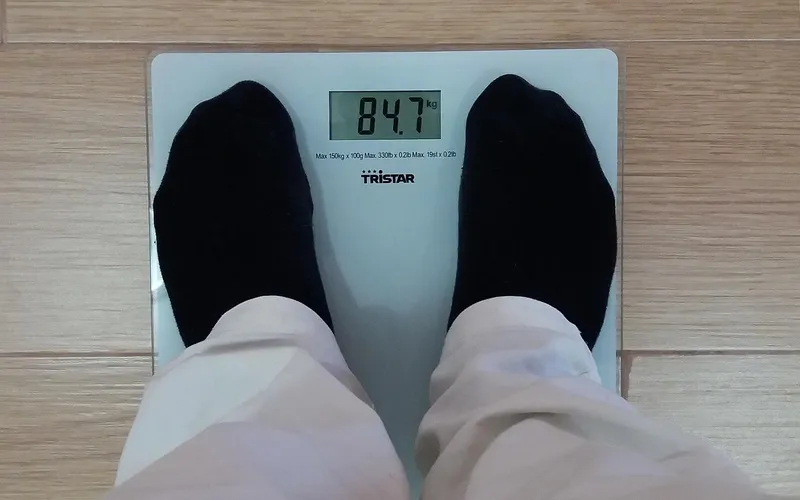
Weigh at the same time, in the same way, a few times a week or every day, and only pay attention to the weekly average. Single readings move with water, salt and food in your gut. Add a waist measurement every two weeks so you are not relying on one number.
On this page
Why your weight jumps around
You can be a kilogram heavier on Tuesday than on Monday without having gained any fat. Your weight on any given morning includes water, the food in your gut, and stored carbohydrate, which holds water with it. A salty dinner, a big training session, a long flight or the days before a period can all move the number. None of it is fat, and all of it settles.
That is why a single weigh-in tells you very little, and a trend tells you a lot.
A simple routine
- Same time. First thing in the morning, after the toilet, before you eat or drink.
- Same conditions. The same clothes, or none. The same scale, on the same hard floor (a rug can throw it off).
- Often enough to average. Every day is fine if it does not bother you. If daily numbers make you anxious, three set mornings a week works too.
- Write it down. A note on your phone, a paper chart, or an app. Do not trust memory.
- Average it. Add up the week and divide by the number of readings. Compare this week's average with last week's.
Reading the trend
Here is what a real fortnight might look like for someone losing weight steadily:
| Day | Week 1 | Week 2 |
|---|---|---|
| Mon | 82.4 | 81.9 |
| Tue | 82.9 | 81.6 |
| Wed | 82.1 | 82.3 |
| Thu | 81.8 | 81.5 |
| Fri | 82.0 | 81.4 |
| Sat | 82.6 | 81.9 |
| Sun | 82.3 | 81.6 |
| Average | 82.3 | 81.7 |
Look at the Wednesday of week 2. On its own it looks like a gain. In the average, it disappears. The real story is about 0.6 kg down over the week.
Expect the trend to slow over the months. That is how bodies respond to eating less over time 1, and it does not mean the plan has stopped working. The guide on how fast to lose weight explains why.
Other measures worth keeping
The scale cannot tell fat from muscle or water. If you are strength training, you may lose fat while keeping or gaining a little muscle, and the scale will undersell your progress. A few other measures fill the gap:
- Waist. Measure every two weeks, at the level of your belly button, breathing out normally. Same tape, same spot.
- Clothes. A pair of trousers that were snug at the start makes a good, honest gauge.
- Photos. Front and side, same light, once a month. Easy to forget, often the most convincing.
- Training log. Weights going up while body weight goes down is a very good sign.
When to weigh less often
If weighing makes you feel bad about yourself, or you find yourself weighing several times a day, cut back to once a week or stop and use your waist and clothes instead. If you have had an eating disorder, talk to your doctor or care team about whether to weigh at all. Progress you can live with is worth more than data.
What to do with the numbers
If the weekly average has been flat for three or four weeks, the plateau guide walks you through what to check, in order. If it is falling, leave the plan alone. And if you want to see where your trend could lead, the pace tool gives a rough picture.
Amble can read your weight from Apple Health, with your permission, so readings from a connected scale show up without typing them in.
Sources
- Hall KD, Sacks G, Chandramohan D, Chow CC, Wang YC, Gortmaker SL et al.. Quantification of the effect of energy imbalance on bodyweight. The Lancet, 2011;378(9793):826-837. doi:10.1016/S0140-6736(11)60812-X · PubMed