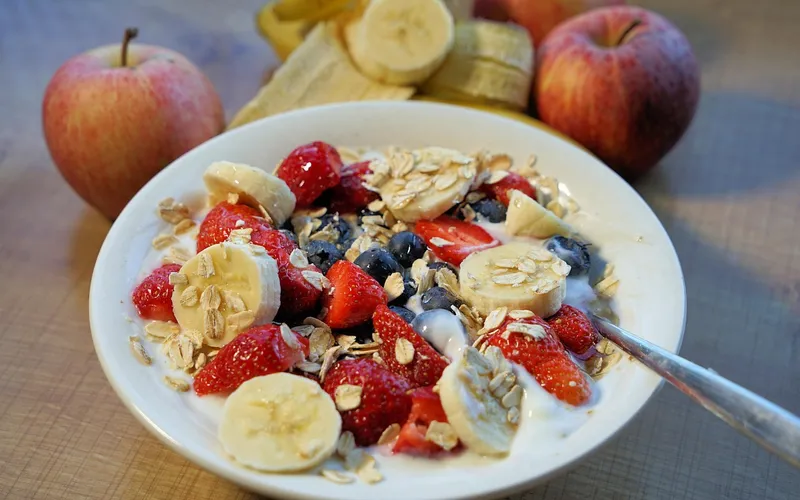
For an ordinary 30 to 60 minute strength session, a normal meal 1 to 3 hours before and a meal with 20 to 40 g of protein within a few hours after is plenty. You do not need special drinks or a 30-minute window. Your daily protein total and the training itself matter far more than the timing.
On this page
Start with what matters most
Before the timeline, some perspective. In a meta-analysis of 49 trials, extra protein added modestly to the gains from strength training, and training itself was the much bigger driver 1. What you eat around a session is a small detail inside a small detail. Get your training done, get your daily protein in, and the timing mostly takes care of itself.
With that said, here is how most people can fit food around a session without thinking about it too much.
2 to 3 hours before
A normal meal is ideal. Something with protein, some carbohydrate, and not so much fat or fibre that it sits heavily.
- Chicken or lentils with rice and vegetables
- An omelette with bread
- Porridge cooked with milk, with a spoonful of kvarg stirred in
This is the easiest option if you train late morning, after work or in the evening.
30 to 60 minutes before
If your last meal was a long time ago, or you train first thing, a small snack is enough. Most people find something easy to digest works best:
- A banana
- A glass of milk or a small yoghurt
- A slice of bread with cheese
- A small bowl of kvarg with fruit
Some people prefer to train with nothing at all, especially early in the morning. That is fine for a typical 40-minute strength session. Listen to how you feel.
During
For a 30 to 60 minute strength session, water is all you need. Sports drinks are built for long endurance work, not for an hour of squats and rows.
Within a few hours after
This is where protein earns its place. A meal with about 20 to 40 g of protein is a reasonable target, the same range that suits any meal 2. For a more personal number, about 0.4 g per kg of body weight per meal works well 3: around 30 g if you weigh 75 kg.
There is no need to rush. If you train at 6 and eat dinner at 7.30, dinner is your post-training meal. Some examples, with approximate protein (values vary by product; Livsmedelsverket's food database is a good reference 4):
| After-training meal | Protein, about |
|---|---|
| 250 g plain kvarg with berries | 25 to 30 g |
| 150 g salmon, potatoes and vegetables | 30 g |
| 3 eggs and 2 slices wholegrain bread | 25 g |
| Tofu and vegetable stir-fry with rice, 200 g tofu | 25 to 30 g |
| A glass of milk and a cheese sandwich, if dinner is far off | 15 to 18 g |
On the days you do not train
Keep protein much the same. The daily total is what counts, and rest days are part of the week your training needs. What can change is carbohydrate: a little more on training days, a little less on rest days, if that suits you. Amble's food plans work this way. Protein stays the same every day, and carbohydrate carries the difference so training days have a bit more fuel.
A simple rule to remember
Eat a normal meal a few hours before, or a small snack if it has been a while. Drink water during. Eat a protein-rich meal afterwards, whenever your next meal naturally falls. That covers almost everyone who trains two or three times a week.
For more on how to spread protein, see protein per meal. For your daily total, read how much protein you need or try the protein calculator. If you want sessions and meals planned together for the week, the plan tool shows how that can look.
Questions
Is it fine to train on an empty stomach in the morning?
Many people do, and for a short strength session it is usually fine. If you feel shaky, dizzy or weak, have something small first, such as a banana or a glass of milk. If you take medicine that lowers blood sugar, talk to your doctor before training fasted.
Do I need a protein shake after training?
No. A normal meal with a good protein source does the same job. A shake is handy if your next meal is several hours away or you are not hungry after training.
Sources
- Morton RW, Murphy KT, McKellar SR, Schoenfeld BJ, Henselmans M, Helms E et al.. A systematic review, meta-analysis and meta-regression of the effect of protein supplementation on resistance training-induced gains in muscle mass and strength in healthy adults. British Journal of Sports Medicine, 2018;52(6):376-384. doi:10.1136/bjsports-2017-097608 · PubMed
- Jäger R, Kerksick CM, Campbell BI, Cribb PJ, Wells SD, Skwiat TM et al.. International Society of Sports Nutrition Position Stand: protein and exercise. Journal of the International Society of Sports Nutrition, 2017;14(1). doi:10.1186/s12970-017-0177-8 · PubMed
- Schoenfeld BJ, Aragon AA. How much protein can the body use in a single meal for muscle-building? Implications for daily protein distribution. Journal of the International Society of Sports Nutrition, 2018;15(1). doi:10.1186/s12970-018-0215-1 · PubMed
- Livsmedelsverket. Livsmedelsdatabasen, the Swedish food composition database. Accessed 23 October 2026.