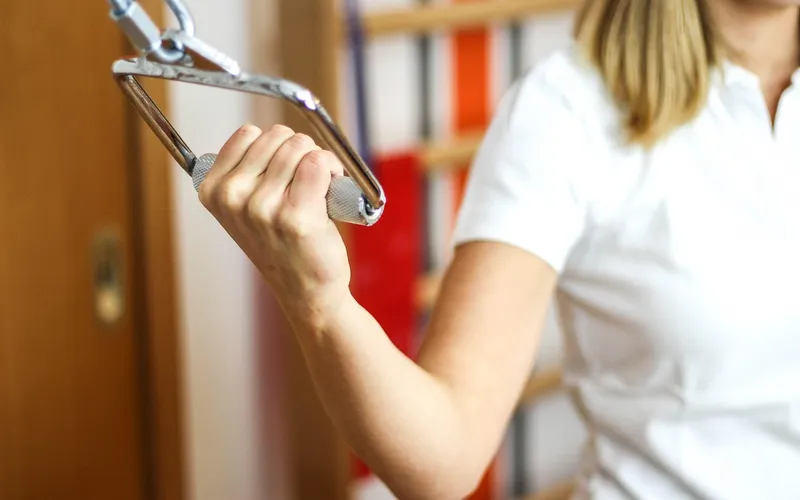
A 2015 study of 139,691 adults in 17 countries found that each 5 kg lower grip strength was linked with a 16 percent higher risk of death over about 4 years. It shows an association, not that training your grip changes your risk1.
On this page
What was studied
Grip strength is easy to measure: squeeze a handheld device as hard as you can. Earlier studies had linked it to health. Leong and colleagues, in The Lancet in 2015, wanted to know whether the link held across many countries and income levels, and how it compared with other things doctors measure1.
Who and how
The study sat inside the Prospective Urban Rural Epidemiology (PURE) project, which followed households in 17 countries of varying income. Adults aged 35 to 70 had their grip strength measured with a Jamar dynamometer. The team then followed them for a median of 4.0 years and recorded deaths and illnesses such as heart attack, stroke, diabetes and cancer, along with falls and fractures1.
In total, 139,691 people were included in the analysis. During follow-up, 3,379 of them (2 percent) died1.
What it found
After adjusting for factors such as age, sex, height, education and economic status, lower grip strength was linked with a higher risk of death from any cause. For every 5 kg lower grip strength, the hazard ratio was 1.16 (95% confidence interval 1.13 to 1.20). That means about 16 percent higher risk1.
The link was seen across country-income groups for most outcomes, with the exceptions of cancer and hospital admission for respiratory illness1.
What it means
The study supports a simple idea: muscle strength is tied to long-term health, and a measure as basic as a hand squeeze carries information. That agrees with the wider evidence on strength and mortality.
For you, the practical points are these. They are coaching advice, not claims from the paper:
- Grip is a sign of general strength, not a goal in itself. If you lift, pull and carry regularly, your grip will tend to follow.
- If you want to train it, farmer's walks, heavy rows and deadlifts with a firm hold all work.
- Do not worry about a single number. Compare yourself with yourself over time.
How grip fits with training
Grip is rarely trained on its own, and it does not need to be. Any program with rows, pulldowns, deadlifts and carries asks your hands to hold on, and grip tends to rise along with the rest of your strength. If you lift two or three days a week, you are already doing most of what the study would point you toward. Read the finding as another small reason to keep going, not as a test to pass.
A word on the number itself: grip strength differs a lot between men and women and falls with age, so a "normal" value depends on who you are. Compare your own result with last month's, not with a chart.
What it does not tell you
- It is an observational study. People with weak grips may be weaker for other reasons, such as illness, age, low activity or poor nutrition, and the adjustment cannot remove every one of these.
- It does not show that raising your grip strength lowers your risk of dying. The authors said more research is needed on that question.
- Follow-up was short, a median of 4 years, and the absolute risk of death in the study was low.
- It is a population finding. It cannot tell a single person their personal risk.
- Grip measured with a dynamometer is not the same as how hard you feel you can squeeze.
If you are worried about your health, talk to your doctor. A grip number alone is not a diagnosis.
Summary written by Amble from the published paper. Read the original for full methods and results.
Sources
- Leong DP, Teo KK, Rangarajan S, Lopez-Jaramillo P, Avezum A, Orlandini A, Seron P, Ahmed SH, Rosengren A, Kelishadi R, Rahman O, Swaminathan S, Iqbal R, Gupta R, Lear SA, Oguz A, Yusoff K, Zatonska K, Chifamba J, Igumbor E, Mohan V, Anjana RM, Gu H, Li W, Yusuf S. Prognostic value of grip strength: findings from the Prospective Urban Rural Epidemiology (PURE) study. The Lancet, 2015;386(9990):266-273. doi:10.1016/S0140-6736(14)62000-6 · PubMed