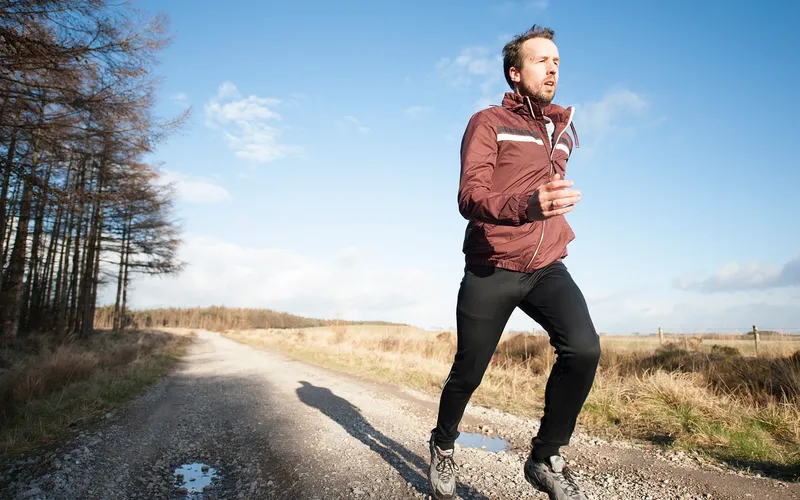
A 2022 meta-analysis of 43 studies found that adding aerobic training to strength training did not compromise muscle size or maximal strength. Explosive strength was slightly lower, more so when both were done in the same session1.
On this page
What was studied
Schumann and colleagues published an updated systematic review and meta-analysis in Sports Medicine in 2022. The question is an old one in the gym: if you run, cycle or swim as well as lift, do you lose some of the muscle and strength you would have gained by lifting alone? This is often called the interference effect1.
Who and how
The review pooled 43 studies in healthy adults of any sex and age. Each study ran supervised training for at least 4 weeks and compared two groups with the same strength program: one group that also did aerobic training, and one that did not. The outcomes were maximal strength, explosive strength and muscle size. The authors also checked whether the type of aerobic work (running or cycling), the number of weekly sessions, training status, age and the order of the sessions changed the result1.
What it found
The pooled differences were small:
- Maximal strength: a standardised mean difference of -0.06 (95% confidence interval -0.20 to 0.09). That is no meaningful difference.
- Muscle size: -0.01 (confidence interval -0.16 to 0.18). Also no meaningful difference.
- Explosive strength: -0.28 (confidence interval -0.48 to -0.08). A small but statistically reliable reduction.
The explosive strength loss was larger when the aerobic and strength work was done in the same session. When sessions were at least 3 hours apart, it was not statistically significant1.
None of the other factors changed the picture: running versus cycling, more or fewer than 5 weekly sessions, untrained versus active people, and people under or over 40 all gave similar results1. The authors' conclusion was that concurrent training does not compromise muscle growth or maximal strength.
How it fits with the older review
A 2012 meta-analysis by Wilson and colleagues, covering 21 studies, had found more interference. In that review, lifting alongside running (but not cycling) was linked with smaller gains in size and strength, and longer and more frequent endurance sessions went with smaller gains2. The 2022 update has more studies and did not find a running versus cycling difference. The two reviews do not fully agree, and both are averages across many different programs.
What it means in practice
The following is coaching advice, not a claim from the paper.
- If your main goal is muscle and strength, you do not need to give up cardio. Moderate amounts of walking, cycling or easy running sit comfortably next to a lifting plan.
- If you care about jumping, sprinting or throwing, separate the sessions where you can. A few hours apart, or different days, is a sensible start.
- If you can only fit both in one session, lift first when strength is the priority and run first when the run is.
- Treat very high amounts of endurance work as a different case. These studies were mostly ordinary training blocks, not marathon builds.
Our guide on cardio and strength together turns this into a weekly layout.
What it does not tell you
- It compares groups on average. Some people will respond differently.
- The studies lasted from 4 weeks up, and most were not long. Years of high-volume endurance training are not covered.
- It is about healthy adults. It says nothing about people with a health condition or an injury.
- Study quality varies, and the pooled results are for groups doing matched strength work, which is not the same as having less time to recover in real life.
If you have a health condition, ask your doctor how much and how hard to train.
Summary written by Amble from the published paper. Read the original for full methods and results.
Sources
- Schumann M, Feuerbacher JF, Sünkeler M, Freitag N, Rønnestad BR, Doma K, Lundberg TR. Compatibility of concurrent aerobic and strength training for skeletal muscle size and function: an updated systematic review and meta-analysis. Sports Medicine, 2022;52(3):601-612. doi:10.1007/s40279-021-01587-7 · PubMed
- Wilson JM, Marin PJ, Rhea MR, Wilson SMC, Loenneke JP, Anderson JC. Concurrent training: a meta-analysis examining interference of aerobic and resistance exercises. Journal of Strength and Conditioning Research, 2012;26(8):2293-2307. doi:10.1519/JSC.0b013e31823a3e2d · PubMed