B-stance hip thrust
The B-stance hip thrust is an intermediate barbell compound exercise for the glutes.
A hip thrust where one foot carries most of the work and the other foot only helps with balance. It targets the glutes with more focus on each side and lets you train unevenness without going fully single-leg.
- Main muscles
- Glutes
- Also works
- Hamstrings, Quads
- Equipment
- Barbell
- Level
- Intermediate, one side at a time
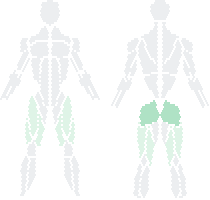
Muscles worked
The B-stance hip thrust mainly works the glutes. It also works the hamstrings and quads.
More exercises for: glutes, hamstrings, quads.
How to do it
- Sit with your upper back against a bench and the bar over your hips, one foot flat and the other heel placed a little further forward.
- Plant the working foot flat with the knee over the ankle and brace your abs.
- Drive through the working foot to lift the hips until the body is straight from shoulder to knee.
- Squeeze the glutes at the top for a moment, keeping the ribs down.
- Lower slowly until the hips are just above the floor, and switch sides after the set.
Where you should feel it: You should feel the glute of the working leg hardest, with the hamstring helping. It should not feel like the lower back or the front of the thigh.
Coach's cues
- Sit with the upper back against a bench and the bar over the hips
- Keep one foot flat and rest the other heel a little further forward
- Push mostly with the flat foot until the hips are fully up, then lower slowly
Try it: a working piece of Amble
B-stance hip thrust
In your week
Pick your goal, days and time. The exercise lands where it belongs.
TueFull body A
- Barbell back squat3 × 8–12
- Barbell bench press3 × 8–12
- Bent-over barbell row3 × 8–12
- B-stance hip thrust3 × 8–12
- Plank3 × 40 s
ThuFull body B
- B-stance hip thrust3 × 8–12
- Bent-over barbell row3 × 8–12
- Barbell bench press3 × 8–12
- Dumbbell lunge3 × 8–12
- Plank3 × 40 s
SatFull body A
- Barbell back squat3 × 8–12
- Barbell bench press3 × 8–12
- Bent-over barbell row3 × 8–12
- B-stance hip thrust3 × 8–12
- Plank3 × 40 s
Each session: 5 exercises for 45 min
Common mistakes
How to start. Start with 2 to 3 sets of 8 to 10 reps per side with just the bar or a light dumbbell, and add weight when form stays clean.
Who it suits
It suits people who already do regular hip thrusts and want to work each side. Skip heavy loads if you have lower back pain, and use a pad on the bar if it presses on your hips. Take care when loading and unloading the bar.
Sets and reps by goal
- Muscle: 3 to 4 sets of 8 to 12 reps per side, 90 seconds rest.
- Strength: 3 to 5 sets of 5 to 8 reps per side with a heavier bar.
- Endurance: 2 to 3 sets of 15 to 20 reps per side.
Easier and harder versions
- Barbell hip thrust (easier): The regular hip thrust is simpler and lets you use more weight.
- Single-leg hip thrust (harder): The single-leg version puts all the load on one glute.
- Single-leg glute bridge (easier): The glute bridge on one leg works well without a bar or bench.
Load on your joints
How Amble rates this movement when it plans around sore joints.
Instead of the B-stance hip thrust
The same main muscles with different kit or a lower difficulty.
Similar exercises
Common questions
What muscles does the B-stance hip thrust work?
The B-stance hip thrust mainly works the glutes. It also works the hamstrings and quads.
How many sets and reps of the B-stance hip thrust should I do?
Muscle: 3 to 4 sets of 8 to 12 reps per side, 90 seconds rest. Strength: 3 to 5 sets of 5 to 8 reps per side with a heavier bar. Endurance: 2 to 3 sets of 15 to 20 reps per side.
What can I do instead of the B-stance hip thrust?
Dumbbell hip thrust, banded glute bridge and machine hip thrust work the same main muscles.
What are the most common mistakes in the B-stance hip thrust?
Arching the lower back at the top. Tuck the ribs down and stop when the body is straight. Reduce the weight if you hyperextend. Pushing with both feet equally. Keep most of the weight on the flat foot. The back foot is only a kickstand. Feet too close or too far. Set the front foot so the shin is vertical at the top.