Mid cable fly
The mid cable fly is a beginner cable isolation exercise for the chest.
A chest fly with the pulleys at chest height, where your hands sweep together in front of your chest. It stretches the chest and keeps steady tension throughout the rep.
- Main muscles
- Mid and lower chest
- Also works
- Front shoulder
- Equipment
- Cable machine
- Level
- Beginner
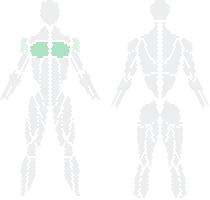
Muscles worked
The mid cable fly mainly works the mid and lower chest. It also works the front shoulder.
How to do it
- Set the pulleys at chest height, stand in the middle with a handle in each hand and one foot forward, with a soft bend in your elbows.
- Keep your torso still and your elbows slightly bent.
- Bring the handles together in front of your chest in a wide arc.
- Squeeze your chest for a second where the handles meet.
- Open slowly until you feel a comfortable stretch across the chest.
Where you should feel it: In the middle of the chest, with a stretch as your arms open. The front of your shoulders should not take over.
Coach's cues
- Pulleys at chest height, one foot forward, soft elbows
- Bring the handles together straight in front of the chest
- Let them open slowly to a comfortable stretch
Try it: a working piece of Amble
Mid cable fly
In your week
Pick your goal, days and time. The exercise lands where it belongs.
TueFull body A
- Barbell back squat3 × 8–12
- Mid cable fly3 × 8–12
- Bent-over barbell row3 × 8–12
- Romanian deadlift3 × 8–12
- Plank3 × 40 s
ThuFull body B
- Romanian deadlift3 × 8–12
- Bent-over barbell row3 × 8–12
- Mid cable fly3 × 8–12
- Dumbbell lunge3 × 8–12
- Plank3 × 40 s
SatFull body A
- Barbell back squat3 × 8–12
- Mid cable fly3 × 8–12
- Bent-over barbell row3 × 8–12
- Romanian deadlift3 × 8–12
- Plank3 × 40 s
Each session: 5 exercises for 45 min
Common mistakes
How to start. 2 sets of 10 to 12 reps with a light weight and slow opening.
Who it suits
Suits lifters who want chest work with steady tension, from beginners to advanced. If your shoulders feel pinched in the stretch, use a smaller range. It is not the best choice for heavy strength work.
Sets and reps by goal
- Muscle: 3 sets of 10 to 15 reps, resting 60 seconds.
- Endurance: 2 sets of 15 to 20 reps with a light weight.
- Strength is better trained with presses.
Easier and harder versions
- High-to-low cable fly (harder): High-to-low shifts focus to the lower chest.
- Low-to-high cable fly (harder): Low-to-high shifts focus to the upper chest.
- Pec deck (easier): A pec deck gives the same pattern with a guided path.
- Cable fly on a flat bench (harder): Lying on a bench changes the angle and stability.
Load on your joints
How Amble rates this movement when it plans around sore joints.
Instead of the mid cable fly
The same main muscles with different kit or a lower difficulty.
Similar exercises
Common questions
What muscles does the mid cable fly work?
The mid cable fly mainly works the mid and lower chest. It also works the front shoulder.
How many sets and reps of the mid cable fly should I do?
Muscle: 3 sets of 10 to 15 reps, resting 60 seconds. Endurance: 2 sets of 15 to 20 reps with a light weight. Strength is better trained with presses.
What can I do instead of the mid cable fly?
Dumbbell fly, pec deck and standing band chest fly work the same main muscles.
What are the most common mistakes in the mid cable fly?
Turning the fly into a press. Keep the same elbow bend throughout so the chest does the work. Opening the arms too far behind you. Stop when you feel a stretch, before the shoulders pull forward. Swinging the body. Plant your feet and brace your stomach, and use a lighter weight.