Paused bench press
The paused bench press is an intermediate barbell compound exercise for the chest.
A bench press where the bar stops still on your chest for a second or two. It removes the bounce, builds strength off the chest and makes your technique cleaner.
- Main muscles
- Mid and lower chest
- Also works
- Front shoulder, Triceps
- Equipment
- Barbell
- Level
- Intermediate
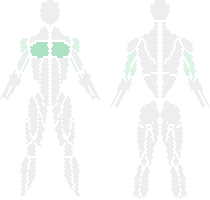
Muscles worked
The paused bench press mainly works the mid and lower chest. It also works the front shoulder and triceps.
How to do it
- Lie on a flat bench with your eyes under the bar, feet planted, shoulder blades pulled together and down, and hands slightly wider than the shoulders.
- Unrack the bar, take a breath and lower it under control to the lower chest.
- Let the bar touch and hold it still for one to two seconds without letting it sink or relaxing the upper back.
- Press the bar up and slightly back toward the shoulders on a smooth line.
- Lock the arms out at the top and breathe out, then set up the next rep.
Where you should feel it: In your chest, front shoulders and triceps, and in the tight upper back that holds you in place. You should not feel it in the front of the shoulder joint or the wrists.
Coach's cues
- Lower the bar to the chest and hold it still for one to two seconds
- Stay tight through the pause without letting the bar sink
- Press up hard from the stop
Try it: a working piece of Amble
Paused bench press
In your week
Pick your goal, days and time. The exercise lands where it belongs.
TueFull body A
- Barbell back squat3 × 8–12
- Paused bench press3 × 8–12
- Bent-over barbell row3 × 8–12
- Romanian deadlift3 × 8–12
- Plank3 × 40 s
ThuFull body B
- Romanian deadlift3 × 8–12
- Bent-over barbell row3 × 8–12
- Paused bench press3 × 8–12
- Dumbbell lunge3 × 8–12
- Plank3 × 40 s
SatFull body A
- Barbell back squat3 × 8–12
- Paused bench press3 × 8–12
- Bent-over barbell row3 × 8–12
- Romanian deadlift3 × 8–12
- Plank3 × 40 s
Each session: 5 exercises for 45 min
Common mistakes
How to start. 3 sets of 4 to 6 reps with a 1 second pause, using about 80 percent of your usual bench weight.
Who it suits
Suits anyone who bench presses with decent technique and wants a stronger start off the chest. Always use safety arms or a spotter. If you get shoulder pain on the bench, lower the weight or swap to dumbbells.
Sets and reps by goal
- Strength: 3 to 5 sets of 2 to 5 reps with a 1 to 2 second pause and 2 to 3 minutes rest.
- Muscle: 3 sets of 6 to 10 reps with a short pause and 1 to 2 minutes rest.
- Technique: 2 to 3 sets of 3 to 5 reps with a light bar and a longer pause.
Easier and harder versions
- Barbell bench press (easier): The regular bench press lets you use a bit of rebound and more load.
- Dumbbell bench press (easier): Dumbbells are easier to bail out of and let each arm work on its own.
- Barbell pin press (harder): Pin presses start every rep from a dead stop with no stretch reflex, and are harder to set up.
Load on your joints
How Amble rates this movement when it plans around sore joints.
Instead of the paused bench press
The same main muscles with different kit or a lower difficulty.
Similar exercises
Common questions
What muscles does the paused bench press work?
The paused bench press mainly works the mid and lower chest. It also works the front shoulder and triceps.
How many sets and reps of the paused bench press should I do?
Strength: 3 to 5 sets of 2 to 5 reps with a 1 to 2 second pause and 2 to 3 minutes rest. Muscle: 3 sets of 6 to 10 reps with a short pause and 1 to 2 minutes rest. Technique: 2 to 3 sets of 3 to 5 reps with a light bar and a longer pause.
What can I do instead of the paused bench press?
Push-up, dumbbell bench press and cable chest press work the same main muscles.
What are the most common mistakes in the paused bench press?
Letting the bar sink into the chest. Keep the chest high and the upper back tight so the bar rests lightly and stays still. Bouncing the bar off the chest. Stop for a full count before pressing. If you cannot pause, the weight is too heavy. Losing the arch and shoulder blade position. Keep the shoulder blades pulled together and the feet planted throughout, including during the pause.