Tuck jump
The tuck jump is an intermediate bodyweight compound exercise for the quads and glutes.
An explosive jump where you pull the knees high at the top. It trains power and coordination, and gets the heart rate up fast.
- Main muscles
- Quads, Glutes
- Also works
- Calves, Hip flexors
- Equipment
- Bodyweight
- Level
- Intermediate
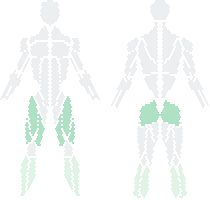
Muscles worked
The tuck jump mainly works the quads and glutes. It also works the calves and hip flexors.
How to do it
- Stand with your feet shoulder width apart, knees slightly bent and arms ready to swing.
- Dip into a quarter squat and swing your arms up as you jump straight up.
- Pull your knees up toward your chest at the top of the jump.
- Land softly on the balls of your feet with bent knees and a quiet landing.
- Reset your stance and jump again, or flow into the next rep if form stays clean.
Where you should feel it: In the thighs, glutes and calves as you push off, and in the abs and hip flexors as you tuck. You should not feel it in the knees or have a hard, stiff landing.
Coach's cues
- Jump straight up and pull the knees high
- Land softly with bent knees
- Reset between reps if form fades
Common mistakes
How to start. 3 sets of 5 reps with full rest between jumps, on a forgiving surface.
Who it suits
Suits trainees with some experience of jumping. Skip it or pick a lower-impact option if you have knee, ankle or back problems, or are heavily overweight. Use a mat or grass, not hard concrete.
Sets and reps by goal
- Power: 3 to 5 sets of 3 to 5 jumps with full rest of 60 to 90 seconds.
- Conditioning: 3 to 4 sets of 8 to 10 reps with 45 to 60 seconds rest.
- Warm-up: 1 or 2 sets of 3 jumps before sprint or lower-body work.
Easier and harder versions
- Jump squat (easier): The jump squat drops the tuck and is a simpler jump.
- Jumping jack (easier): Jumping jacks are a low-impact way to build up to bigger jumps.
- Box jump (harder): The box jump adds a height target and a controlled landing.
Load on your joints
How Amble rates this movement when it plans around sore joints.
Instead of the tuck jump
The same main muscles with different kit or a lower difficulty.
Similar exercises
Guides that use it
Common questions
What muscles does the tuck jump work?
The tuck jump mainly works the quads and glutes. It also works the calves and hip flexors.
How many sets and reps of the tuck jump should I do?
Power: 3 to 5 sets of 3 to 5 jumps with full rest of 60 to 90 seconds. Conditioning: 3 to 4 sets of 8 to 10 reps with 45 to 60 seconds rest. Warm-up: 1 or 2 sets of 3 jumps before sprint or lower-body work.
What can I do instead of the tuck jump?
Box jump, split jump and broad jump work the same main muscles.
What are the most common mistakes in the tuck jump?
Landing with straight, stiff legs. Land softly with bent knees and let the hips sit back. Chasing height with sloppy form. Jump for clean, controlled reps, not maximum height. Continuing when tired. Stop the set when landings get loud or heavy. Fatigue raises the injury risk.
Amble puts tuck jump in your week, at the right amount
Swap, move or skip an exercise in a couple of taps, or ask the coach to do it.