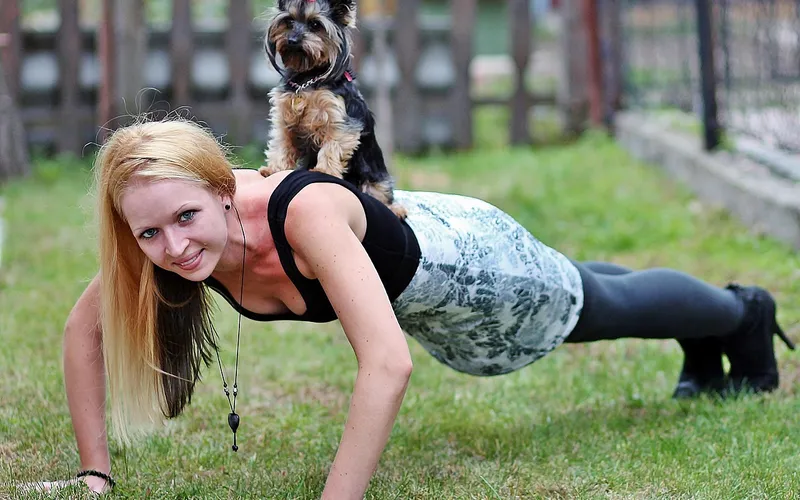
Start with six movements: chair squat, counter push-up, glute bridge, a back exercise on the floor, dead bug and side plank. Do 2 sets of each, twice a week. When you can do 15 clean reps on every set, move that exercise up one level.
On this page
How this workout works
Each movement comes in three levels. Everybody starts at level 1, even if it looks easy. It will tell you more about your body in one session than any quiz can, and moving up is quick if you are ready.
Do the whole list twice a week, with at least a day between. Rest about a minute between sets. The session takes 25 to 30 minutes.
The ladder
| Movement | Level 1 | Level 2 | Level 3 |
|---|---|---|---|
| Squat | Chair squat | Bodyweight squat | Split squat |
| Push | Incline push-up at a counter | Incline push-up at a sofa or low step | Push-up on the floor |
| Hips | Glute bridge | Glute bridge with a 3 s pause at the top | Single-leg glute bridge |
| Back | Superman, small lift | Superman, 3 s hold | Inverted row under a sturdy table |
| Front of trunk | Dead bug, legs only | Dead bug, arms and legs | Plank, 20 to 40 s |
| Side of trunk | Side plank from the knees | Side plank from the feet, 15 s | Side plank from the feet, 30 s |
Sets and reps: 2 sets of 8 to 15 for the squat, push, hips and back. For the dead bug, 2 sets of 6 per side. For planks, 2 holds.
When to move up
Move one exercise up a level when you can do 2 sets of 15 clean reps with a couple left in the tank. Do not move everything up on the same day. Usually the hips go first, then the squat, and the push-up and back take the longest.
A step that looks small often isn't. Going from a counter to the floor more than doubles how much of your weight your arms push. That is why there is a middle step: a sofa seat or the second stair. Find heights in your home that make an in-between level, and use them.
The honest gap: pulling
Bodyweight training is weak on the back. Pushing is easy to load; pulling needs something to pull on. The superman works the muscles along your spine, but nothing in a bare room trains rowing well.
The inverted row under a solid dining table is the best no-kit option, but only if the table is sturdy enough to take your weight and will not tip. If you are not sure, skip it. A light resistance band costs very little and gives you the band pull-apart, which fills the gap better than any floor exercise. The resistance band workout shows the rest.
What the first weeks feel like
Expect to be stiff a day or two after the first sessions, mostly in the thighs and the backs of the legs. Delayed soreness follows unfamiliar exercise and usually fades within 5 to 7 days 1. It is milder by week three for most people. You can train again while slightly sore; if a movement hurts rather than aches, drop it a level. Muscle soreness after training explains what is normal.
Breathe out as you push or stand up, and in as you lower. Holding your breath through a whole set is common and makes a simple set feel harder than it is.
If knees, wrists or shoulders are already sore before you start, the level 1 versions are the right place to stay for longer. Push-ups against a counter are kinder on the wrists than the floor. If a joint pain is new, sharp or getting worse, ask a doctor or physiotherapist before training through it.
After this
Bodyweight takes most beginners a long way, often several months before level 3 feels routine. The American College of Sports Medicine's 2026 review found that bodyweight and home training give marked benefits, and that the biggest gain of all comes from going from no training to some 2. You are already past that step once you start.
When level 3 gets easy, you have two choices. Make the movements harder with slow lowering, pauses and fewer rest seconds, or add load. The bigger picture is in strength training at home.
Questions
Can I build muscle with bodyweight only?
Yes, especially at the start. A large 2026 review found that bodyweight and home training give marked benefits for strength and muscle 2. The limit comes later, once the hardest versions get easy, and then a band or a pair of dumbbells takes you further.
How long will I be sore?
Soreness after unfamiliar exercise usually peaks 24 to 72 hours later and fades within 5 to 7 days 1. It gets milder each week as your body gets used to the movements.
Sources
- Cheung K, Hume PA, Maxwell L. Delayed Onset Muscle Soreness. Sports Medicine, 2003;33(2):145-164. doi:10.2165/00007256-200333020-00005 · PubMed
- American College of Sports Medicine. Resistance Training Prescription for Muscle Function, Hypertrophy, and Physical Performance in Healthy Adults: An Overview of Reviews. Medicine and Science in Sports and Exercise, 2026. acsm.org/resistance-training-guidelines-update-2026