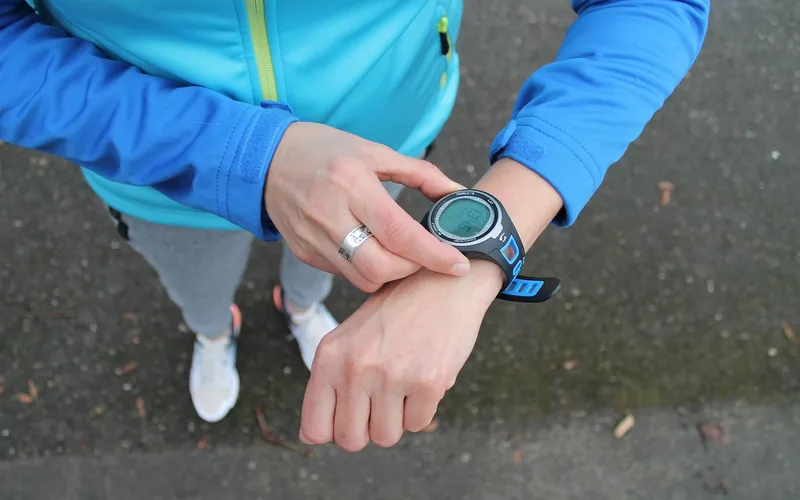
HRV, or heart rate variability, is the variation in time between one heartbeat and the next, measured in milliseconds. More variation at rest usually means the nervous system is relaxed; less often goes with stress, poor sleep, illness or hard training. The number is personal and falls with age 1, so compare it with your own trend over days, not with other people or a single morning 2.
On this page
What HRV is
Your heart does not beat like a metronome. The gaps between beats vary by a few milliseconds, and heart rate variability, or HRV, is a measure of how much. When you are relaxed and recovered, the gaps tend to vary more. When you are stressed, tired or ill, they tend to vary less. This is because the nervous system is adjusting your heart from beat to beat.
Wearables and phones measure it, usually overnight or in the morning, and give you a number in milliseconds. Different devices use different methods, so numbers from two devices should not be compared.
How HRV is measured: RMSSD and SDNN
Two measures cover most of what you will see in apps 1:
| Measure | What it is | What it mainly reflects |
|---|---|---|
| RMSSD | The root mean square of the differences between one beat gap and the next | Fast, beat-to-beat changes driven by the vagus nerve, the "rest and digest" side |
| SDNN | The standard deviation of all the beat gaps in a recording | Overall variation; in a short rest recording, mostly the same breathing-linked changes |
Both come out in milliseconds, but they are different numbers. The length of the recording matters too: a five-minute reading, a night and 24 hours give values that are not interchangeable 1. That is why a watch and a ring can show different HRV on the same morning, and why you should stick to one device.
What is a normal HRV?
A review of HRV norms reproduces pooled values from short resting recordings in healthy adults 1:
| Measure | Average | Range across studies |
|---|---|---|
| RMSSD | 42 ms | 19 to 75 ms |
| SDNN | 50 ms | 32 to 93 ms |
Read these as a rough picture, not a target. They come from five-minute lab-style recordings, not from overnight wearable data, and HRV falls with age 1. A value outside the range is not a diagnosis. What tells you most is your own number against your own usual range.
Why your number is yours
HRV differs a lot from person to person. Age, genes, fitness and many other things change it. Two healthy people can have values far apart. A "high" or "low" HRV only means something compared with your own usual range.
A good starting point is to wear your device for a few weeks and note what a normal day looks like. That range is your baseline.
Trends beat single days
Day-to-day HRV is noisy. A review of HRV monitoring in endurance athletes, in Sports Medicine in 2013, discussed the problem in detail. Its authors argued that day-to-day monitoring needs appropriate averaging of values, and showed how averaged measures related to fitness and freshness in Olympic and World Champion athletes2. They also said that results in elite athletes are mixed: both increases and decreases in HRV have been linked with negative adaptation in different studies2.
For you, the lesson is practical:
- Look at the trend over a week or more, not one morning.
- Compare with your own range.
- Do not chase a higher number at all costs.
What lowers HRV
A low reading on a given day can come from many causes, most of them ordinary:
- A short or broken night. Sleep and muscle recovery are linked: in a small study of 13 healthy young adults, one night without sleep lowered muscle protein synthesis after a meal by 18 percent3. That study did not measure HRV, but it shows how much sleep matters for recovery.
- Alcohol the evening before.
- A hard session or a big increase in training.
- Illness or the early signs of it.
- Heat, travel or dehydration.
- Stress at work or at home.
- A late, heavy meal.
How to use it
Treat HRV as one input among several. The others are how you slept, how your legs feel, your resting pulse and how motivated you are. When most of these point in the same direction, you have a clearer picture.
A simple way to act on it:
- HRV near your range, you feel fine: train as planned.
- HRV lower for several days, sleep poor, session feels heavy: keep the session but cut a set or two, or lower the weight. This is a coaching rule of thumb, not a result from a study.
- HRV low and you feel unwell: rest, and see a doctor if symptoms persist.
Note what the evidence does not say. It does not say a low reading is a reason to skip training, or that a high reading means a hard session is safe.
How to get a cleaner reading
- Measure at the same time each day, ideally on waking or overnight.
- Use the same device.
- Do not compare weekdays with weekends without thinking about sleep and alcohol.
- Be patient. It takes a few weeks to learn your own pattern.
What the evidence covers, and what it does not
The research on HRV for training is mostly in endurance athletes, with a small number of elite subjects, and the review above notes the results are mixed. It is not a medical test. A single HRV value cannot diagnose anything, and an odd reading is not a reason to panic. If you have a heart condition, palpitations, fainting or chest pain, see your doctor.
How Amble uses HRV
Amble reads HRV from Apple Health (with your permission) or from Oura, WHOOP, Polar, Fitbit, Withings, COROS, Suunto, Ultrahuman and Wahoo, and shows each night against your own usual range, never against other people. It goes into Amble's Recovery and Training readiness scores next to sleep and resting pulse. When they point the same way, the coach recommends a gentler session and says why; your session only changes if you tap Confirm change, and Undo puts it back.
Questions
What does HRV stand for?
Heart rate variability: how much the time between heartbeats changes from beat to beat. It is given in milliseconds (ms).
What is the difference between HRV and heart rate?
Heart rate counts beats per minute. HRV looks at the gaps between those beats. Two people can both have a resting pulse of 60 and very different HRV, because one heart varies its timing more than the other.
What is a good HRV?
There is no good number for everyone. HRV differs a lot between people and falls with age 1, so comparing yours with someone else's tells you little. Compare yourself with your own usual range.
Is a higher HRV always better?
No. A rise in your own usual range is often a good sign, but a review of HRV norms notes that higher is not always better, because some heart conditions can also raise HRV 1. A sudden, unusual change is worth noticing, in either direction.
Why is my HRV low today?
Many things lower it for a day: a poor night, alcohol, illness, stress, a hard session, heat or a late meal. One low reading is common and not a reason to worry.
Should I skip training when my HRV is low?
Not automatically. Research in athletes recommends averaging readings over days rather than reacting to one 2. If you also slept badly and feel flat, a gentler session is a fair choice.
Sources
- Shaffer F, Ginsberg JP. An Overview of Heart Rate Variability Metrics and Norms. Frontiers in Public Health, 2017;5:258. doi:10.3389/fpubh.2017.00258 · PubMed
- Plews DJ, Laursen PB, Stanley J, Kilding AE, Buchheit M. Training adaptation and heart rate variability in elite endurance athletes: opening the door to effective monitoring. Sports Medicine, 2013;43(9):773-781. doi:10.1007/s40279-013-0071-8 · PubMed
- Lamon S, Morabito A, Arentson-Lantz E, Knowles O, Vincent GE, Condo D, Alexander SE, Garnham A, Paddon-Jones D, Aisbett B. The effect of acute sleep deprivation on skeletal muscle protein synthesis and the hormonal environment. Physiological Reports, 2021;9(1):e14660. doi:10.14814/phy2.14660 · PubMed