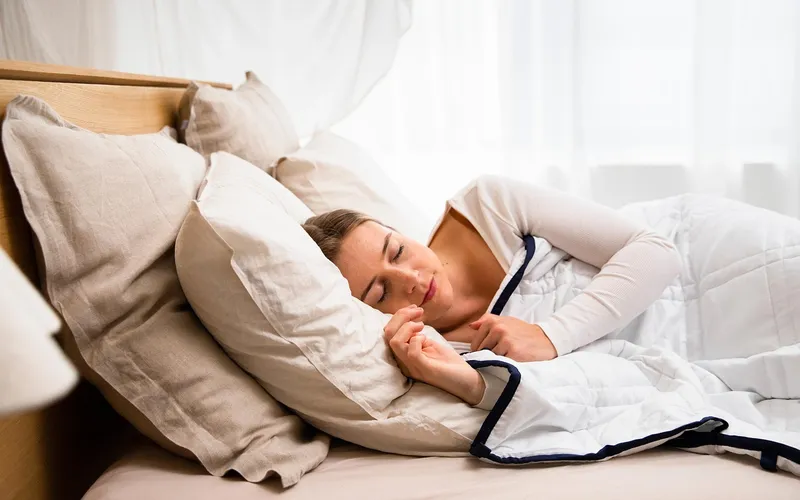
Adults should sleep 7 or more hours a night on a regular basis, according to the American Academy of Sleep Medicine and Sleep Research Society. One poor night is not a reason to skip training. Make the session lighter instead, and protect the following night.
On this page
How much sleep you need
The American Academy of Sleep Medicine and the Sleep Research Society reviewed the evidence together and agreed on one plain recommendation: adults should sleep 7 or more hours a night on a regular basis 1.
Two words in that sentence carry weight. "Or more" means seven is the floor, not the goal. "Regular" means the habit across weeks, not any single night. A late night once a week is a different thing from six hours every night.
If you are often short on sleep, that is worth knowing before you plan a training week. A week of two strength sessions and daily walks is manageable on good sleep. On five hours a night it can feel like a lot more.
After a bad night: train, adjust, or rest
Most people have a bad night now and then. This is a reasonable way to decide what to do with the session that day.
Slept badly, but feel fine once up. Train as planned. Many people find the session goes better than they expected.
Slept badly and feel flat. Train, but lighter:
- Do 2 sets instead of 3.
- Use the weight from last week rather than going up.
- Stop each set with 3 or 4 reps in reserve rather than 2.
- Swap the hardest exercise for an easier version.
Several bad nights in a row, or unwell. Swap the strength session for a short, easy walk, and move the session to another day. One moved session costs nothing.
The point is to keep the habit going without forcing a hard session through heavy fatigue. Most people find that a lighter session keeps the rhythm of the week, and the rhythm is what matters over months.
Habits that help both
None of these are rules. They are what tends to work for people who train and want to sleep well.
- Keep the same wake-up time. It anchors the rest of your day, training times included.
- Train earlier if late sessions keep you up. Some people sleep well after evening training, others do not. Your own experience is the best guide.
- Get outside in daylight. A morning walk does double duty: it counts toward your weekly activity and gets you light early in the day.
- Do not use a hard session to tire yourself out at 10 pm. A gentle walk after dinner is a better fit than a late workout.
- Watch caffeine timing. Pre-workout drinks and late coffee can stay with you well into the evening.
What the evidence covers, and what it does not
The 7-hour recommendation is a consensus of sleep specialists, based on the health of adults in general 1. It is not a training guideline. There is less solid evidence on exact links between sleep and strength gains in everyday adults, so be wary of precise claims you might read elsewhere about how many percent of your gains you lose per lost hour.
What we can say with more confidence is practical: feeling rested makes it easier to show up, and showing up regularly is what builds strength over time.
Fitting it into the week
If sleep is often short, plan around it. Put strength sessions on days that follow your more reliable nights, and leave walking for the rest. The layout in walking and strength training works well for this because walking is easy to scale up or down on the day.
In Amble, you can tell the coach you slept badly. If you have allowed it to read Apple Health, it shows last night's sleep, resting pulse and HRV next to your usual numbers, and proposes a gentler session for the day. Nothing changes until you say yes, and you can undo it.
Questions
Is it bad to train in the evening?
Many people sleep fine after an evening session. If you notice you lie awake after training late, move it earlier or keep evening sessions to gentle walking.
Should I nap after training?
A short nap is fine if it does not stop you falling asleep at night. If your night sleep suffers, cut the nap first.
Sources
- Watson NF, Badr MS, Belenky G, Bliwise DL, Buxton OM, Buysse D et al.. Recommended Amount of Sleep for a Healthy Adult: A Joint Consensus Statement of the American Academy of Sleep Medicine and Sleep Research Society. SLEEP, 2015. doi:10.5665/sleep.4716 · PubMed