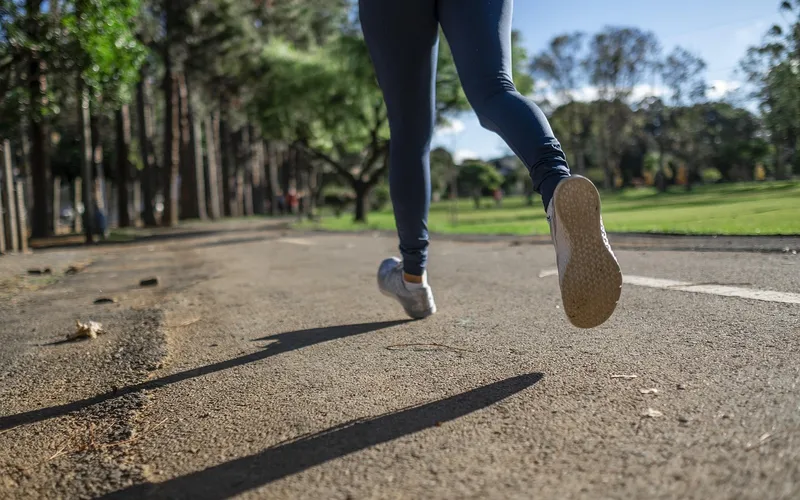
For a first race, the plan is simple: finish comfortably, start slower than you want to, and change nothing on race day. Research on pacing suggests that for events longer than about 2 minutes, an even pace tends to give better times than a fast start 3.
On this page
What a first race is like
Most first races are less intimidating than they look. People of every pace take part. Most of the field is not racing anyone, only themselves and the clock. There is a crowd at the start, music, a queue for the toilets, and a mix of nerves and excitement. Then a gun, a horn or a countdown, and you walk, jog or run across the line.
If you are doing a 5K, a 10K or a half marathon, a good training base is a few months of regular running. If you are not there yet, our Couch to 5K plan and 10K plan are built for it. Check with a doctor first if you have a heart condition, chest pain or dizziness during exercise.
The goals that work
Pick three goals before race day:
- A safe goal: finish, enjoy it.
- A realistic goal: a time you could run on a normal day.
- A stretch goal: a time you would be happy about, if everything goes well.
Do not tell yourself the first one is not good enough. For a first race it is plenty.
Race week checklist
If you can, taper a little. Volume goes down, intensity stays, and a meta-analysis found the best results from a 2 week taper in which volume fell by 41 to 60 percent 1. For a 5K or 10K, a lighter final week is enough. Our taper guide has the details.
| When | What to do |
|---|---|
| 7 days out | Two short easy runs. Look at the course map and the start time |
| 5 days out | Pick race clothes and shoes. Nothing new, wear what you have trained in |
| 3 days out | Easy 20 minutes. Eat as usual, with a little extra carbohydrate the day before |
| 2 days out | Collect your number if the race offers it. Check transport and parking |
| Day before | 10 to 15 minutes easy. Lay out kit, pin the number, set two alarms. Early to bed |
| Race morning | Eat, hydrate, arrive early. Warm up |
Race morning
- Wake early. Leave 2 to 3 hours before the start if you can. Eat a familiar breakfast, mostly carbohydrate. See race day nutrition. Carbohydrate eaten in the hours before a session helps keep carbohydrate availability up 2.
- Arrive 45 to 60 minutes early. Queues for toilets and bag drop take longer than you think.
- Warm up gently. 5 to 10 minutes easy jogging and a few leg swings. For a half marathon, a short walk and a couple of minutes of jogging is plenty.
- Line up honestly. Start near the pace group that matches your goal. Starting too near the front means getting swept along.
- Fill in the back of the bib. Some races ask for an emergency contact there.
During the race
The biggest first-timer mistake is going out too fast. Adrenaline makes the first kilometre feel easy. A review of pacing research found that in prolonged events, performance times may improve if athletes distribute their pace more evenly 3. Aim for the first kilometre a little slower than goal pace, then settle. If you are unsure, the running pace calculator turns your goal time into a pace, and how to pace a race goes through splits.
Other things to expect:
- Crowded early km. You will be bumped. Keep your stride and let people pass.
- A rough patch. Most runners hit a low at some point. It usually passes in 5 to 10 minutes. Slow a touch, shorten your steps, breathe.
- Aid stations. Slow down, take a few sips, walk if you need to. Do not stop dead in the middle of the path.
- The last kilometre. If you have anything left, now is the time. Smile for the photographer.
Crossing the line
Keep walking for a few minutes. Drink some water, eat something with carbohydrate and a little protein, and put on warm clothes. Your legs will feel odd. That is normal.
After the race
- The same evening: a proper meal, plenty of fluids, and an early night.
- The next 2 days: very easy movement only. A walk or an easy spin. Muscle soreness is common and passes. See muscle soreness after training.
- The next week: go back to training only when your legs feel normal, with easy runs first.
- Write it down. What worked, what you would change, what you ate. This is the real prize of a first race: information for the second.
Most people already have a next race in mind before they get home. Give yourself a couple of weeks before starting a new build.
What this guide does not cover
It does not diagnose or treat injuries, and it does not replace advice from a doctor or physiotherapist. If something hurts in a way that changes how you move, stop and get it checked.
Amble can build your plan around your race date, with the meal plan and the coach following along. You can pick a challenge such as Couch to 5K or a marathon, and the coach adjusts the next week from what you log.
Questions
What if I have to walk?
Then you walk. Many first-timers use a run-walk pattern, such as 4 minutes running and 1 minute walking, and finish with a smile. Walking early, before you need to, usually helps you run more at the end.
How fast should I run my first race?
Slower than you think. Most coaches suggest an easy, steady pace you could hold in conversation for the first half, and then speeding up only if you feel good 3. Your first goal is a finish, and the time is a bonus.
Should I run the full distance before the race?
For a 5K or 10K, running the distance once in training is a good rehearsal. For a half marathon or marathon, most plans stop short of the full distance and build up to a long run of about 16 to 19 km or 30 to 35 km (see the long run).
Sources
- Bosquet L, Montpetit J, Arvisais D, Mujika I. Effects of tapering on performance: a meta-analysis. Medicine & Science in Sports & Exercise, 2007;39(8):1358-1365. doi:10.1249/mss.0b013e31806010e0 · PubMed
- Burke LM, Hawley JA, Wong SH, Jeukendrup AE. Carbohydrates for training and competition. Journal of Sports Sciences, 2011;29(Suppl 1):S17-S27. doi:10.1080/02640414.2011.585473 · PubMed
- Abbiss CR, Laursen PB. Describing and understanding pacing strategies during athletic competition. Sports Medicine, 2008;38(3):239-252. doi:10.2165/00007256-200838030-00004 · PubMed