Soreness a day or two after training is called delayed onset muscle soreness. It follows unfamiliar exercise, usually peaks 24 to 72 hours later and fades within 5 to 7 days. It is normal, it gets milder as your body gets used to the exercise, and it is not a measure of a good workout.
On this page
What a normal week of soreness looks like
Here is the typical course after a first session, or after a session with new exercises.
| When | What you notice |
|---|---|
| During and right after | Muscles feel tired, maybe a little shaky. Usually no soreness yet. |
| Evening, same day | Little or nothing. |
| Next day (24 hours) | Stiffness and tenderness, worst when you start moving. Stairs may feel odd. |
| Day 2 to 3 (48 to 72 hours) | Usually the peak. Sitting down on a chair or lifting your arms can ache. |
| Day 4 to 5 | Clearly easing. Moving around helps. |
| Day 5 to 7 | Mostly gone. |
That pattern matches the research summary: delayed onset muscle soreness follows unfamiliar exercise, usually peaks 24 to 72 hours afterwards and fades within 5 to 7 days 1.
The delay is what catches people out. You feel fine on the evening of your first session and think you got away with it. Then the second morning arrives.
Why it happens
Soreness is linked most of all to the lowering part of a movement, called the eccentric part 1. Sitting down slowly into a squat, lowering a dumbbell from a curl, walking downhill. Muscles working while they lengthen under load seem to be what the body reacts to, especially when the movement is new.
The good news is that your body adapts quickly. The second time you do the same session, soreness is usually much milder. By the third or fourth week of a steady plan, most people barely notice it.
Should you train while sore
Usually, yes, with some sense.
- Mild soreness (you notice it, but it does not change how you move): train as planned. It often eases once you warm up.
- Moderate soreness (it changes how you walk or lift): train, but lighter. Same exercises, one step down in weight, or one set fewer. Or train the muscles that are not sore.
- Severe soreness (hard to straighten an arm, very swollen, very weak): rest those muscles and see the section below.
Gentle movement tends to help more than full rest. A walk, an easy bike ride, or a light version of the same exercises usually leaves you feeling better than a day on the sofa.
How to keep it milder
The best tool is the plan itself.
- Start light. Make your first week clearly easier than you think it needs to be. The guide to how heavy you should lift gives a way to pick the weight.
- Stop short of failure. You do not need to push every set to the very last rep. Sets stopped short of failure gave similar muscle growth when total work was similar 2, and most people find they are less sore.
- Add new things one at a time. A new exercise, extra sets and heavier weight all in the same week is a recipe for a sore weekend.
- Keep training regularly. Soreness is worst after a long break. Two sessions every week keep it small.
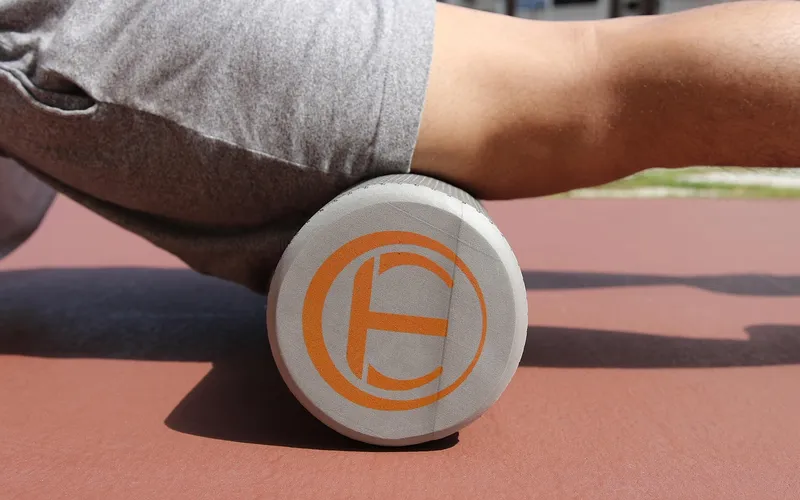
Foam rollers, massage, hot baths and cold baths may help you feel better. None of them are needed. Sleep and moving gently will do most of the work; see sleep and training.
When it is not normal soreness
Also see a doctor or physiotherapist if:
- The pain is sharp, sudden, or started during a specific rep. That is more like a strain.
- It is in a joint rather than the meat of the muscle.
- It is on one side only after a two-sided exercise.
- It is getting worse after day 3 rather than better.
- It lasts longer than a week.
If you have a health condition, or take medication such as a statin and notice unusual muscle pain, mention it to your doctor rather than waiting it out.
If you are sore after every session
That usually means the plan changes too much from week to week, or the sessions are spread too far apart. Try keeping the exercises the same for four weeks, adding weight in small steps, and training at least twice a week. If you have had a break, read missed a week of training for how to restart without a week of aches.
The first-month plan in how to start strength training is built to keep soreness small: a light first week, two sets per exercise, and slow increases.
Questions
Does stretching prevent soreness?
Stretching may feel nice, but most people find it does little for soreness the next day. A lighter first session does much more.
If I am not sore, did the workout work?
Yes. Soreness tells you the exercise was new, not that it was effective. Most regular lifters are rarely sore and still get stronger.
Sources
- Cheung K, Hume PA, Maxwell L. Delayed Onset Muscle Soreness. Sports Medicine, 2003;33(2):145-164. doi:10.2165/00007256-200333020-00005 · PubMed
- Refalo MC, Helms ER, Trexler ET, Hamilton DL, Fyfe JJ. Influence of Resistance Training Proximity-to-Failure on Skeletal Muscle Hypertrophy: A Systematic Review with Meta-analysis. Sports Medicine, 2023;53(3):649-665. doi:10.1007/s40279-022-01784-y · PubMed