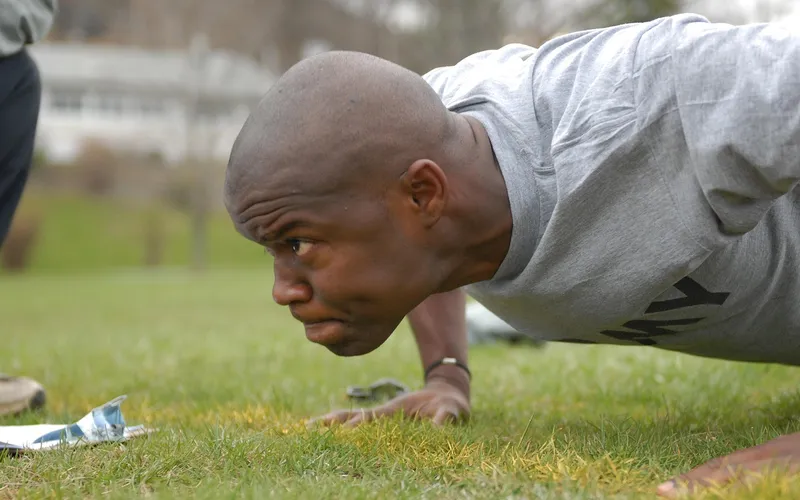
A 2023 meta-analysis found that training to complete muscle failure was not needed for muscle growth. Sets stopped short of failure gave similar growth in the pooled studies when volume was similar1.
On this page
What was studied
Refalo and colleagues published a systematic review with meta-analysis in Sports Medicine in 2023. The question was about "proximity to failure": how close to the point where you cannot do another rep your sets need to finish if the goal is muscle growth1. For the number of studies, the participants and the methods, see the paper. We only have the headline finding.
What it found
Training to complete muscle failure was not needed for muscle growth. In the pooled studies, sets stopped short of failure gave similar growth when the volume (the amount of work) was similar1.
The condition is the part after "when". Similar growth was seen when the total work was similar. The result is not a licence to do much less.
What it means if you are starting out
For a beginner this is good news. Pushing every set until the weight stops moving is tiring, can make you very sore, and for many people is not pleasant. The research suggests you can leave a rep or two in the tank and still make progress.
The 2026 ACSM position stand lands in a similar place: training to failure did not consistently change outcomes for average healthy adults2. Our summary of it has the rest.
Here is how that might look in practice, as coaching advice and not a claim from the meta-analysis:
- Pick a weight that lets you finish each set feeling you could have done a few more reps.
- Let the last rep of each set be slow and controlled, never a scramble.
- When the target reps start to feel easy across all sets, add a small amount of weight.
- Never push to the point where your form breaks down, particularly on free weights without someone nearby.
What it does not tell you
- It does not say failure is harmful. It says it was not needed in the pooled studies.
- It is about muscle growth. The summary says nothing about strength, or about how it feels to train.
- It does not tell you how many reps to leave in reserve. See the paper.
- The result is an average from the studies pooled, and individuals will differ. Some people like training hard and may find it motivating.
- Whether the studies included older adults, or people with health conditions, is not in the summary we have.
If you have a health condition, a recent injury or high blood pressure, ask your doctor how hard you should push before you begin.
Summary written by Amble from the published paper. Read the original for full methods and results.
Sources
- Refalo MC, Helms ER, Trexler ET, Hamilton DL, Fyfe JJ. Influence of Resistance Training Proximity-to-Failure on Skeletal Muscle Hypertrophy: A Systematic Review with Meta-analysis. Sports Medicine, 2023;53(3):649-665. doi:10.1007/s40279-022-01784-y · PubMed
- American College of Sports Medicine. Resistance Training Prescription for Muscle Function, Hypertrophy, and Physical Performance in Healthy Adults: An Overview of Reviews. Medicine and Science in Sports and Exercise, 2026. acsm.org/resistance-training-guidelines-update-2026