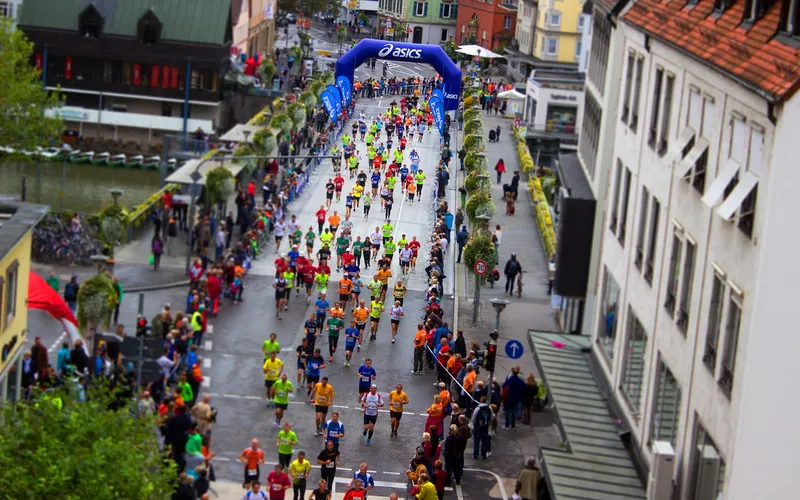
A marathon training plan usually takes 16 to 20 weeks, with 4 to 5 runs a week, one long run that grows toward about 30 to 32 km and a taper of 2 to 3 weeks. The free 16-week plan below shows every week: 4 runs, an easier week every fourth week and a 32 km long run three weeks before race day. The race itself is 42.195 km 1. Research on tapering found the best results from a 2-week taper that cut volume by 41 to 60 percent and kept intensity 5.
On this page
The plan at a glance
| This plan | |
|---|---|
| Length | 16 weeks |
| Runs a week | 4: two easy, one tempo, one long |
| Start from | About 20 to 25 km a week, with a 14 km run behind you |
| Biggest week | 56 km, week 13 |
| Longest run | 32 km, week 13 |
| Easier weeks | Weeks 4, 8 and 12 |
| Taper | Weeks 14 to 16 |
The switch at the top of the page shows every distance in kilometres or miles.
What a marathon is
A marathon is 42.195 km, or 26 miles 385 yards, a distance standardised in 1921 1. It is a long enough race that you cannot wing it: the training is what gets you to the start line with an easy-to-hold pace and legs that have done the work.
How many weeks and sessions
For most people the build is 16 to 20 weeks, with 4 to 5 runs a week. Those numbers are practice, not a law. If you are not running regularly, give yourself a base block first, because the start of a marathon build assumes you already run three or four times a week. A week usually has:
- 1 long run, building toward about 30 to 32 km, reached about 3 weeks before the race.
- 1 quality session: tempo or intervals.
- 2 to 3 easy runs.
- 1 or 2 days of lifting, and at least 1 full rest day. Put hard lifting and hard running on the same day, then make the next day easy.
Weekly running and the long run grow by about 10 percent a week at most, with an easier week every 3 or 4 weeks. That is a rule of thumb used by coaches, not a result from a study, so treat it as a cap on the pace of change, not a target.
The 16-week plan
For someone who already runs 3 times a week, has done so for about six months and covers roughly 20 to 25 km a week, with at least one 14 km run behind them. If that is not you, do the half marathon plan first. Four runs a week. Easy means a pace where you can talk but not sing 2. The tempo run is hard but steady. The long run is always easy, with a one minute walk at each drink station if you like.
| Week | Run 1 | Run 2: tempo | Run 3 | Run 4: long | Total |
|---|---|---|---|---|---|
| 1 | Easy, 6 km | Easy, 7 km with 6 x 20 sec strides | Easy, 5 km | Easy, 14 km | 32 km |
| 2 | Easy, 6 km | Easy 2 km, 15 min tempo, easy 2 km | Easy, 5 km | Easy, 16 km | 34 km |
| 3 | Easy, 6 km | Easy 2 km, 20 min tempo, easy 2 km | Easy, 6 km | Easy, 18 km | 38 km |
| 4 (easier) | Easy, 6 km | Easy, 6 km with 6 x 20 sec strides | Easy, 5 km | Easy, 14 km | 31 km |
| 5 | Easy, 7 km | Easy 2 km, 25 min tempo, easy 2 km | Easy, 6 km | Easy, 20 km | 41 km |
| 6 | Easy, 7 km | Easy 2 km, 30 min tempo, easy 2 km | Easy, 6 km | Easy, 22 km | 44 km |
| 7 | Easy, 7 km | Easy 2 km, 2 x 15 min tempo with 3 min jog, easy 2 km | Easy, 6 km | Easy, 24 km | 46 km |
| 8 (easier) | Easy, 6 km | Easy 2 km, 20 min tempo, easy 2 km | Easy, 5 km | Easy, 16 km | 34 km |
| 9 | Easy, 8 km | Easy 2 km, 35 min tempo, easy 2 km | Easy, 6 km | Easy, 26 km | 50 km |
| 10 | Easy, 8 km | Easy 2 km, 3 x 12 min tempo with 3 min jog, easy 2 km | Easy, 6 km | Easy, 28 km | 52 km |
| 11 | Easy, 8 km | Easy 2 km, 35 min tempo, easy 2 km | Easy, 6 km | Easy, 30 km | 54 km |
| 12 (easier) | Easy, 6 km | Easy 2 km, 25 min tempo, easy 2 km | Easy, 5 km | Easy, 20 km | 39 km |
| 13 | Easy, 8 km | Easy 2 km, 30 min tempo, easy 2 km | Easy, 6 km | Easy, 32 km | 56 km |
| 14 (taper) | Easy, 7 km | Easy 2 km, 20 min tempo, easy 2 km | Easy, 5 km | Easy, 22 km | 42 km |
| 15 (taper) | Easy, 6 km | Easy 2 km, 15 min tempo, easy 2 km | Easy, 5 km | Easy, 14 km | 31 km |
| 16 (race) | Easy, 5 km | Easy, 4 km with 4 x 20 sec strides | Rest | Marathon, 42.195 km | 51 km |
Weeks 4, 8 and 12 are easier on purpose. The long run grows by 2 km a week, with an easier week every fourth week. That is a rule of thumb from coaching practice, not a study result. A review of 85 studies linked weekly distance, number of runs and long runs over 32 km to faster marathon times 3, but that does not mean more kilometres always give a faster result.
How to adjust it:
- Only 3 days a week: drop Run 3 and keep Run 1, the tempo run and the long run. The long run is the one to protect.
- 5 days a week: add an easy 5 to 6 km on a rest day, never the day before the long run. Keep the other four runs as written.
- Miss a run: skip it, preferably the tempo run, and do not double up.
- Miss a week: repeat it. Two weeks off means going back one week; three or more means going back two.
- Ill: rest until you are well, wait a day, and take the first week back easy. With fewer than three weeks to go, drop an easy run before you drop the long run.
- Too much: drop Run 3 and keep the other three. The long run and one tempo run are the ones to protect.
- Pain in the same place for several days is one for a doctor or physiotherapist.
Goal paces
Run the long runs and easy runs on feel, at a pace where you can talk. Race pace only matters on race day and for a few kilometres at the end of the last long runs, if you want to practise it. These are even paces for common goal times; the marathon pace chart has every time from 2:45 to 5:30 with splits.
| Goal time | Pace per km | Pace per mile |
|---|---|---|
| 3:30:00 | 4:59 | 8:01 |
| 4:00:00 | 5:41 | 9:09 |
| 4:30:00 | 6:24 | 10:18 |
| 5:00:00 | 7:07 | 11:27 |
| 5:30:00 | 7:49 | 12:35 |
For a first marathon, a goal time from a recent half marathon is the safest guide. The running pace calculator turns a half marathon time into a marathon estimate, and that estimate is a best case.
A sample week
A mid-build example for someone running 4 days a week. Durations and distances are a guide.
| Day | Session | What it looks like |
|---|---|---|
| Mon | Rest | |
| Tue | Easy run | 40 to 50 min where you can talk |
| Wed | Quality run and strength | 10 min easy, tempo or intervals, 10 min easy, then leg press, Romanian deadlift and plank |
| Thu | Rest or easy walk | |
| Fri | Easy run | 30 to 40 min |
| Sat | Rest | |
| Sun | Long run | The week's longest, easy pace |
Hard lifting and the hard run share Wednesday, and Thursday is easy, so the other days stay truly easy. Keep heavy leg work away from the day before the long run.
Pacing the first marathon
Start slower than the pace you want to finish at. The usual error is a fast first half that costs the last ten kilometres. An easy pace is one where you can talk but not sing 2; for the first 10 km the race should feel almost too easy. Take food and water as you practised in the long runs, and do not try anything new on race day. Walk through an aid station if that helps you drink. There is no target time on this page, because the right pace is the one you rehearsed.
Training around work and recovery
Marathon training is mostly about consistency. The long run is the one that cannot be moved. If you miss a weekday run, drop it; do not stack it onto another day. If you are ill, stop and return when you are well, then drop back a week. After a hard session, an easy day is part of the plan. If something hurts in the same place for more than a few days, rest and see a doctor or physiotherapist. Guidelines ask for strength training of all major muscle groups on at least two days a week 4, and a single lifting day in a marathon block is a reasonable compromise.
The taper
The last 2 to 3 weeks are for freshness. A meta-analysis of tapering found the best results from a 2-week taper in which training volume fell by 41 to 60 percent while intensity and frequency stayed the same 5. For a marathon that means shorter runs, with a little short, faster running to keep sharp, a last long run about 3 weeks before, and lifting at maintenance with no heavy leg work in the last three days. Expect to feel restless and a little heavy. That is normal; do not add a hard session to fix it.
How Amble builds it into your week
In Amble you add the marathon as a challenge with your race date. The plan, the meal plan and the coach follow it: 4 to 5 runs a week, a long run that builds toward about 30 to 32 km, 1 or 2 lifting days, and a taper before the date. If the date is far away the build starts later and is written as a rolling plan that the coach adjusts from what you log. Challenges that fit together can run side by side, such as a daily steps goal, but a second race build in the same weeks is a choice between the two. If a marathon looks too big, Amble can suggest a half marathon or a later date instead. The table on this page is the same for everyone. In Amble it is the starting point: miss a run, sleep badly or lose an evening, and the coach proposes a change to the week with the reason, such as a lighter day or a moved run, and nothing changes until you confirm.
Questions
Do I need to have run a half marathon first?
No, but you should be running regularly before a marathon build starts. If you are new to running, the Couch to 5K plan and the half marathon plan are a natural way up.
Should I keep lifting during a marathon build?
Yes, one or two days a week. Combining running and lifting costs some strength gains, with more frequent and longer endurance work giving smaller gains 6. A newer 2022 meta-analysis found little to no effect on maximal strength and muscle size at ordinary amounts 7; the cost is mainly explosive power. So lifting is for staying strong and keeping injuries away, not for building.
What is the longest run in training?
Most plans build to about 30 to 32 km around 3 weeks before the race. You do not run the full 42.195 km in training.
How many weeks do I need to train for a marathon?
16 to 20 weeks is the common length for someone who already runs three or four times a week. The plan on this page is 16 weeks. If you are not running regularly yet, add a base block first, or start with the half marathon plan.
Can I train for a marathon in 12 weeks?
Only if you already run long. Twelve weeks works for someone who is already running around 30 km a week with a long run of 18 km or more, who can start this plan at week 5. Starting from less, a 12-week build means growing the long run faster than about 10 percent a week, which is the usual cap. Pick a later race instead.
How many kilometres a week should I run for a marathon?
In this plan the weeks grow from 32 km to a peak of 56 km in week 13. A review of 85 studies linked more weekly distance and more runs a week to faster marathon times 3, but more is only better while you can recover from it.
Is it fine to walk during a marathon?
Yes. A short walk through each drink station is common, and it is easier to drink while walking. Practise it on your long runs so it feels normal on race day.
Sources
- World Athletics. Marathon. Accessed 12 November 2026.
- Centers for Disease Control and Prevention. Measuring physical activity intensity. Accessed 12 November 2026.
- Doherty C, Keogh A, Davenport J, Lawlor A, Smyth B, Caulfield B. An evaluation of the training determinants of marathon performance: A meta-analysis with meta-regression. J Sci Med Sport, 2020;23(2):182-188. doi:10.1016/j.jsams.2019.09.013 · PubMed
- American College of Sports Medicine. Resistance Training Prescription for Muscle Function, Hypertrophy, and Physical Performance in Healthy Adults: An Overview of Reviews. Medicine and Science in Sports and Exercise, 2026. acsm.org/resistance-training-guidelines-update-2026
- Bosquet L, Montpetit J, Arvisais D, Mujika I. Effects of tapering on performance: a meta-analysis. Medicine & Science in Sports & Exercise, 2007;39(8):1358-1365. doi:10.1249/mss.0b013e31806010e0 · PubMed
- Wilson JM, Marin PJ, Rhea MR, Wilson SMC, Loenneke JP, Anderson JC. Concurrent training: a meta-analysis examining interference of aerobic and resistance exercises. Journal of Strength and Conditioning Research, 2012;26(8):2293-2307. doi:10.1519/JSC.0b013e31823a3e2d · PubMed
- Schumann M, Feuerbacher JF, Sünkeler M, Freitag N, Rønnestad BR, Doma K, Lundberg TR. Compatibility of concurrent aerobic and strength training for skeletal muscle size and function: an updated systematic review and meta-analysis. Sports Medicine, 2022;52(3):601-612. doi:10.1007/s40279-021-01587-7 · PubMed