Downward dog
The downward dog is a beginner bodyweight stretch for the hamstrings and calves.
A yoga-style pose where the body forms an upside-down V. It stretches the hamstrings, calves and back of the body while the arms and shoulders hold you up.
- Main muscles
- Hamstrings, Calves
- Also works
- Lats, Front shoulder
- Equipment
- Bodyweight
- Level
- Beginner
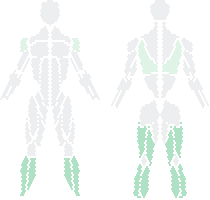
Muscles worked
The downward dog mainly works the hamstrings and calves. It also works the lats and front shoulder.
More exercises for: hamstrings, calves, lats, shoulders.
How to do it
- Start on hands and knees with the hands slightly ahead of the shoulders and the toes tucked under.
- Lift the knees and push the hips up and back.
- Push the floor away with straight arms and lengthen the back.
- Press the heels towards the floor, bending the knees if the back rounds.
- Hold, breathing slowly, then lower the knees.
Where you should feel it: You should feel a stretch in the back of the legs and calves and light work in the shoulders. It should not feel sharp in the wrists or the hamstrings.
Coach's cues
- Start on hands and knees and lift the hips up and back
- Push the floor away with straight arms and lengthen the back
- Press the heels towards the floor, bend the knees if the back rounds
Common mistakes
How to start. Hold 20 to 30 seconds for 2 to 3 rounds, bending the knees as much as needed.
Who it suits
It suits most people and works as a warm-up or cool-down. Take it carefully if you have sore wrists or shoulders, and bend the knees if hamstrings are tight. Stop with sharp pain.
Sets and reps by goal
- Mobility: 2 to 3 holds of 20 to 45 seconds.
- Warm-up: 5 to 8 slow breaths with bent knees.
- Cool-down: 30 to 60 seconds with calm breathing.
Easier and harder versions
- Child's pose (easier): Child's pose is a gentler way to rest and stretch the back.
- Inchworm (harder): The inchworm adds a walk-out and a hamstring stretch in motion.
- Hamstring stretch (easier): The hamstring stretch focuses on the back of the legs alone.
Load on your joints
How Amble rates this movement when it plans around sore joints.
Similar exercises
Guides that use it
Common questions
What muscles does the downward dog work?
The downward dog mainly works the hamstrings and calves. It also works the lats and front shoulder.
How many sets and reps of the downward dog should I do?
Mobility: 2 to 3 holds of 20 to 45 seconds. Warm-up: 5 to 8 slow breaths with bent knees. Cool-down: 30 to 60 seconds with calm breathing.
What are the most common mistakes in the downward dog?
Rounding the back. Bend the knees and push the hips back to keep the spine long. Shrugging the shoulders. Press the floor away and keep the neck relaxed. Forcing the heels down. Let the heels float. The knees can stay bent.
Amble puts downward dog in your week, at the right amount
Swap, move or skip an exercise in a couple of taps, or ask the coach to do it.