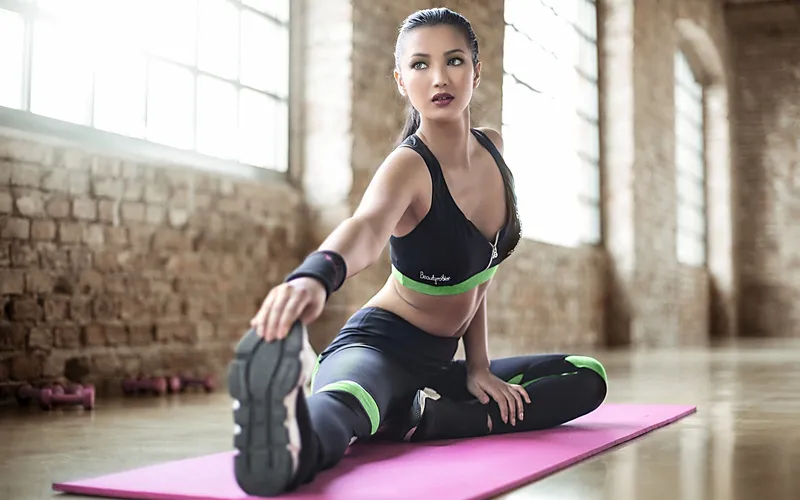
Spend five to eight minutes getting warm and moving the joints you are about to use: a few minutes of easy movement, then gentle mobility drills, then one or two light sets of your first exercise. Save long, held stretches for after the session or another time.
On this page
What a warm-up is for
A warm-up has two jobs. It gets your body ready to move, and it gets your head into the session. Most people find the first set feels easier and smoother after a few minutes of moving, and that stiff joints loosen up as they go.
It does not need to be long or clever. If your warm-up takes longer than the workout it is warming up for, it is too long.
The routine: about 6 minutes
Do these in order. No equipment needed except a band for step 4, which you can skip.
1. Get warm (2 minutes). March on the spot, walk briskly round the house, or use a treadmill walk if you are at a gym. You want to feel slightly warmer and breathe a little faster, not to be out of breath.
2. Shoulders and upper back (1 minute).
- Arm circles: 10 forwards, 10 backwards. Start small and let them grow.
- Shoulder circles: 10 each way.
3. Spine and hips (1 minute).
- Cat-cow: 8 slow rounds on hands and knees.
- Front leg swings: 10 per leg, holding a wall or chair for balance.
4. Wake up the upper back (30 seconds).
- Band pull-aparts: 15 with a light band. Especially useful before any pushing exercise.
5. Lower body (1 minute).
- Ankle circles: 10 each way per foot.
- Bodyweight squats: 10 slow reps to a depth that feels comfortable. Use a chair behind you if you like.
6. Optional: inchworm (30 seconds). 3 to 5 slow reps. Bend your knees as much as you need. Leave it out if getting down to the floor and up again is hard work for you right now.
Then: ramp-up sets
The routine above warms you up in general. The ramp-up sets prepare you for the exact exercise you are about to do. This step matters most, and it is the one people skip.
Before your first exercise:
| Set | Load | Reps |
|---|---|---|
| Ramp 1 | Very light, or bodyweight | 10 |
| Ramp 2 | About half your working weight | 6 |
| Working sets | Your planned weight | As planned |
So if your working weight for a dumbbell squat is two 10 kg dumbbells, do 10 reps with no weight, then 6 reps with two 5 kg dumbbells, then start your sets.
For later exercises in the session you are already warm. One light set of 6 to 8 reps is usually enough, and for small exercises like curls you can often skip it.
What to skip
Long held stretches right before lifting. Holding a stretch for a long time immediately before strength work is something many coaches avoid, because it can leave muscles feeling loose rather than ready. Keep pre-session moves short and moving. If you want to get more flexible, held stretches after the session or in the evening work well.
Hard cardio. A warm-up should leave you more ready for the session, not tired before it.
Anything that hurts. Mild stiffness that eases as you move is normal. Pain that gets sharper is a sign to stop that movement.
Adjusting it for you
Stiff mornings. If you train early, give step 1 an extra minute or two. Many people with stiff joints find the first few minutes of any movement are the hardest and it loosens from there.
Short on time. Keep step 1 and the ramp-up sets. Drop the rest.
Sore knees or hips. Swap the squats in step 5 for a chair squat to a high seat, and take the ramp-up sets slowly. If a joint is being treated, ask your physiotherapist which warm-up moves suit you.
Cold room or cold day. Wear a layer for the warm-up and take it off when you start your sets.
Fitting it into the plan
A warm-up is part of the session, not an extra. When you plan a 30-minute workout, count the first six to eight minutes as warm-up. The dumbbell workout, bodyweight workout and resistance band workout all assume you have done this first. Amble has exercise videos in the app, so you can check how a move looks before you try it.
Questions
Do I need to warm up for a home bodyweight session?
A short one, yes. Two or three minutes of movement and a few easy reps of the first exercise are enough for a light session.
Should I stretch before lifting?
Short, moving stretches are fine. Long, held stretches are better left for after the session, or another time of day, if you want to work on flexibility.