Dumbbell snatch
The dumbbell snatch is an advanced dumbbell compound exercise for the glutes, hamstrings and shoulders.
A one-arm lift that takes a dumbbell from the floor to overhead in one movement. It trains power through the hips and teaches you to move fast and stay stable.
- Main muscles
- Glutes, Hamstrings, Front shoulder
- Also works
- Quads, Upper traps, Lower back
- Equipment
- Dumbbells
- Level
- Advanced, one side at a time
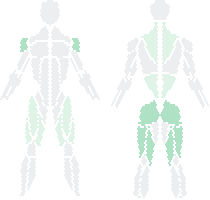
Muscles worked
The dumbbell snatch mainly works the glutes, hamstrings and front shoulder. It also works the quads, upper traps and lower back.
More exercises for: glutes, hamstrings, shoulders, quads.
How to do it
- Stand with feet slightly wider than shoulder width, a dumbbell on the floor between your feet, hinge down with a flat back and grip it with one hand.
- Brace, then drive through your legs and hips to pull the dumbbell up close to your body.
- Let your elbow lead high as the dumbbell passes your chest.
- Punch your hand up and under the dumbbell and catch it overhead on a straight arm.
- Stand tall, then lower the dumbbell under control back to the floor.
Where you should feel it: In the glutes, hamstrings and shoulders, with a strong push from the legs. You should feel it as one fast drive, not an arm pull.
Coach's cues
- Stand over the dumbbell, hinge with a flat back and grip it with one hand
- Drive up with the legs and hips and pull the dumbbell close to the body
- Catch it overhead on a straight arm, then lower it with control
Common mistakes
How to start. Practise with a light dumbbell: 3 sets of 5 reps per arm with full rest, after a warm-up.
Who it suits
Suits experienced lifters who already hinge and press overhead well. Beginners should learn the swing and the overhead press first. Skip it with shoulder pain or limited overhead range, and stop if form breaks as you tire.
Sets and reps by goal
- Power: 4 to 6 sets of 3 to 5 reps per arm, resting 90 to 120 seconds.
- Conditioning: 3 to 4 sets of 8 to 10 reps per arm at a steady pace.
- Skip very high rep sets, since fatigue ruins the technique.
Easier and harder versions
- Kettlebell swing (easier): Learn the hip drive with a two-hand swing first.
- Dumbbell shoulder press (easier): Build overhead strength and range with a plain press before adding speed.
- Kettlebell snatch (harder): Kettlebell snatches need more wrist and timing skill.
- Snatch (harder): The full barbell snatch is the most technical version.
Load on your joints
How Amble rates this movement when it plans around sore joints.
Instead of the dumbbell snatch
The same main muscles with different kit or a lower difficulty.
Similar exercises
Guides that use it
Common questions
What muscles does the dumbbell snatch work?
The dumbbell snatch mainly works the glutes, hamstrings and front shoulder. It also works the quads, upper traps and lower back.
How many sets and reps of the dumbbell snatch should I do?
Power: 4 to 6 sets of 3 to 5 reps per arm, resting 90 to 120 seconds. Conditioning: 3 to 4 sets of 8 to 10 reps per arm at a steady pace. Skip very high rep sets, since fatigue ruins the technique.
What can I do instead of the dumbbell snatch?
Snatch, kettlebell snatch and kettlebell clean work the same main muscles.
What are the most common mistakes in the dumbbell snatch?
Pulling with the arm instead of the hips. The legs and hips do the work. The arm only guides the dumbbell upward. Swinging the dumbbell away from the body. Keep it close to your torso as it rises, the way a zipper moves. Catching with a bent or soft elbow. Finish with the arm locked straight and the biceps by your ear. Use a lighter weight until you can.
Amble puts dumbbell snatch in your week, with the right weight
Under each exercise Amble shows what to lift next time, with the reason.