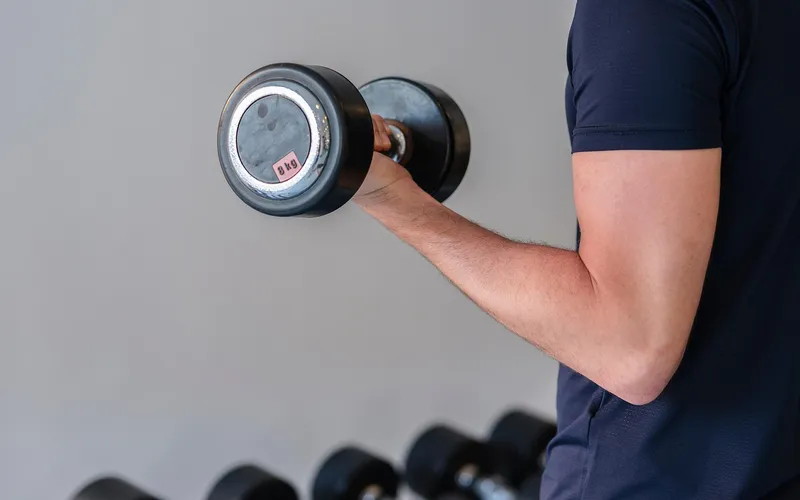
Do two full-body sessions a week, A and B, on non-consecutive days. Each has five to seven exercises for 2 or 3 sets of 8 to 12 reps, and takes about 40 minutes. Pick a weight where the last two reps are hard but clean, and go up once every set reaches 12.
On this page
What you need
One or two pairs of dumbbells, a sturdy chair, a bottom stair or a low step, and enough floor to lie down. That is it. No bench is needed, which is why the chest exercise below is done on the floor.
If you are buying, adjustable dumbbells save space and money over a rack of fixed pairs. If you already have a light pair and a heavier pair, use the light pair for shoulders and arms and the heavier one for legs and rows.
Session A
| Exercise | Sets x reps | Rest |
|---|---|---|
| Dumbbell squat | 3 x 8 to 12 | 90 s |
| Dumbbell floor press | 3 x 8 to 12 | 90 s |
| Single-arm dumbbell row | 3 x 10 to 12 per side | 60 s |
| Stiff-leg dumbbell deadlift | 2 x 10 | 90 s |
| Farmer's walk | 3 x 30 seconds | 60 s |
Session B
| Exercise | Sets x reps | Rest |
|---|---|---|
| Dumbbell split squat | 2 x 8 to 10 per leg | 90 s |
| Seated dumbbell shoulder press | 3 x 8 to 12 | 90 s |
| Push-up | 2 x 8 to 12 | 90 s |
| Bent-over dumbbell row | 3 x 10 to 12 | 60 s |
| Dumbbell step-up | 2 x 8 per leg | 60 s |
| Dumbbell Romanian deadlift | 2 x 10 | 90 s |
| Hammer curl | 2 x 10 to 15 | 60 s |
Alternate them: A on Monday, B on Thursday, A the next Monday, and so on. Start each session with five minutes of warm-up and one light set of the first exercise.
In the first two weeks, do 2 sets of everything rather than 3. Your muscles will cope with more than your joints and tendons are ready for, and the extra set can wait.
How to pick the weight
Do a test set of 10. If you could have done 2 or 3 more clean reps, that is your working weight. If you could have done 8 more, go heavier. If rep 10 was a grind or your form slipped, go lighter. How heavy should you lift covers this in more detail.
You do not need to push every set until you cannot do another rep. A review of the research found that sets stopped short of failure gave similar muscle growth when the total work was similar 1. Two or three reps in reserve is a good place to live.
A few form notes that matter
Squat. Hold the dumbbells at your sides and sit down and back as if onto a chair. If your heels lift, widen your stance a little. Only go as low as you can keep your chest up.
Floor press. Lie with knees bent. Lower until your upper arms touch the floor, pause, then press. The floor stops the shoulder from going too far back, which suits stiff shoulders.
Rows. Put one hand and knee on the chair for the single-arm version. Pull the dumbbell toward your hip, not your armpit.
Stiff-leg deadlift. Soft knees, slide the dumbbells down the front of your thighs, push your hips back. Stop when you feel a stretch in the back of your legs, which for most people is around the knee or just below. A flat back matters more than depth.
Step-up. Use the bottom stair before anything taller. Push through the front foot; the back foot should do as little as possible.
How to progress
Use a double progression. Stay at one weight until you reach the top of the rep range on every set, then move up to the next weight and start back at the bottom of the range.
An example for the squat over a few weeks:
- Week 1: 8 kg dumbbells, 10, 9 reps
- Week 3: 8 kg, 12, 11, 10
- Week 5: 8 kg, 12, 12, 12. Time to move up.
- Week 6: 10 kg, 9, 8, 8
If the next pair is too big a jump, add a slow three-second lowering phase at the old weight for a week or two first. Adjustable dumbbells with small plates help a lot here.
Is this enough?
For most adults coming back to training, yes. The ACSM's 2026 review recommends training all major muscle groups at least twice a week, around 10 sets per muscle group a week for growth, and 2 to 3 sets per exercise at heavier loads for strength 2. These two sessions are a starter that covers each movement pattern once a week, with chest and hamstrings in both sessions. They leave room to add a set as you adapt.
Once the sessions feel routine, after two or three months, you can add a third day or a set here and there. The broader picture, including how to cover the week with other kit, is in strength training at home. Amble can also build these sessions for you from the dumbbells you own, and suggest when to go up a weight based on what you log.
Sources
- Refalo MC, Helms ER, Trexler ET, Hamilton DL, Fyfe JJ. Influence of Resistance Training Proximity-to-Failure on Skeletal Muscle Hypertrophy: A Systematic Review with Meta-analysis. Sports Medicine, 2023;53(3):649-665. doi:10.1007/s40279-022-01784-y · PubMed
- American College of Sports Medicine. Resistance Training Prescription for Muscle Function, Hypertrophy, and Physical Performance in Healthy Adults: An Overview of Reviews. Medicine and Science in Sports and Exercise, 2026. acsm.org/resistance-training-guidelines-update-2026