Kettlebell swing
The kettlebell swing is an intermediate kettlebell compound exercise for the glutes and hamstrings.
A two-hand kettlebell swing driven by a fast hip hinge. It trains the glutes and hamstrings for power and doubles as hard conditioning work.
- Main muscles
- Glutes, Hamstrings
- Also works
- Lower back, Forearms and grip, Abs
- Equipment
- Kettlebell
- Level
- Intermediate
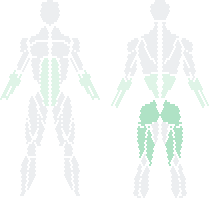
Muscles worked
The kettlebell swing mainly works the glutes and hamstrings. It also works the lower back, forearms and grip and abs.
More exercises for: glutes, hamstrings, lower back, forearms.
How to do it
- Stand with your feet a bit wider than your hips and a kettlebell on the floor a foot in front of you, hinge down and grip the handle with both hands.
- Hike the bell back between your legs with your back flat and arms loose.
- Snap your hips forward hard so the bell floats to chest height.
- Let your arms stay relaxed and use them only as guides.
- Let the bell fall back and hinge again, catching it as it passes your hips.
Where you should feel it: In the glutes and hamstrings, with your grip and stomach braced. The bell should feel weightless at the top, and your lower back should feel stable.
Coach's cues
- Hinge at the hips with a flat back and swing the kettlebell back between the legs
- Drive the hips forward hard so the kettlebell floats up to chest height
- Let it fall back and hinge again, the arms only guide it
Try it: a working piece of Amble
Kettlebell swing
In your week
Pick your goal, days and time. The exercise lands where it belongs.
TueFull body A
- Goblet squat3 × 8–12
- Wide push-up3 × 8–12
- Single-arm dumbbell row3 × 8–12
- Kettlebell swing3 × 8–12
- Plank3 × 40 s
ThuFull body B
- Kettlebell swing3 × 8–12
- Single-arm dumbbell row3 × 8–12
- Wide push-up3 × 8–12
- Dumbbell split squat3 × 8–12
- Plank3 × 40 s
SatFull body A
- Goblet squat3 × 8–12
- Wide push-up3 × 8–12
- Single-arm dumbbell row3 × 8–12
- Kettlebell swing3 × 8–12
- Plank3 × 40 s
Each session: 5 exercises for 45 min
Common mistakes
How to start. 3 to 5 sets of 10 reps with a moderate bell and 60 seconds rest, after learning the hinge.
Who it suits
Suits people who can hinge with a flat back. Beginners should learn the kettlebell deadlift first. Skip it with an acute back injury and stop if form falls apart as you tire. Make sure you have clear space.
Sets and reps by goal
- Power: 6 to 10 sets of 5 to 8 reps with a heavy bell and full rest.
- Conditioning: 10 to 15 rounds of 20 seconds of swings and 40 seconds rest.
- Endurance: 3 sets of 20 to 30 reps with a lighter bell.
Easier and harder versions
- Kettlebell deadlift (easier): Learn the hinge with a deadlift first.
- Cable pull-through (easier): A cable pull-through teaches the hinge without impact.
- Single-arm kettlebell swing (harder): A single-arm swing adds a rotation challenge.
- Kettlebell clean (harder): A clean brings the bell all the way to the shoulder.
Load on your joints
How Amble rates this movement when it plans around sore joints.
Instead of the kettlebell swing
The same main muscles with different kit or a lower difficulty.
Similar exercises
Swap it out?
Guides that use it
Common questions
What muscles does the kettlebell swing work?
The kettlebell swing mainly works the glutes and hamstrings. It also works the lower back, forearms and grip and abs.
How many sets and reps of the kettlebell swing should I do?
Power: 6 to 10 sets of 5 to 8 reps with a heavy bell and full rest. Conditioning: 10 to 15 rounds of 20 seconds of swings and 40 seconds rest. Endurance: 3 sets of 20 to 30 reps with a lighter bell.
What can I do instead of the kettlebell swing?
Machine deadlift, band pull-through and cable pull-through work the same main muscles.
What are the most common mistakes in the kettlebell swing?
Squatting the swing. Push your hips back and keep your shins fairly vertical. A swing is a hinge, not a squat. Lifting with the arms and shoulders. Think hips drive, arms only guide. The bell should float up. Leaning back at the top. Finish standing tall with glutes squeezed and ribs down.