Single-leg dumbbell Romanian deadlift
The single-leg dumbbell Romanian deadlift is an intermediate dumbbell compound exercise for the hamstrings and glutes.
A Romanian deadlift on one leg with a dumbbell in the opposite hand. It trains the hamstrings and glutes, plus balance and hip stability.
- Main muscles
- Hamstrings, Glutes
- Also works
- Side glutes, Lower back
- Equipment
- Dumbbells
- Level
- Intermediate, one side at a time
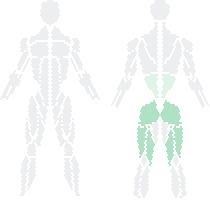
Muscles worked
The single-leg dumbbell Romanian deadlift mainly works the hamstrings and glutes. It also works the side glutes and lower back.
More exercises for: hamstrings, glutes, lower back.
How to do it
- Stand on one leg with a soft knee and a dumbbell in the hand opposite the standing leg, or hold it on the same side to make it easier.
- Brace your trunk and hinge at the hip, pushing the free leg straight back as the body leans forward.
- Keep the back flat and the dumbbell close to the standing leg as it slides down.
- Stop when you feel a stretch in the hamstring or when you cannot keep the hips level.
- Squeeze the glute and drive the hips forward to stand tall again.
Where you should feel it: In the hamstring and glute of the standing leg, with the hip muscles working to keep you steady. You should not feel it in the lower back.
Coach's cues
- Stand on one leg with a soft knee and a dumbbell in the opposite hand
- Hinge forward with a flat back while the free leg goes straight back
- Stop when the hamstring is stretched and stand up again
Try it: a working piece of Amble
Single-leg dumbbell Romanian deadlift
In your week
Pick your goal, days and time. The exercise lands where it belongs.
TueFull body A
- Goblet squat3 × 8–12
- Wide push-up3 × 8–12
- Single-arm dumbbell row3 × 8–12
- Single-leg dumbbell Romanian deadlift3 × 8–12
- Plank3 × 40 s
ThuFull body B
- Single-leg dumbbell Romanian deadlift3 × 8–12
- Single-arm dumbbell row3 × 8–12
- Wide push-up3 × 8–12
- Dumbbell split squat3 × 8–12
- Plank3 × 40 s
SatFull body A
- Goblet squat3 × 8–12
- Wide push-up3 × 8–12
- Single-arm dumbbell row3 × 8–12
- Single-leg dumbbell Romanian deadlift3 × 8–12
- Plank3 × 40 s
Each session: 5 exercises for 45 min
Common mistakes
How to start. 2 or 3 sets of 8 reps per leg with a light dumbbell, holding on to a wall at first if needed.
Who it suits
Suits those who can already hinge with a flat back and want to build single-leg strength and balance. Start with a light dumbbell or none. Skip it if you feel back pain and swap for a supported hinge.
Sets and reps by goal
- Muscle: 3 sets of 8 to 12 reps per leg with 60 to 90 seconds rest.
- Strength: 3 to 4 sets of 5 to 8 reps per leg with a heavier dumbbell.
- Balance: 2 sets of 10 slow reps per leg with a light weight.
Easier and harder versions
- Dumbbell Romanian deadlift (easier): The two-leg version is more stable and easier to learn.
- B-stance Romanian deadlift (easier): The B-stance keeps a light support foot on the floor.
- Single-leg kettlebell Romanian deadlift (harder): A kettlebell version asks for more control.
Load on your joints
How Amble rates this movement when it plans around sore joints.
Instead of the single-leg dumbbell Romanian deadlift
The same main muscles with different kit or a lower difficulty.
Similar exercises
Guides that use it
Common questions
What muscles does the single-leg dumbbell Romanian deadlift work?
The single-leg dumbbell Romanian deadlift mainly works the hamstrings and glutes. It also works the side glutes and lower back.
How many sets and reps of the single-leg dumbbell Romanian deadlift should I do?
Muscle: 3 sets of 8 to 12 reps per leg with 60 to 90 seconds rest. Strength: 3 to 4 sets of 5 to 8 reps per leg with a heavier dumbbell. Balance: 2 sets of 10 slow reps per leg with a light weight.
What can I do instead of the single-leg dumbbell Romanian deadlift?
Good morning, single-leg kettlebell Romanian deadlift and Smith machine stiff-leg deadlift work the same main muscles.
What are the most common mistakes in the single-leg dumbbell Romanian deadlift?
Rounding the back. Keep the chest proud and stop the hinge where the back starts to round. Opening the hips toward the side. Keep the hips square to the floor, as if between two walls. Locking the standing knee. Hold a small, steady bend in the knee throughout.