L-sit
The L-sit is an advanced isolation exercise for the abs and hip flexors.
A gymnastic hold where you support yourself on straight arms with your legs held out in front, level with the hips. It builds the abs, hip flexors and triceps and a lot of body control.
- Main muscles
- Abs, Hip flexors
- Also works
- Triceps, Quads
- Equipment
- Other kit
- Level
- Advanced
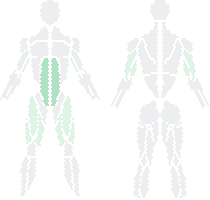
Muscles worked
The L-sit mainly works the abs and hip flexors. It also works the triceps and quads.
How to do it
- Support yourself on parallel bars, parallettes or the floor with straight arms, shoulders pressed down and your legs hanging or tucked.
- Push the handles down and depress your shoulders away from your ears.
- Lift your legs until they are level with your hips, as straight as you can.
- Keep your chest tall and your lower back neutral.
- Hold and breathe in short breaths, then lower under control.
Where you should feel it: In the whole front of your stomach, hip flexors and triceps, with your shoulders working hard. Your wrists should feel loaded but not sharp.
Coach's cues
- Support yourself on parallel bars or handles with straight arms and the shoulders down
- Lift the straight legs until they are level with the hips
- Hold, and bend the knees to make it easier
Try it: a working piece of Amble
L-sit
In your week
Pick your goal, days and time. The exercise lands where it belongs.
TueFull body A
- Goblet squat3 × 8–12
- Wide push-up3 × 8–12
- Single-arm dumbbell row3 × 8–12
- Stiff-leg dumbbell deadlift3 × 8–12
- L-sit3 × 40 s
ThuFull body B
- Stiff-leg dumbbell deadlift3 × 8–12
- Single-arm dumbbell row3 × 8–12
- Wide push-up3 × 8–12
- Dumbbell split squat3 × 8–12
- L-sit3 × 40 s
SatFull body A
- Goblet squat3 × 8–12
- Wide push-up3 × 8–12
- Single-arm dumbbell row3 × 8–12
- Stiff-leg dumbbell deadlift3 × 8–12
- L-sit3 × 40 s
Each session: 5 exercises for 45 min
Common mistakes
How to start. Start with tucked knees: 3 holds of 10 seconds, resting 60 seconds between holds.
Who it suits
Suits people who are already strong on planks, dips and hanging leg raises. It is advanced and takes weeks to learn. Skip or modify it if your wrists or shoulders hurt, and stop if your elbows ache.
Sets and reps by goal
- Skill: 4 to 6 short holds of 5 to 10 seconds with full rest.
- Strength: 3 holds of 15 to 30 seconds once the form is solid.
- Progression: tuck, one leg out, then both legs straight.
Easier and harder versions
- Hollow hold (easier): A floor core hold that builds the same trunk strength.
- Hanging knee raise (easier): A hanging move for the same muscles.
- Hanging leg raise (harder): Hanging with straight legs is a step up.
- Toes to bar (harder): A dynamic hanging move that needs strong abs and grip.
Load on your joints
How Amble rates this movement when it plans around sore joints.
Instead of the L-sit
The same main muscles with different kit or a lower difficulty.
Similar exercises
Guides that use it
Common questions
What muscles does the L-sit work?
The L-sit mainly works the abs and hip flexors. It also works the triceps and quads.
How many sets and reps of the L-sit should I do?
Skill: 4 to 6 short holds of 5 to 10 seconds with full rest. Strength: 3 holds of 15 to 30 seconds once the form is solid. Progression: tuck, one leg out, then both legs straight.
What can I do instead of the L-sit?
Crunch, hanging leg raise and lying leg raise on a bench work the same main muscles.
What are the most common mistakes in the L-sit?
Shrugging the shoulders up. Push down hard and keep your shoulders away from your ears. Legs dropping or knees bending too early. Start with tucked knees and make it harder gradually. Leaning back and rounding the spine. Keep your chest tall and your pelvis tilted slightly under.