Paused deadlift
The paused deadlift is an advanced barbell compound exercise for the glutes, hamstrings and lower back.
A deadlift with a two-second stop just below the knees. It trains the middle of the pull and drills a flat back, with the bar kept close to your legs.
- Main muscles
- Glutes, Hamstrings, Lower back
- Also works
- Quads, Forearms and grip, Upper traps, Lats
- Equipment
- Barbell
- Level
- Advanced
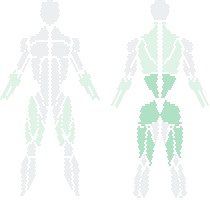
Muscles worked
The paused deadlift mainly works the glutes, hamstrings and lower back. It also works the quads, forearms and grip, upper traps and lats.
More exercises for: glutes, hamstrings, lower back, quads.
How to do it
- Stand with the bar over the middle of your feet, grip it just outside the legs, hips back, chest up and the back flat before you pull.
- Take a breath, brace your trunk and push the floor away to lift the bar to just below the knees.
- Stop there for two seconds with the bar against the legs, the back flat and the shoulders over the bar.
- Squeeze your glutes and drive the hips forward to stand tall.
- Lower the bar under control by pushing the hips back, and reset before the next rep.
Where you should feel it: In your glutes, hamstrings and the muscles along your back, with a strong grip and brace during the pause. You should not feel pulling or rounding in the lower back.
Coach's cues
- Lift the bar to just below the knees and hold for two seconds
- Keep the back flat and the bar against the legs in the pause
- Finish by standing tall with the hips through
Try it: a working piece of Amble
Paused deadlift
In your week
Pick your goal, days and time. The exercise lands where it belongs.
TueFull body A
- Barbell back squat3 × 8–12
- Barbell bench press3 × 8–12
- Bent-over barbell row3 × 8–12
- Paused deadlift3 × 8–12
- Plank3 × 40 s
ThuFull body B
- Paused deadlift3 × 8–12
- Bent-over barbell row3 × 8–12
- Barbell bench press3 × 8–12
- Dumbbell lunge3 × 8–12
- Plank3 × 40 s
SatFull body A
- Barbell back squat3 × 8–12
- Barbell bench press3 × 8–12
- Bent-over barbell row3 × 8–12
- Paused deadlift3 × 8–12
- Plank3 × 40 s
Each session: 5 exercises for 45 min
Common mistakes
How to start. 3 sets of 3 reps with a 1 to 2 second pause, using about 60 to 70 percent of your usual deadlift weight.
Who it suits
Suits lifters who already deadlift with a solid, flat back and want to fix the mid-range of the pull. If you are new to deadlifting, learn the regular version first. Skip it if a heavy pull causes back pain.
Sets and reps by goal
- Strength: 3 to 5 sets of 2 to 4 reps with a 2 second pause and 3 minutes rest.
- Technique: 3 sets of 3 reps with a light bar and a longer pause.
- Muscle: 3 sets of 5 to 6 reps with moderate weight and 2 minutes rest.
Easier and harder versions
- Barbell deadlift (easier): The regular deadlift removes the pause and lets you go heavier.
- Rack pull (easier): Starting from the rack shortens the range and lowers the demand on the lower back.
- Deficit deadlift (harder): Standing on a plate makes the start deeper and more demanding.
Load on your joints
How Amble rates this movement when it plans around sore joints.
Instead of the paused deadlift
The same main muscles with different kit or a lower difficulty.
Similar exercises
Guides that use it
Common questions
What muscles does the paused deadlift work?
The paused deadlift mainly works the glutes, hamstrings and lower back. It also works the quads, forearms and grip, upper traps and lats.
How many sets and reps of the paused deadlift should I do?
Strength: 3 to 5 sets of 2 to 4 reps with a 2 second pause and 3 minutes rest. Technique: 3 sets of 3 reps with a light bar and a longer pause. Muscle: 3 sets of 5 to 6 reps with moderate weight and 2 minutes rest.
What can I do instead of the paused deadlift?
Dumbbell deadlift, machine deadlift and kettlebell swing work the same main muscles.
What are the most common mistakes in the paused deadlift?
Rounding the back in the pause. If the back rounds, the weight is too heavy. Reduce the load and keep the chest up through the pause. Letting the bar drift away from the legs. Keep the bar dragging along your legs, since distance makes the pull harder on the back. Standing up with the back instead of the hips. Finish by pushing the hips forward, not by leaning back at the top.