Prone Y and T raise
The prone Y and T raise is a beginner bodyweight isolation exercise for the shoulders and upper back.
A face-down raise that works the small muscles between and behind the shoulder blades. It improves posture and shoulder control, and needs no equipment.
- Main muscles
- Rear shoulder, Mid back
- Also works
- Lower back
- Equipment
- Bodyweight
- Level
- Beginner
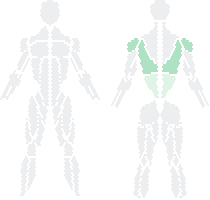
Muscles worked
The prone Y and T raise mainly works the rear shoulder and mid back. It also works the lower back.
More exercises for: shoulders, upper back, lower back.
How to do it
- Lie face down on the floor with your forehead resting lightly and your arms extended overhead in a Y shape, thumbs pointing up.
- Squeeze your shoulder blades together and down to lift the arms a few centimetres off the floor.
- Hold for a second without shrugging or arching the lower back.
- Lower slowly, then move the arms out to the sides into a T and repeat the lift.
- Alternate Y and T reps, breathing steadily.
Where you should feel it: Between your shoulder blades and in the back of the shoulders, with a light effort in the lower back. You should not feel it in your neck or have the shoulders shrug up to your ears.
Coach's cues
- Lie face down, arms in a Y with thumbs up
- Lift the arms a few cm by squeezing the shoulder blades
- Lower slowly, then repeat with the arms out in a T
Try it: a working piece of Amble
Prone Y and T raise
In your week
Pick your goal, days and time. The exercise lands where it belongs.
TueFull body A
- Goblet squat3 × 8–12
- Wide push-up3 × 8–12
- Prone Y and T raise3 × 8–12
- Stiff-leg dumbbell deadlift3 × 8–12
- Plank3 × 40 s
ThuFull body B
- Stiff-leg dumbbell deadlift3 × 8–12
- Prone Y and T raise3 × 8–12
- Wide push-up3 × 8–12
- Dumbbell split squat3 × 8–12
- Plank3 × 40 s
SatFull body A
- Goblet squat3 × 8–12
- Wide push-up3 × 8–12
- Prone Y and T raise3 × 8–12
- Stiff-leg dumbbell deadlift3 × 8–12
- Plank3 × 40 s
Each session: 5 exercises for 45 min
Common mistakes
How to start. 2 sets of 8 to 10 reps of each position, with no weight and a 1 second hold.
Who it suits
Suits beginners, desk workers and lifters who want stronger postural muscles. Skip it if you have a shoulder or neck issue that hurts when lifting the arms. Add light dumbbells only when the bodyweight version feels easy.
Sets and reps by goal
- Posture: 2 to 3 sets of 8 to 12 reps with a 1 to 2 second hold.
- Muscle: 3 sets of 12 to 15 reps with 1 to 3 kg dumbbells.
- Warm-up: 1 set of 8 reps before pressing or pulling.
Easier and harder versions
- Superman (easier): Superman is a simpler back-lift to start with.
- Band pull-apart (easier): Band pull-aparts work the same muscles standing, with light resistance.
- Prone dumbbell rear delt raise (harder): Adding dumbbells on a bench raises the load on the rear delts.
Load on your joints
How Amble rates this movement when it plans around sore joints.
Instead of the prone Y and T raise
The same main muscles with different kit or a lower difficulty.
Similar exercises
Guides that use it
Common questions
What muscles does the prone Y and T raise work?
The prone Y and T raise mainly works the rear shoulder and mid back. It also works the lower back.
How many sets and reps of the prone Y and T raise should I do?
Posture: 2 to 3 sets of 8 to 12 reps with a 1 to 2 second hold. Muscle: 3 sets of 12 to 15 reps with 1 to 3 kg dumbbells. Warm-up: 1 set of 8 reps before pressing or pulling.
What can I do instead of the prone Y and T raise?
Band pull-apart, cable rear delt fly and dumbbell reverse fly work the same main muscles.
What are the most common mistakes in the prone Y and T raise?
Lifting too high. The range is small. Lift only a few centimetres and keep the ribs on the floor. Shrugging the shoulders. Think of sliding the shoulder blades down toward your hips before you lift. Swinging with momentum. Move slowly with a short pause at the top. No weights are needed to make it work.