Wall slide
The wall slide is a beginner bodyweight isolation exercise for the upper back and shoulders.
A standing slide where your arms stay in contact with a wall as they move overhead. It trains shoulder blade control and the small muscles that help you raise your arms comfortably.
- Main muscles
- Mid back, Rotator cuff
- Also works
- Front shoulder
- Equipment
- Bodyweight
- Level
- Beginner
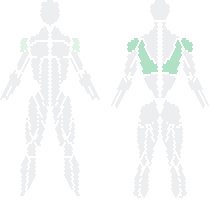
Muscles worked
The wall slide mainly works the mid back and rotator cuff. It also works the front shoulder.
More exercises for: upper back, shoulders.
How to do it
- Stand with your back against a wall, feet a little in front of you, elbows bent and your arms and the backs of the hands against the wall.
- Flatten your lower back lightly against the wall and keep the ribs down.
- Slide your arms up the wall as far as they stay in contact with it.
- Pause at the top without shrugging the shoulders toward your ears.
- Slide back down slowly with the lower back still in place.
Where you should feel it: In the muscles between and below the shoulder blades and around the shoulders. You should not feel it in the neck or have a pinching feeling in the front of the shoulder.
Coach's cues
- Stand with the back against a wall, elbows bent and the arms against the wall
- Slide the arms up as far as they stay in contact with the wall
- Slide back down slowly and keep the lower back still
Common mistakes
How to start. 2 sets of 8 to 10 slow reps, going only as high as you can keep contact.
Who it suits
Suits desk workers, beginners and lifters warming up before overhead work. If you feel pinching in the shoulder, reduce the range. Pain that continues should be checked by a physio.
Sets and reps by goal
- Warm-up: 1 or 2 sets of 8 to 10 slow reps before pressing or pull-ups.
- Posture: 2 to 3 sets of 10 to 12 reps with a pause at the top.
- Mobility: 2 sets of 8 reps daily, going a little higher over time.
Easier and harder versions
- Prone Y and T raise (harder): The prone Y and T raise adds gravity to the same shoulder blade muscles.
- Band pull-apart (harder): The band pull-apart adds resistance to the rear shoulder.
- Arm circles (easier): Arm circles are a simpler, freer shoulder warm-up.
Load on your joints
How Amble rates this movement when it plans around sore joints.
Instead of the wall slide
The same main muscles with different kit or a lower difficulty.
Similar exercises
Guides that use it
Common questions
What muscles does the wall slide work?
The wall slide mainly works the mid back and rotator cuff. It also works the front shoulder.
How many sets and reps of the wall slide should I do?
Warm-up: 1 or 2 sets of 8 to 10 slow reps before pressing or pull-ups. Posture: 2 to 3 sets of 10 to 12 reps with a pause at the top. Mobility: 2 sets of 8 reps daily, going a little higher over time.
What can I do instead of the wall slide?
Side-lying dumbbell external rotation and cable external rotation work the same main muscles.
What are the most common mistakes in the wall slide?
Arching the lower back. Keep the ribs down and the lower back gently flat against the wall. Shrugging up. Think of keeping the shoulders away from the ears as you slide. Losing wall contact. Move only as far as the arms and hands stay on the wall.
Amble puts wall slide in your week, at the right amount
Swap, move or skip an exercise in a couple of taps, or ask the coach to do it.