Stability ball knee tuck
The stability ball knee tuck is an intermediate compound exercise for the abs.
A core move from a push-up position with your shins on a stability ball. You roll the knees to the chest, which trains the abs and trunk control.
- Main muscles
- Abs
- Also works
- Hip flexors, Front shoulder
- Equipment
- Other kit
- Level
- Intermediate
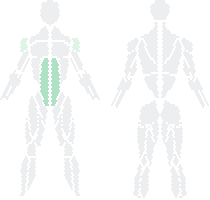
Muscles worked
The stability ball knee tuck mainly works the abs. It also works the hip flexors and front shoulder.
How to do it
- Start in a push-up position with your hands under your shoulders and your shins or the tops of your feet resting on a stability ball.
- Brace your abs and squeeze your glutes so your body forms a straight line from head to ankles.
- Pull your knees in toward your chest by rolling the ball with your feet.
- Pause for a moment with the hips slightly lifted.
- Roll the ball back out until the body is straight again, keeping the hips from sagging.
Where you should feel it: In the lower abs and hip flexors, with the shoulders and arms holding you steady. You should not feel it in the lower back or the wrists.
Coach's cues
- Start in a push-up position with your shins on the ball
- Pull your knees in toward your chest by rolling the ball
- Roll back out until your body is straight again
Try it: a working piece of Amble
Stability ball knee tuck
In your week
Pick your goal, days and time. The exercise lands where it belongs.
TueFull body A
- Goblet squat3 × 8–12
- Wide push-up3 × 8–12
- Single-arm dumbbell row3 × 8–12
- Stiff-leg dumbbell deadlift3 × 8–12
- Stability ball knee tuck3 × 40 s
ThuFull body B
- Stiff-leg dumbbell deadlift3 × 8–12
- Single-arm dumbbell row3 × 8–12
- Wide push-up3 × 8–12
- Dumbbell split squat3 × 8–12
- Stability ball knee tuck3 × 40 s
SatFull body A
- Goblet squat3 × 8–12
- Wide push-up3 × 8–12
- Single-arm dumbbell row3 × 8–12
- Stiff-leg dumbbell deadlift3 × 8–12
- Stability ball knee tuck3 × 40 s
Each session: 5 exercises for 45 min
Common mistakes
How to start. 2 or 3 sets of 6 to 10 reps, placing the ball under your shins for an easier lever.
Who it suits
Suits trainees who can hold a solid plank and have used a stability ball. Skip it if wrists or shoulders hurt in a push-up position. It needs a stable floor and some space.
Sets and reps by goal
- Strength: 3 sets of 8 to 12 reps with a slow tempo and 60 to 90 seconds rest.
- Endurance: 2 to 3 sets of 15 to 20 reps.
- Core control: 2 sets of 6 slow reps with a 2 second pause.
Easier and harder versions
- Plank (easier): The plain plank is the base for the ball version.
- Knee plank (easier): A knee plank is a gentler way to learn bracing.
- Hollow hold (harder): The hollow hold is a demanding abs challenge without equipment.
Load on your joints
How Amble rates this movement when it plans around sore joints.
Instead of the stability ball knee tuck
The same main muscles with different kit or a lower difficulty.
Similar exercises
Guides that use it
Common questions
What muscles does the stability ball knee tuck work?
The stability ball knee tuck mainly works the abs. It also works the hip flexors and front shoulder.
How many sets and reps of the stability ball knee tuck should I do?
Strength: 3 sets of 8 to 12 reps with a slow tempo and 60 to 90 seconds rest. Endurance: 2 to 3 sets of 15 to 20 reps. Core control: 2 sets of 6 slow reps with a 2 second pause.
What can I do instead of the stability ball knee tuck?
Dead bug, bird dog and kneeling barbell rollout work the same main muscles.
What are the most common mistakes in the stability ball knee tuck?
Letting the hips sag. Keep the abs braced and squeeze the glutes so the body stays in one line. Rushing the pull. Move slowly and breathe. Fast reps lose control of the ball. Piking the hips too high. Roll the knees toward the chest, with the hips lifting only a little.