Kettlebell windmill
The kettlebell windmill is an advanced kettlebell compound exercise for the obliques.
A kettlebell held overhead while you fold sideways at the hip and reach toward the floor. It trains the obliques, hips and shoulder stability, and rewards good mobility.
- Main muscles
- Obliques
- Also works
- Glutes, Hamstrings, Rotator cuff, Front shoulder
- Equipment
- Kettlebell
- Level
- Advanced, one side at a time
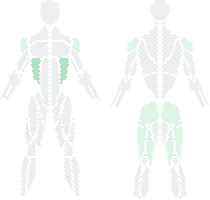
Muscles worked
The kettlebell windmill mainly works the obliques. It also works the glutes, hamstrings, rotator cuff and front shoulder.
More exercises for: obliques, glutes, hamstrings, shoulders.
How to do it
- Stand with feet slightly wider than shoulders, turn your toes about 45 degrees away from the weight side, and lock a kettlebell overhead with a straight arm.
- Keep your eyes on the kettlebell and push your hip out toward the weight side.
- Fold down by hinging, keeping the front leg nearly straight.
- Reach your free hand toward the floor, down the leg.
- Stand back up by squeezing the glute and pushing the floor away, with the arm still locked.
Where you should feel it: In the side of the waist, glutes and hamstrings, with the shoulder working to hold the bell. It should stretch the back of the legs, not pinch your lower back.
Coach's cues
- Lock the kettlebell overhead and turn the feet away from that side
- Push the hip out and fold down with your eyes on the kettlebell
- Reach the free hand toward the floor, then stand up with a straight arm
Try it: a working piece of Amble
Kettlebell windmill
In your week
Pick your goal, days and time. The exercise lands where it belongs.
TueFull body A
- Goblet squat3 × 8–12
- Wide push-up3 × 8–12
- Single-arm dumbbell row3 × 8–12
- Stiff-leg dumbbell deadlift3 × 8–12
- Kettlebell windmill3 × 40 s
ThuFull body B
- Stiff-leg dumbbell deadlift3 × 8–12
- Single-arm dumbbell row3 × 8–12
- Wide push-up3 × 8–12
- Dumbbell split squat3 × 8–12
- Kettlebell windmill3 × 40 s
SatFull body A
- Goblet squat3 × 8–12
- Wide push-up3 × 8–12
- Single-arm dumbbell row3 × 8–12
- Stiff-leg dumbbell deadlift3 × 8–12
- Kettlebell windmill3 × 40 s
Each session: 5 exercises for 45 min
Common mistakes
How to start. Practise with no weight or a light bell, 3 sets of 3 to 5 reps per side.
Who it suits
Suits experienced lifters with good shoulder and hip mobility. It is a skill move that takes practice. Skip it if overhead positions or bending sideways hurt, and build up with simpler hinges and presses.
Sets and reps by goal
- Skill and control: 3 sets of 3 to 5 reps per side with a light bell.
- Strength: 3 sets of 3 to 5 reps per side with a heavier bell once the form is solid.
- Mobility: 2 sets of 5 reps per side with no weight.
Easier and harder versions
- Dumbbell side bend (easier): A simple side bend to train the same muscles with less skill.
- Kettlebell halo (easier): Builds shoulder control with the bell.
- Turkish get-up (harder): The Turkish get-up links overhead stability with more movement.
- Good morning (easier): A simple hinge pattern to build the folding motion.
Load on your joints
How Amble rates this movement when it plans around sore joints.
Similar exercises
Guides that use it
Common questions
What muscles does the kettlebell windmill work?
The kettlebell windmill mainly works the obliques. It also works the glutes, hamstrings, rotator cuff and front shoulder.
How many sets and reps of the kettlebell windmill should I do?
Skill and control: 3 sets of 3 to 5 reps per side with a light bell. Strength: 3 sets of 3 to 5 reps per side with a heavier bell once the form is solid. Mobility: 2 sets of 5 reps per side with no weight.
What are the most common mistakes in the kettlebell windmill?
Using too heavy a bell. Start with no weight or a very light bell. Learn the movement before adding load. Bending the lower back sideways instead of hinging. Push the hip out and fold at the hip, keeping your back flat. Letting the bell arm bend or drift forward. Keep the arm locked with the wrist neutral and your gaze on the bell.