Pull-up
The pull-up is an intermediate pull-up bar compound exercise for the lats.
Hang from a bar and pull your chest toward it. One of the best checks of upper body strength, and worth building up to with a band or assisted machine.
- Main muscles
- Lats
- Also works
- Biceps, Mid back
- Equipment
- Pull-up bar
- Level
- Intermediate
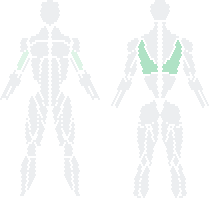
Muscles worked
The pull-up mainly works the lats. It also works the biceps and mid back.
More exercises for: lats, biceps, upper back.
How to do it
- Grab the bar with an overhand grip a little wider than your shoulders, and hang with your arms straight.
- Pull your shoulder blades down and back.
- Pull your chest toward the bar, leading with the elbows.
- Pause with your chin above the bar.
- Lower slowly until your arms are straight again.
Where you should feel it: Through the sides of your back and the fronts of your arms, with your grip and stomach working too.
Coach's cues
- Hang with arms straight and shoulders engaged
- Pull your chest toward the bar
- Lower all the way under control
Try it: a working piece of Amble
Pull-up
In your week
Pick your goal, days and time. The exercise lands where it belongs.
TueFull body A
- Barbell back squat3 × 8–12
- Barbell bench press3 × 8–12
- Pull-up3 × 8–12
- Romanian deadlift3 × 8–12
- Plank3 × 40 s
ThuFull body B
- Romanian deadlift3 × 8–12
- Pull-up3 × 8–12
- Barbell bench press3 × 8–12
- Dumbbell lunge3 × 8–12
- Plank3 × 40 s
SatFull body A
- Barbell back squat3 × 8–12
- Barbell bench press3 × 8–12
- Pull-up3 × 8–12
- Romanian deadlift3 × 8–12
- Plank3 × 40 s
Each session: 5 exercises for 45 min
Common mistakes
How to start. 3 sets of 3 to 5 reps, or use a band or assistance machine for 6 to 8.
Sets and reps by goal
- Getting started: 2 to 3 sets of 5 to 10 reps, stopping with 2 reps left.
- Muscle size: 3 to 4 sets of 8 to 20 reps close to your limit. When 20 feels easy, move to a harder version.
- Endurance: 2 to 3 sets of 20 or more reps.
Common starting ranges, not rules. Adjust to how the sets feel. Source: ACSM position stand on progression in resistance training (2009). Sets and reps explained.
Load on your joints
How Amble rates this movement when it plans around sore joints.
Easier or harder
Instead of the pull-up
The same main muscles with different kit or a lower difficulty.
Similar exercises
Swap it out?
Common questions
What muscles does the pull-up work?
The pull-up mainly works the lats. It also works the biceps and mid back.
How many sets and reps of the pull-up should I do?
Getting started: 2 to 3 sets of 5 to 10 reps, stopping with 2 reps left. Muscle size: 3 to 4 sets of 8 to 20 reps close to your limit. When 20 feels easy, move to a harder version. Endurance: 2 to 3 sets of 20 or more reps.
What can I do instead of the pull-up?
Band-assisted pull-up, wide-grip lat pulldown and assisted pull-up machine work the same main muscles.
What are the most common mistakes in the pull-up?
Swinging or kicking to get above the bar. Keep your legs still and slow the pull. Stopping short at the bottom. Lower to a full hang each rep. Shrugging your shoulders up at the top. Keep your shoulders low as you pull.
What is an easier version of the pull-up?
Easier versions are the close-grip lat pulldown and underhand lat pulldown.