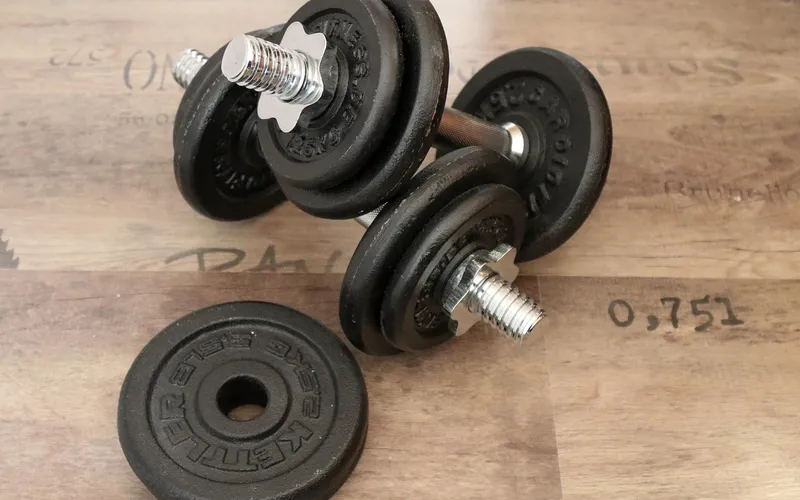
A rep is one lift; a set is a group of reps done without stopping. Most beginners do well with 2 to 3 sets of 8 to 12 reps per exercise. Over a week, about 10 sets per muscle group is a good target for muscle growth, but even a few sets a week gives a real result.
On this page
The words
A rep (repetition) is one complete lift: lowering the weight and lifting it again.
A set is a group of reps done in a row before you rest. "3 sets of 10" means ten reps, rest, ten reps, rest, ten reps.
Rest is the pause between sets, usually 1 to 3 minutes.
Volume is how much work you do. For planning, the most useful way to count it is hard sets per muscle group per week.
That last one is where most of the confusion lives, so the rest of this page is about counting it.
A worked example
Anna trains twice a week. Each session is the same:
| Exercise | Sets x reps | Main muscles |
|---|---|---|
| Leg press | 3 x 10 | Thighs, glutes |
| Dumbbell bench press | 3 x 10 | Chest, front of shoulders, triceps |
| Seated cable row | 3 x 10 | Upper back, biceps |
| Stiff-leg dumbbell deadlift | 2 x 10 | Hamstrings, glutes |
| Dumbbell shoulder press | 2 x 10 | Shoulders, triceps |
To count her weekly sets per muscle, add up the sets where that muscle is a main mover, then multiply by her two sessions.
- Thighs (front): leg press 3 sets. 3 x 2 sessions = 6 sets a week.
- Glutes: leg press 3 + deadlift 2 = 5. x 2 = 10 sets a week.
- Hamstrings: deadlift 2. x 2 = 4 sets a week.
- Chest: bench press 3. x 2 = 6 sets a week.
- Upper back: row 3. x 2 = 6 sets a week.
- Shoulders: bench 3 (partly) + shoulder press 2 = 5. x 2 = 10 sets a week, counting the bench generously.
So Anna does roughly 4 to 10 sets a week per muscle group, from 13 sets per session. That is a sound beginner's week.
If she wanted more for her hamstrings, she could add a third deadlift set (now 6 a week) or a seated leg curl for 2 sets (now 8 a week). If she added a third training day, every number would go up by half.
Counting this way is rough. You do not need to be exact about which muscle a bench press "really" works. The point is to see which muscles are getting almost nothing.
How many sets is enough
The ACSM's 2026 position stand gives two useful anchors. For muscle growth, around 10 sets per muscle group a week. For strength, heavier loads for 2 to 3 sets 1.
More sets do help, with a catch. A 2026 meta-regression of 67 studies found that more weekly sets per muscle gave more muscle and more strength on average, but each extra set added less than the one before 2. An older meta-analysis found the same graded pattern for muscle growth: higher weekly volumes gave more growth than lower ones 3.
Here is how that plays out for a beginner. Going from 0 to 4 sets a week is a big change. From 4 to 10 is a clear improvement. From 10 to 20 still helps a little, and it doubles the time you spend in the gym. Most people starting out are best served somewhere between 4 and 10, rising over the first few months.
How many reps per set
For most exercises, 8 to 12 reps is a practical range. It is heavy enough to build strength and light enough to practise good form. For the plank and other holds, count seconds instead.
Fewer reps (3 to 6) with heavier weight leans more towards strength, and the ACSM's strength recommendation uses loads around 80 percent of the most you could lift once 1. That is worth working towards on a few exercises once your form is steady. It is not where to start.
More reps (15 to 20) with lighter weight also builds muscle, as long as the set gets hard near the end. It suits exercises where heavy weight feels bad on the joints.
When a set counts
A set only counts as a "hard set" if it ends with a few reps left in the tank, not twenty. You do not need to go to failure. Sets stopped short of failure gave similar growth to sets taken all the way, when total work was similar 4. Two or three reps in reserve is the usual target. How heavy should you lift explains how to judge that.
Warm-up sets do not count. Neither does a set of 10 with a weight you could lift 30 times.
Rest between sets
Rest until your breathing has settled and you feel ready to do the next set as well as the last. For big exercises like the leg press, that is often 2 minutes. For smaller ones like a shoulder press, 60 to 90 seconds is usually enough. Short rests make the session quicker, and if your reps drop sharply on the next set, rest longer.
Putting it together
If you are starting from zero, begin with 2 sets of 10 per exercise, five or six exercises, twice a week. Count your weekly sets per muscle after a month. Add a set where a muscle is low. The full starting plan is in how to start strength training.
In Amble you log each set as you go, and the coach proposes changes to the plan, such as an extra set. You confirm before anything changes.
Questions
Does it matter if I do 8 reps or 15?
Less than people think, as long as the set is hard by the end. Heavier sets of fewer reps lean towards strength; lighter sets of more reps work too, they just take longer.
Do warm-up sets count?
No. Only count sets that end close to the point where you could not do many more reps.
Sources
- American College of Sports Medicine. Resistance Training Prescription for Muscle Function, Hypertrophy, and Physical Performance in Healthy Adults: An Overview of Reviews. Medicine and Science in Sports and Exercise, 2026. acsm.org/resistance-training-guidelines-update-2026
- Pelland JC, Remmert JF, Robinson ZP, Hinson SR, Zourdos MC. The Resistance Training Dose Response: Meta-Regressions Exploring the Effects of Weekly Volume and Frequency on Muscle Hypertrophy and Strength Gains. Sports Medicine, 2026;56(2):481-505. doi:10.1007/s40279-025-02344-w · PubMed
- Schoenfeld BJ, Ogborn D, Krieger JW. Dose-response relationship between weekly resistance training volume and increases in muscle mass: A systematic review and meta-analysis. Journal of Sports Sciences, 2017;35(11):1073-1082. doi:10.1080/02640414.2016.1210197 · PubMed
- Refalo MC, Helms ER, Trexler ET, Hamilton DL, Fyfe JJ. Influence of Resistance Training Proximity-to-Failure on Skeletal Muscle Hypertrophy: A Systematic Review with Meta-analysis. Sports Medicine, 2023;53(3):649-665. doi:10.1007/s40279-022-01784-y · PubMed