Suspension trainer push-up
The suspension trainer push-up is an intermediate compound exercise for the chest.
Your hands sit in straps, so the handles move and your trunk and shoulders work harder to keep you steady. It suits people who can already do regular push-ups.
- Main muscles
- Mid and lower chest
- Also works
- Triceps, Front shoulder, Abs
- Equipment
- Other kit
- Level
- Intermediate
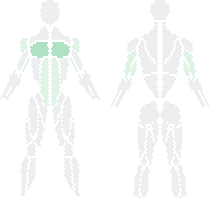
Muscles worked
The suspension trainer push-up mainly works the mid and lower chest. It also works the triceps, front shoulder and abs.
How to do it
- Grab the handles of the suspension trainer, walk your feet back into a plank and hold the handles at chest height.
- Keep your body in a straight line.
- Lower your chest between the handles.
- Keep your elbows at an angle of about 45 degrees.
- Press back up without letting the straps drift apart.
Where you should feel it: In the chest and shoulders, with your stomach working to keep you straight.
Coach's cues
- Hold the handles and walk the feet back into a plank
- Lower the chest between the handles with the body straight
- Press up without letting the straps drift apart
Try it: a working piece of Amble
Suspension trainer push-up
In your week
Pick your goal, days and time. The exercise lands where it belongs.
TueFull body A
- Goblet squat3 × 8–12
- Suspension trainer push-up3 × 8–12
- Single-arm dumbbell row3 × 8–12
- Stiff-leg dumbbell deadlift3 × 8–12
- Plank3 × 40 s
ThuFull body B
- Stiff-leg dumbbell deadlift3 × 8–12
- Single-arm dumbbell row3 × 8–12
- Suspension trainer push-up3 × 8–12
- Dumbbell split squat3 × 8–12
- Plank3 × 40 s
SatFull body A
- Goblet squat3 × 8–12
- Suspension trainer push-up3 × 8–12
- Single-arm dumbbell row3 × 8–12
- Stiff-leg dumbbell deadlift3 × 8–12
- Plank3 × 40 s
Each session: 5 exercises for 45 min
Common mistakes
How to start. 2 sets of 6 to 8 with your feet closer in, where it is easier.
Sets and reps by goal
- Getting started: 2 to 3 sets of 5 to 10 reps, stopping with 2 reps left.
- Muscle size: 3 to 4 sets of 8 to 20 reps close to your limit. When 20 feels easy, move to a harder version.
- Endurance: 2 to 3 sets of 20 or more reps.
Common starting ranges, not rules. Adjust to how the sets feel. Source: ACSM position stand on progression in resistance training (2009). Sets and reps explained.
Load on your joints
How Amble rates this movement when it plans around sore joints.
Instead of the suspension trainer push-up
The same main muscles with different kit or a lower difficulty.
Similar exercises
Common questions
What muscles does the suspension trainer push-up work?
The suspension trainer push-up mainly works the mid and lower chest. It also works the triceps, front shoulder and abs.
How many sets and reps of the suspension trainer push-up should I do?
Getting started: 2 to 3 sets of 5 to 10 reps, stopping with 2 reps left. Muscle size: 3 to 4 sets of 8 to 20 reps close to your limit. When 20 feels easy, move to a harder version. Endurance: 2 to 3 sets of 20 or more reps.
What can I do instead of the suspension trainer push-up?
Push-up, dumbbell bench press and machine decline chest press work the same main muscles.
What are the most common mistakes in the suspension trainer push-up?
Letting the hips sag. Squeeze your buttocks and tighten your stomach. Letting the straps spread out. Press them straight forward and keep control. Going too deep too soon. Lower only as far as you can control.