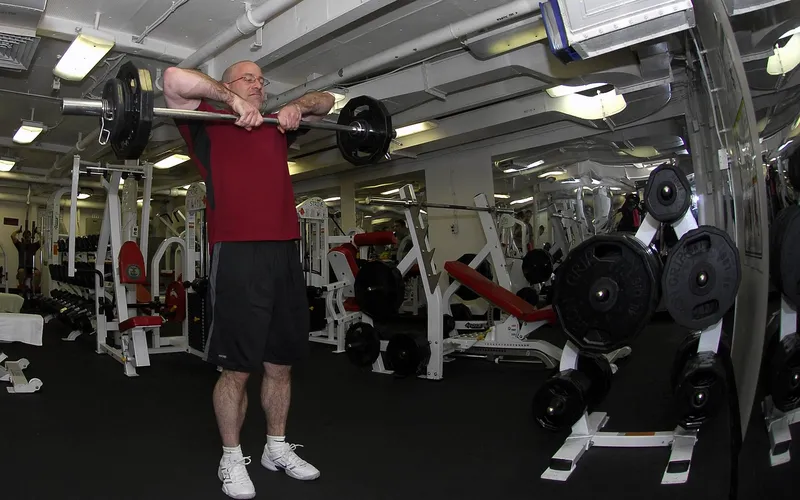
No. Resistance training is safe and effective for older adults, including frail people, and adults over 50 clearly gain strength from it. The biggest gain comes from going from no training to some, so starting late still brings the largest improvement you can make.
On this page
The short version of the evidence
Three findings matter most.
It works in older adults. A meta-analysis of resistance training in adults over 50 found that training clearly increased muscle strength, and higher-intensity training gave larger gains 1.
It is safe, even for frail people. The NSCA's position statement on older adults says resistance training is safe and effective, including for frail people, when it is supervised or well instructed and progressed gradually 2.
Starting is the biggest step. The ACSM's 2026 position stand, which pooled 137 systematic reviews, found that the biggest gain comes from going from no resistance training to any 3.
Put together: if you do no strength training today, you are standing in front of the largest improvement on offer. That is the opposite of too late.
What to expect in the first three months
Nobody can promise you a result, and people differ. But this is a common pattern for someone starting at 55 or 65 with two sessions a week.
Weeks 1 to 4: learning. The weights you lift go up quickly, sometimes every session. Most of that is your nervous system learning the movement, not new muscle. Getting out of a chair or up stairs may already feel a little easier. Some soreness in the first two weeks, then very little.
Weeks 5 to 8: real strength. Progress slows to a step of weight every week or two. Carrying things feels different. You may notice your posture when you catch yourself in a mirror. Clothes rarely change much yet.
Weeks 9 to 12: the habit settles. Training is part of the week rather than a project. Muscle is starting to grow, slowly. This is also the point where many people drop off, because the early fast gains have slowed. It is a good time to add a third session, or a third set to a few exercises.
Beyond three months, progress continues for years for most people, just more slowly.
Why it is worth doing anyway
Strength is only one reason. In a meta-analysis of 16 cohort studies, muscle-strengthening activity was linked to a 10 to 17 percent lower risk of dying from any cause, heart disease, cancer and diabetes, with the largest reduction at about 30 to 60 minutes a week 4. This is observational data, so it shows a link and does not prove that strength training caused the difference.
And there is the plain practical case. Getting up off the floor. Lifting a grandchild. Carrying your own suitcase. These are strength tasks, and strength responds to training at any age we have data for.
What makes it work at 60 and beyond
The same things as at 30, with more patience.
- Two or three sessions a week. The NSCA recommends 2 to 3, with 1 to 3 sets per exercise 2.
- A load that goes up over time. Not every session, but steadily. When you can do 12 good reps, make it harder.
- Some heavier work, eventually. Higher-intensity training gave larger gains in adults over 50 1. Build up to it over months.
- Power and balance. The NSCA includes both 2. Stand up briskly, sit down slowly. Practise standing on one leg.
- Enough protein. The PROT-AGE group recommends at least 1.0 to 1.2 g per kg a day for healthy adults over 65, together with exercise 5.
A first step this week
Do this twice this week, a couple of days apart:
- Stand up from a dining chair and sit down slowly, 10 times. Rest. Do it again.
- Push up against the kitchen counter, 10 times. Rest. Again.
- Hold the counter and rise up onto your toes, 15 times. Rest. Again.
If that went fine, you are ready for a full plan. Strength training after 60 has a sample week with balance work, and strength training after 40 has more on choosing exercises and adding weight.
If you are worried about keeping it up, read how to stick with training. It is written for people who have started and stopped before.
Questions
Will I build as much muscle as a younger person?
Probably a little less, and a little more slowly. But the research shows clear gains in strength for adults over 50 1, and that is what changes daily life.
I have never trained in my life. Does that matter?
It helps, if anything. People with no training history tend to make the fastest progress in the first months.
Sources
- Peterson MD, Rhea MR, Sen A, Gordon PM. Resistance exercise for muscular strength in older adults: A meta-analysis. Ageing Research Reviews, 2010;9(3):226-237. doi:10.1016/j.arr.2010.03.004 · PubMed
- Fragala MS, Cadore EL, Dorgo S, Izquierdo M, Kraemer WJ, Peterson MD et al.. Resistance Training for Older Adults: Position Statement From the National Strength and Conditioning Association. Journal of Strength and Conditioning Research, 2019;33(8):2019-2052. doi:10.1519/JSC.0000000000003230 · PubMed
- American College of Sports Medicine. Resistance Training Prescription for Muscle Function, Hypertrophy, and Physical Performance in Healthy Adults: An Overview of Reviews. Medicine and Science in Sports and Exercise, 2026. acsm.org/resistance-training-guidelines-update-2026
- Momma H, Kawakami R, Honda T, Sawada SS. Muscle-strengthening activities are associated with lower risk and mortality in major non-communicable diseases: a systematic review and meta-analysis of cohort studies. British Journal of Sports Medicine, 2022;56(13):755-763. doi:10.1136/bjsports-2021-105061 · PubMed
- Bauer J, Biolo G, Cederholm T, Cesari M, Cruz-Jentoft AJ, Morley JE et al.. Evidence-Based Recommendations for Optimal Dietary Protein Intake in Older People: A Position Paper From the PROT-AGE Study Group. Journal of the American Medical Directors Association, 2013;14(8):542-559. doi:10.1016/j.jamda.2013.05.021 · PubMed