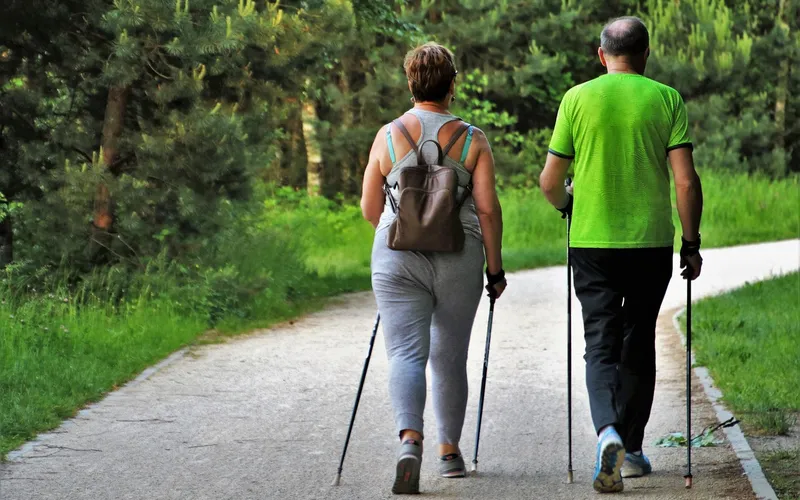
Strength training is safe and effective after 60, including for frail people, when it is well instructed and built up gradually. Aim for two or three sessions a week of 1 to 3 sets per exercise, add balance work, and keep moving on the other days.
On this page
A sample week
Here is what a realistic week looks like for someone starting at 65. Two strength sessions, some balance work, walking on most days.
| Day | What to do | Time |
|---|---|---|
| Monday | Strength session | 35 to 40 minutes |
| Tuesday | Walk, plus 5 minutes of balance practice | 30 minutes |
| Wednesday | Walk or rest | |
| Thursday | Strength session | 35 to 40 minutes |
| Friday | Walk, plus 5 minutes of balance practice | 30 minutes |
| Saturday | Something you enjoy: garden, swim, dance, longer walk | |
| Sunday | Rest or easy walk |
The strength session (same both days to begin with):
- Chair squat: sit down slowly, stand up. 2 sets of 8 to 10. Use your hands on your knees at first if you need to.
- Incline push-up against a kitchen counter or wall: 2 sets of 8 to 10.
- Seated cable row, or a row with a band: 2 sets of 10.
- Dumbbell step-up onto the bottom stair, holding the banister, no dumbbells at first: 2 sets of 6 per leg.
- Glute bridge on a bed or the floor: 2 sets of 10.
- Calf raises holding a counter, or the standing calf raise machine at the gym: 2 sets of 12.
Balance practice (5 minutes, near a counter you can hold):
- Stand on one leg for 10 to 20 seconds, each side, three times.
- Walk heel to toe along a hallway, ten steps, three times.
- Stand up from a chair without using your hands, five times.
Why it is worth it
The NSCA's position statement on older adults is clear: resistance training is safe and effective, including for frail people, when it is supervised or well instructed and progressed gradually 1. A meta-analysis of adults over 50 found that resistance training clearly increased strength, and harder training gave larger gains 2.
The guidelines for this age group add balance. The WHO asks older adults for varied activity that trains balance and strength on three or more days a week, on top of muscle-strengthening on two or more days 3. The NHS advice for adults 65 and over says the same in simpler words: be active every day, and do activities that improve strength, balance and flexibility on at least two days a week 4.
The week above does exactly that, in a little over two hours of planned activity.
How to progress
The NSCA recommends 2 to 3 sessions a week, 1 to 3 sets per exercise, at a load that goes up over time 1. "Over time" is the key phrase.
- Weeks 1 to 2: learn the movements. Every set should feel comfortable.
- Weeks 3 to 6: make the last few reps of each set feel like real effort. Add a third set to the exercises you like.
- After week 6: when you can do 12 good reps on every set, make it a little harder. Hold a light dumbbell for the chair squat. Move your hands lower for the push-up. Use the next step on the machine.
The NSCA also recommends power work for older adults 1. That simply means standing up from the chair briskly, then sitting down slowly. Speed on the way up, control on the way down.
Safety first
Some practical habits:
- Train near something sturdy to hold: a counter, a rail, a wall.
- Breathe out as you push or stand up. Do not hold your breath through the effort.
- Wear shoes with a firm, flat sole.
- Get up slowly from lying down, and sit for a moment before you stand.
- If you have a joint replacement, ask your surgeon or physiotherapist which movements to avoid.
A few sessions with a physiotherapist or a qualified trainer at the start is money well spent, particularly if you have a health condition.
Eat enough protein
Training gives the signal; protein provides the material. The PROT-AGE group recommends that healthy adults over 65 eat at least 1.0 to 1.2 g of protein per kg of body weight a day, and 1.2 to 1.5 g/kg for those with acute or chronic illness, together with exercise 5.
For a 70 kg person, 1.2 g/kg is 84 g a day. That is about 25 to 30 g at each main meal: two eggs and a glass of milk at breakfast, a fish fillet at lunch, a portion of chicken or lentils at dinner. Many older adults eat a small breakfast and lunch and most of their protein at dinner, so the first two meals are the easiest place to add. The protein calculator gives a number for your weight, and protein after 50 has more food ideas.
Keep walking
Walking supports everything else. In a meta-analysis of 15 cohorts, more daily steps were linked to lower risk of death, and for adults 60 and older the benefit levelled off at about 6,000 to 8,000 steps a day 6. If you walk 3,000 today, aim for 4,000 for a few weeks, then 5,000. The walking guide has more.
If you worry it is too late
It is not. Read is it too late to build muscle for what the research says about starting at 60, 70 and beyond. For more detail on exercise choice and progression, strength training after 40 covers the same ground for a slightly younger group.
Amble shows a video for most exercises and lets you adjust the plan to the equipment you have at home or at the gym. It can also read your step count from Apple Health, with your permission.
Questions
I have osteoporosis. Can I lift weights?
Many people with low bone density do strength training, but the right exercises depend on your situation. Ask your doctor or a physiotherapist before you start.
How many steps a day should I aim for?
For adults 60 and older, the link between more steps and lower risk of death levelled off at about 6,000 to 8,000 a day 6.
Sources
- Fragala MS, Cadore EL, Dorgo S, Izquierdo M, Kraemer WJ, Peterson MD et al.. Resistance Training for Older Adults: Position Statement From the National Strength and Conditioning Association. Journal of Strength and Conditioning Research, 2019;33(8):2019-2052. doi:10.1519/JSC.0000000000003230 · PubMed
- Peterson MD, Rhea MR, Sen A, Gordon PM. Resistance exercise for muscular strength in older adults: A meta-analysis. Ageing Research Reviews, 2010;9(3):226-237. doi:10.1016/j.arr.2010.03.004 · PubMed
- Bull FC, Al-Ansari SS, Biddle S, Borodulin K, Buman MP, Cardon G et al.. World Health Organization 2020 guidelines on physical activity and sedentary behaviour. British Journal of Sports Medicine, 2020;54(24):1451-1462. doi:10.1136/bjsports-2020-102955 · PubMed
- NHS. Physical activity guidelines for older adults. Accessed 23 October 2026.
- Bauer J, Biolo G, Cederholm T, Cesari M, Cruz-Jentoft AJ, Morley JE et al.. Evidence-Based Recommendations for Optimal Dietary Protein Intake in Older People: A Position Paper From the PROT-AGE Study Group. Journal of the American Medical Directors Association, 2013;14(8):542-559. doi:10.1016/j.jamda.2013.05.021 · PubMed
- Paluch AE, Bajpai S, Bassett DR, Carnethon MR, Ekelund U, Evenson KR et al.. Daily steps and all-cause mortality: a meta-analysis of 15 international cohorts. The Lancet Public Health, 2022;7(3):e219-e228. doi:10.1016/S2468-2667(21)00302-9 · PubMed