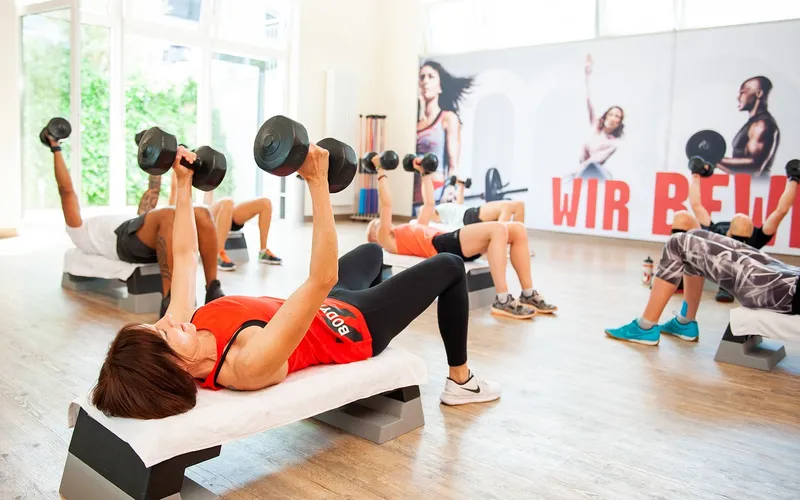
Start with two full-body sessions a week of five or six exercises, two sets each, at a weight you could lift three or four more times. Add a little weight or a rep or two each week. Going from no strength training to some is where the largest gain is, so the first month matters more than the perfect program.
On this page
The first four weeks
Here is the whole plan before the explanation. Two sessions a week, at least one rest day between them. Each session is the same six exercises. It takes about 40 minutes including a short warm-up.
| Exercise | Gym version | Home version |
|---|---|---|
| Squat | Leg press | Goblet squat |
| Push | Dumbbell bench press | Incline push-up |
| Pull | Seated cable row | One-arm dumbbell row |
| Hinge | Stiff-leg dumbbell deadlift | Glute bridge |
| Press overhead | Dumbbell shoulder press | Same, with light dumbbells |
| Trunk | Plank | Same |
How the four weeks move:
- Week 1. Two sets of 10 on each exercise. Pick a weight that feels like you could do 4 or 5 more reps. The plank is two holds of 20 seconds. This week is for learning the movements, so it should feel too easy.
- Week 2. Same weights. Aim for two sets of 12. If 12 comes easily on both sets, note it down.
- Week 3. Where you hit 12 on both sets, go up one step in weight (the next dumbbell, the next pin on the machine) and go back to 10 reps. Add a third set to the squat, push and pull.
- Week 4. Same pattern. Work from 10 towards 12 at the new weight. Planks to 30 seconds.
Rest about 90 seconds between sets, longer if you need it. Breathing should be back to normal before the next set.
At the end of four weeks you will have done eight sessions, learned six movements, and lifted more on most of them than you did on day one. That is the goal of the first month. It is a modest one on purpose.
Why two days, full body
The ACSM's 2026 position stand, which pooled 137 systematic reviews, says to train all major muscle groups at least twice a week 1. The WHO guideline says the same for adults: muscle-strengthening activity for all major muscle groups on two or more days 2. A full-body session twice a week hits both marks with the fewest days in the gym.
The same ACSM review found that the biggest gain comes from going from no resistance training to any 1. That should take some pressure off. You do not need the best split, the best exercises or the best app. You need to show up twice a week for long enough that it becomes ordinary.
There is also a longer view. In a meta-analysis of 16 cohort studies, people who did muscle-strengthening activity had a 10 to 17 percent lower risk of dying from any cause, heart disease, cancer and diabetes, and the largest drop was at about 30 to 60 minutes a week 3. That is observational data, so it shows a link and does not prove that lifting caused it. Still, two 30-minute sessions sit right in that range.
If you want three days later on, read how many days a week to lift.
How heavy to start
The single most common mistake is starting too heavy. The second is staying too light for months.
For each exercise, pick a weight you can lift 10 times with good form and feel like you could have done 3 or 4 more. That gap is called reps in reserve. You do not need to go to failure: in a meta-analysis, sets stopped short of failure gave similar muscle growth to sets taken all the way, when the total work was similar 4.
A quick way to find the weight on day one:
- Do a set of 10 with something clearly light.
- If the last rep felt the same as the first, go up a step and do another 10.
- Stop going up when rep 10 feels like work but your form has not changed.
- That is your starting weight. Write it down.
More detail, with a worked example, is in how heavy should you lift.
How much is enough
Two sets per exercise twice a week gives each muscle group roughly four to six hard sets a week, depending on how the exercises overlap. That is a low number, and it is meant to be.
A 2026 meta-regression of 67 studies found that more weekly sets gave more muscle and more strength on average, but each extra set added less than the one before 5. The first few sets do most of the work. For a beginner, the jump from zero to a handful of sets a week is large, and the step from there to 15 or 20 sets is small by comparison. The ACSM puts around 10 sets per muscle group a week as a good target for muscle growth 1, and that is a fine place to be by month three, not in week one.
Sets and reps explained walks through how to count this.
What the first week will feel like
You will probably be sore. Delayed onset muscle soreness comes after unfamiliar exercise, especially the lowering part of a movement. It usually peaks 24 to 72 hours after the session and fades within 5 to 7 days 6. It is a sign that the exercise was new, not a sign that it was good.
That is one reason week 1 is light. Most people find that the second session is less sore than the first, and by week 3 soreness has mostly gone even though they are lifting more. If it does not, read muscle soreness after training.
A session from start to finish
Here is what one session looks like in practice, so you are not guessing.
Warm-up, 5 minutes. Walk briskly, use a bike, or march on the spot until you are a little warm. Then one light set of the first exercise. There is more on this in warming up before strength training.
Main work, 30 minutes. Do the six exercises in order. Two sets each in weeks 1 and 2. Rest about 90 seconds between sets. Use the rest to write down the weight and the reps.
Finish, 2 minutes. Write one line about how it went: which exercise felt too easy, which felt awkward. That note decides what you change next time.
Order matters a little. Put the exercise that uses the most muscle first (the squat or leg press), while you are fresh, and the plank last.
Gym or home
Both work. The ACSM review found that bands, bodyweight and home training give marked benefits, and that machines versus free weights did not consistently change outcomes for average healthy adults 1. Pick the place you are most likely to keep going to.
A gym gives you machines, which are easy to learn and easy to load in small steps. Home saves the trip, and a pair of adjustable dumbbells and a sturdy chair cover most of the plan above. Home strength training has full home sessions. There is a full comparison in gym or home, and if the gym makes you nervous, your first time at the gym explains what to expect.
How to make progress after week 4
Keep the same rule: when you reach the top of the rep range on every set, add a small step of weight and drop back to the bottom of the range. For most exercises that range is 8 to 12. A step is the smallest jump available, often 1 to 2.5 kg.
Some weeks you will not hit the top of the range. That is normal. Repeat the weight. Progress over a month matters more than progress every session.
Around week 6 to 8, most people are ready for one of these changes:
- A third set on the exercises you like.
- A third training day.
- Swapping one exercise for a harder version, such as the goblet squat for a split squat with dumbbells.
Change one thing at a time so you can tell what worked.
When it gets hard to keep going
Most people stop because of time, travel, illness or a bad week, not because the training stopped working. The ACSM stand says programmes should be built around goals, enjoyment and safety so people stick with them 1. That is permission to drop an exercise you hate and do one you like.
If you miss a week, start again at the weights you last used, or one step lighter. You have not lost your progress. How to stick with training has more on building a routine that survives real life.
If you are over 40
Everything above applies. The main differences are that recovery can take a little longer and joints may need a gentler start, so the light first week matters more. The guide to strength training after 40 covers the adjustments.
Where Amble fits
Amble plans your training week around the days you have and shows a video for most exercises. Next week's weights are worked out from what you logged: when every set reaches the top of the rep range, the weight goes up a small step. If your week changes, the coach suggests a change to the plan and you confirm it. You can follow the plan on this page just as well with a notebook. If you want a first week built for you, try the planning tool.
Questions
How long before I see results from strength training?
Most beginners notice that the same weights feel easier within two or three weeks, mostly because you get better at the movements. Visible change in muscle takes longer, usually a few months of steady training.
Do I need to train to failure?
No. Stopping a set with a couple of reps left gave similar muscle growth to going to failure when the total amount of work was similar 4.
Should I do cardio as well?
Yes, if you can. The WHO suggests 150 to 300 minutes of moderate activity a week on top of strength work on two or more days 2. Brisk walking counts.
Sources
- American College of Sports Medicine. Resistance Training Prescription for Muscle Function, Hypertrophy, and Physical Performance in Healthy Adults: An Overview of Reviews. Medicine and Science in Sports and Exercise, 2026. acsm.org/resistance-training-guidelines-update-2026
- Bull FC, Al-Ansari SS, Biddle S, Borodulin K, Buman MP, Cardon G et al.. World Health Organization 2020 guidelines on physical activity and sedentary behaviour. British Journal of Sports Medicine, 2020;54(24):1451-1462. doi:10.1136/bjsports-2020-102955 · PubMed
- Momma H, Kawakami R, Honda T, Sawada SS. Muscle-strengthening activities are associated with lower risk and mortality in major non-communicable diseases: a systematic review and meta-analysis of cohort studies. British Journal of Sports Medicine, 2022;56(13):755-763. doi:10.1136/bjsports-2021-105061 · PubMed
- Refalo MC, Helms ER, Trexler ET, Hamilton DL, Fyfe JJ. Influence of Resistance Training Proximity-to-Failure on Skeletal Muscle Hypertrophy: A Systematic Review with Meta-analysis. Sports Medicine, 2023;53(3):649-665. doi:10.1007/s40279-022-01784-y · PubMed
- Pelland JC, Remmert JF, Robinson ZP, Hinson SR, Zourdos MC. The Resistance Training Dose Response: Meta-Regressions Exploring the Effects of Weekly Volume and Frequency on Muscle Hypertrophy and Strength Gains. Sports Medicine, 2026;56(2):481-505. doi:10.1007/s40279-025-02344-w · PubMed
- Cheung K, Hume PA, Maxwell L. Delayed Onset Muscle Soreness. Sports Medicine, 2003;33(2):145-164. doi:10.2165/00007256-200333020-00005 · PubMed