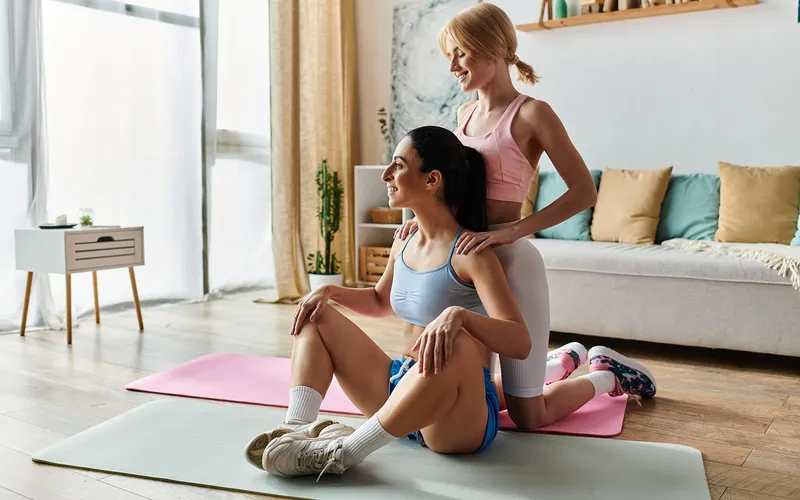
Yes, you can get properly stronger at home. Train every major muscle group at least twice a week, do 2 or 3 sets per exercise, and add a little weight, resistance or reps when the last reps start to feel easier. Dumbbells, bands and bodyweight all work; the best kit is the one you will keep using.
On this page
Why home is a fair place to start
The single biggest gain in strength training comes from going from nothing to something. That is the headline of the American College of Sports Medicine's 2026 review, which pooled 137 systematic reviews: the jump from no resistance training to any resistance training beats every refinement that comes after it 1. The same review found that bands, bodyweight and home training give marked benefits, and that machines versus free weights did not consistently change outcomes for average healthy adults 1.
So the living room is not a second-best gym. For someone who has not trained in years, it often beats the gym, because there is no travel, no audience and no excuse about opening hours. Ten minutes after you decide to train, you are training. If you are still deciding, gym or home weighs up the two.
What home training does ask is a bit more planning. A gym has a rack of weights that go up in small steps. At home you have to make progress with what you own, and that is most of what this guide is about.
Choose your kit
You do not need all three. Pick one to start, and add another later if it helps.
| Kit | Cost and space | Good at | Harder with |
|---|---|---|---|
| Bodyweight | Free, a mat's worth of floor | Legs, chest, core, learning movements | Back and pulling, adding load once you get strong |
| Resistance bands | Cheap, fits in a drawer | Upper back, shoulders, hips, travel | Very heavy leg work, measuring progress precisely |
| Dumbbells | More money, a corner of a room | Everything, clear progress in kilos | Cost if you buy many pairs |
If you can afford it, a pair of adjustable dumbbells covers the most ground. If you cannot, a set of three bands plus your own body is a complete starting kit. A sturdy chair and a step or low stair are useful whatever you choose.
How often, how many sets, how hard
The guidance is simpler than most programmes make it look.
Twice a week, every major muscle group. That is the floor the ACSM sets for healthy adults 1. For older adults, the National Strength and Conditioning Association recommends 2 to 3 sessions a week, 1 to 3 sets per exercise, with the load built up over time 2. Two full-body sessions on non-consecutive days, say Monday and Thursday, cover it.
About 10 sets per muscle group a week, eventually. For muscle growth the ACSM points to around 10 weekly sets per muscle group 1. More sets give more on average, but each extra set adds less than the one before 3. A beginner does not need to start there. Two or three sets of one exercise per muscle group, twice a week, is 4 to 6 weekly sets, which is plenty for the first couple of months.
Stop a few reps short of failure. Training until you cannot do one more rep is not needed for muscle growth; sets stopped short gave similar growth when the total amount of work was similar 4. A good working rule: finish each set feeling you could have done 2 or 3 more clean reps. This keeps form tidy and makes the next session easier to face.
Reps. Anywhere from about 8 to 15 per set works well at home. If you can do more than 20 easily, the exercise is too light and it is time to make it harder. Sets and reps, explained goes further into the numbers.
The movements to cover
Rather than thinking in muscles, think in five movement patterns. Cover each one in a week and nothing big is left out.
- Squat. Sitting down and standing up. Chair squat, dumbbell squat or banded squat.
- Hinge. Bending at the hips with a flat back, the way you pick something off the floor. Stiff-leg dumbbell deadlift or a glute bridge.
- Push. Pushing away from you or overhead. Incline push-up against a kitchen counter is the friendliest start.
- Pull. Rowing toward you. Single-arm dumbbell row or a band pull-apart. This is the pattern bodyweight training covers worst, so it is the best reason to own a band or a dumbbell.
- Carry and brace. Holding your trunk steady. A dead bug on the floor, or carrying heavy shopping bags with good posture.
Making progress without a gym full of weights
Progress is the whole point. If the sessions feel the same in week eight as in week one, your body has no reason to change. At home you have several dials to turn, roughly in this order:
- More reps. Work from 8 up to 12 or 15 at the same difficulty.
- More sets. Go from 2 sets to 3.
- Slower lowering. Take three seconds to lower each rep. Same weight, harder set.
- A harder version. Counter push-up to a lower surface, then to the floor. Chair squat to a squat with no chair.
- More load. Heavier dumbbells, a stronger band, or a dumbbell held in a squat that used to be bodyweight only.
- One side at a time. A split squat loads each leg with far more of your body weight than a squat does.
A simple rule that works for most people: when you hit the top of your rep range on every set, with 2 or 3 reps in reserve, make it a little harder next time. Then build the reps back up.
A starting week
Two full-body sessions, about 30 to 40 minutes each including a short warm-up. Do the same session both days for the first month; consistency beats variety at this stage.
| Pattern | Exercise | Sets x reps |
|---|---|---|
| Squat | Chair squat or dumbbell squat | 2 x 10 |
| Push | Incline push-up | 2 x 8 to 12 |
| Hinge | Glute bridge or stiff-leg dumbbell deadlift | 2 x 10 |
| Pull | Single-arm dumbbell row or band pull-apart | 2 x 10 to 15 |
| Brace | Dead bug | 2 x 6 per side |
Rest about a minute between sets, longer if you need it. For full sessions built around one kind of kit, see the dumbbell workout, the bodyweight workout for beginners and the resistance band workout.
On the other days, walk. The two fit together well, and walking and strength training shows how to lay out the week.
Soreness, space and safety
Expect some stiffness a day or two after the first sessions. Delayed soreness follows unfamiliar exercise, especially the lowering part of a movement, usually peaks 24 to 72 hours later and fades within 5 to 7 days 5. It is not a sign of damage and it is not a sign the workout was good. It gets much milder once the movements are familiar. More on this in muscle soreness after training.
Some practical points that save trouble at home:
- Clear the floor. Most home training injuries are trips, not lifts.
- Check the anchor point before you trust a band to a door.
- Use a chair you would happily stand on, against a wall so it cannot slide.
- Keep dumbbells on the floor between sets, not on a sofa arm.
Sticking with it
The ACSM's review ends on a point that is easy to skip: programmes should suit the person's goals, enjoyment and safety, because that is what keeps people going 1. A plan you like at 70 percent effort beats a perfect plan you drop in week three.
Put the two sessions in your calendar like appointments. Keep a simple log of what you did, even on paper, so you can see the numbers rise. If you would rather have the plan written for you, Amble builds a week of training around the kit you own and adjusts it as your logged sessions show progress; the coach suggests changes and you decide whether to take them.
Questions
Is home training as good as going to a gym?
For most adults, yes. The largest review of the evidence found that bands, bodyweight and home training give marked benefits, and that machines versus free weights did not consistently change results for average healthy adults 1.
How heavy should my dumbbells be?
Heavy enough that the last two or three reps of a set of 10 feel hard but tidy. Many people start with a light pair for the upper body and a heavier one for the legs.
I'm over 65. Is this safe for me?
Resistance training is considered safe and effective for older adults, including frail people, when it is well instructed and built up gradually 2. If you have a heart condition, recent surgery or a joint that is being treated, check with your doctor or physiotherapist first.
Sources
- American College of Sports Medicine. Resistance Training Prescription for Muscle Function, Hypertrophy, and Physical Performance in Healthy Adults: An Overview of Reviews. Medicine and Science in Sports and Exercise, 2026. acsm.org/resistance-training-guidelines-update-2026
- Fragala MS, Cadore EL, Dorgo S, Izquierdo M, Kraemer WJ, Peterson MD et al.. Resistance Training for Older Adults: Position Statement From the National Strength and Conditioning Association. Journal of Strength and Conditioning Research, 2019;33(8):2019-2052. doi:10.1519/JSC.0000000000003230 · PubMed
- Pelland JC, Remmert JF, Robinson ZP, Hinson SR, Zourdos MC. The Resistance Training Dose Response: Meta-Regressions Exploring the Effects of Weekly Volume and Frequency on Muscle Hypertrophy and Strength Gains. Sports Medicine, 2026;56(2):481-505. doi:10.1007/s40279-025-02344-w · PubMed
- Refalo MC, Helms ER, Trexler ET, Hamilton DL, Fyfe JJ. Influence of Resistance Training Proximity-to-Failure on Skeletal Muscle Hypertrophy: A Systematic Review with Meta-analysis. Sports Medicine, 2023;53(3):649-665. doi:10.1007/s40279-022-01784-y · PubMed
- Cheung K, Hume PA, Maxwell L. Delayed Onset Muscle Soreness. Sports Medicine, 2003;33(2):145-164. doi:10.2165/00007256-200333020-00005 · PubMed