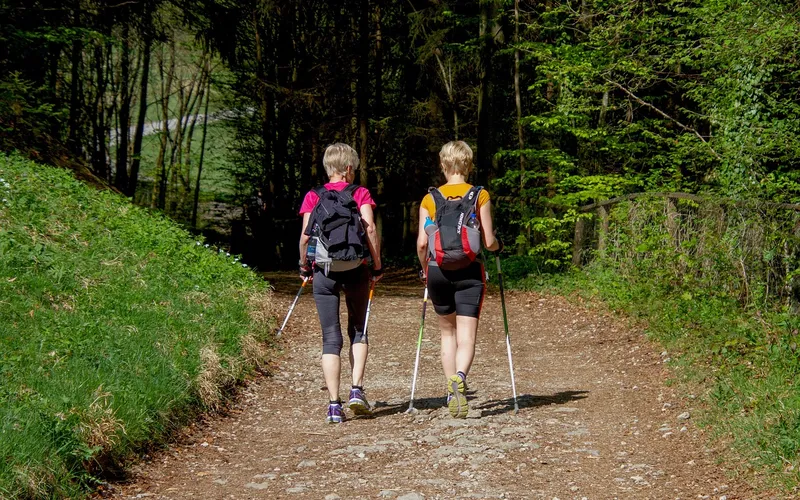
Do two strength sessions a week on non-consecutive days and walk on most days, including the strength days if you like. On a day with both, lift first if strength is the priority, or walk first as a warm-up. In practice, a daily walk rarely gets in the way of getting stronger.
On this page
Why you want both
Walking and strength training do different jobs, and the guidelines ask for both. The WHO recommends 150 to 300 minutes a week of moderate aerobic activity, plus muscle-strengthening activity for all major muscle groups on 2 or more days a week 1. Walking is the easiest way to meet the first part. It does very little for the second.
Strength training is the reverse. It builds muscle and strength, and the biggest gain comes from going from no resistance training to any 2. It does not give you the 150 minutes.
So the question is not which one. It is how to lay out the week so both happen without wearing you out.
The basic shape
- Strength: two sessions, with at least one rest day between. Monday and Thursday, or Tuesday and Friday.
- Walking: most days, in whatever chunks fit. Daily step counts linked to the largest benefit levelled off at about 6,000 to 8,000 for adults 60 and older and 8,000 to 10,000 for younger adults 3.
- One easier day: a short walk only, or full rest.
Walking on strength days is fine. A gentle walk the day after a strength session often eases stiffness more than sitting still does.
Three sample weeks
The busy week. Two 30-minute strength sessions at home and walks fitted around work.
| Day | Plan |
|---|---|
| Mon | Strength, 30 min. 10-minute walk at lunch |
| Tue | Walk 30 min |
| Wed | Walk 20 min |
| Thu | Strength, 30 min. 10-minute walk at lunch |
| Fri | Walk 30 min |
| Sat | Longer walk, 45 to 60 min |
| Sun | Rest or a short stroll |
The early riser. Walk first thing, lift in the evening on two days.
| Day | Morning | Evening |
|---|---|---|
| Mon | Walk 20 min | Strength |
| Tue | Walk 30 min | |
| Wed | Walk 20 min | |
| Thu | Walk 20 min | Strength |
| Fri | Walk 30 min | |
| Sat | Walk 45 min | |
| Sun | Rest |
The one-trip week. For people who go to a gym or class and want to combine things: walk to the session, train, walk home. If the gym is 15 minutes away, that is 30 minutes of walking on each strength day without planning anything else.
Same day: which first?
It depends on what you care about most that day.
- Lift first if getting stronger is the main goal. You start the strength work fresh and the walk afterwards cools you down.
- Walk first if you like a gentle warm-up. Ten minutes of easy walking before a home session is a good way to start. Keep it relaxed, not a fast hour.
- Split them across the day if you can. Strength in the morning, walk in the evening, or the other way round.
For normal amounts of walking, the order matters much less than doing both. People sometimes worry that cardio cancels out strength training. That worry is about large amounts of hard endurance training. A daily walk is a different thing, and in practice it rarely gets in the way.
When to ease off
Watch for signs that the week is too full: legs that feel heavy for days, poor sleep, sessions where the weights feel much heavier than usual. That is a reason to make one walk shorter or move a strength session a day later. It is not a reason to stop. Sleep and training has more on how to adjust when you are tired.
New walkers sometimes jump straight to an hour a day. Build up by about 10 minutes at a time instead, as described in how many steps a day you need. Your feet and shins adapt more slowly than your heart and lungs.
If you have one hour a week
Use it for two 30-minute strength sessions and walk in the gaps of ordinary life: stairs, an earlier bus stop, a call taken on foot. Strength training is harder to fit in by accident. Walking can be.
The details of the strength part are in strength training at home. Amble plans both into the same week, so a long walk on Saturday and a strength session on Monday are part of one plan rather than two separate apps.
Sources
- Bull FC, Al-Ansari SS, Biddle S, Borodulin K, Buman MP, Cardon G et al.. World Health Organization 2020 guidelines on physical activity and sedentary behaviour. British Journal of Sports Medicine, 2020;54(24):1451-1462. doi:10.1136/bjsports-2020-102955 · PubMed
- American College of Sports Medicine. Resistance Training Prescription for Muscle Function, Hypertrophy, and Physical Performance in Healthy Adults: An Overview of Reviews. Medicine and Science in Sports and Exercise, 2026. acsm.org/resistance-training-guidelines-update-2026
- Paluch AE, Bajpai S, Bassett DR, Carnethon MR, Ekelund U, Evenson KR et al.. Daily steps and all-cause mortality: a meta-analysis of 15 international cohorts. The Lancet Public Health, 2022;7(3):e219-e228. doi:10.1016/S2468-2667(21)00302-9 · PubMed