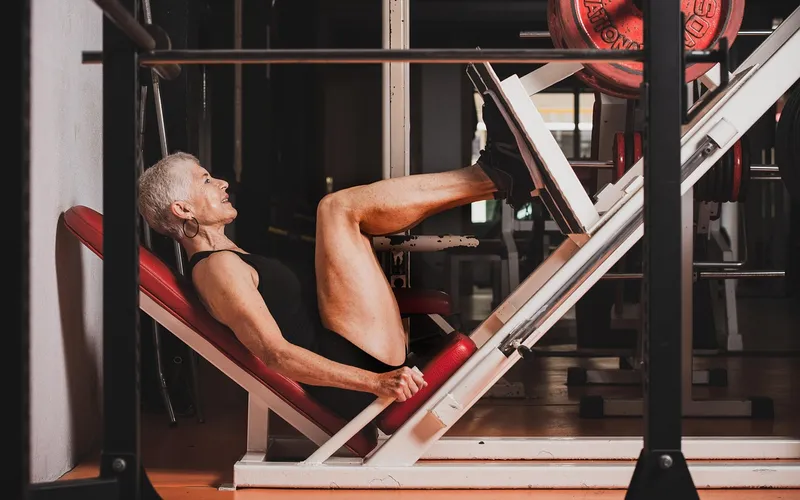
Strength training is worth discussing with your doctor if you have osteoporosis or low bone density. In one trial, supervised high-intensity lifting and impact training improved bone density at the spine and hip in postmenopausal women. Start with a physiotherapist or supervised programme, and add balance work.
On this page
What the LIFTMOR trial found
Many people with osteoporosis are told to be careful, and end up doing very little. The LIFTMOR trial tested something quite different.
It included 101 postmenopausal women with low bone mass. The training group did 8 months of supervised high-intensity resistance and impact training, twice a week. The comparison group did a low-intensity programme at home. The high-intensity group improved bone density at the spine and hip compared with the home group, and there were no serious training injuries 1.
We cover the trial in more detail in can lifting heavy help bones?
That is encouraging. It suggests that, for the right person, real loading can help bones more than gentle exercise.
What it did not show
Two details matter before you load a barbell.
It was supervised. The high-intensity training in LIFTMOR was supervised. Participants did not learn heavy lifts from a video and try them alone. The lack of serious injuries was found in that setting, and we cannot assume it carries over to training alone.
It was one group of people. Postmenopausal women with low bone mass. It does not tell us what is safe for every person with osteoporosis, such as someone who has already had a fracture of the spine.
So the honest reading is: heavier training may help bones, under supervision, for people who have been assessed. It is not a reason to start heavy lifting on your own.
How to start
1. Talk to your doctor. Ask about your fracture risk, whether you have had any fractures of the spine, and whether there are movements you should avoid. Keep taking any bone medicine as prescribed.
2. Find supervision if you can. A physiotherapist, a supervised bone-health class, or a trainer with experience of osteoporosis. The NSCA position statement on older adults found strength training safe and effective when it is supervised or well instructed and progressed gradually 2.
3. Begin with the basics. Learn the movements with light weights first. A simple starting set to take to your physiotherapist:
- Chair squat or leg press: 2 sets of 10
- Glute bridge: 2 sets of 12
- Machine row, chest against the pad: 2 sets of 12
- Calf raise, holding something for balance: 2 sets of 15
- Side-lying leg raise: 2 sets of 12 per side
4. Progress the load. With your physiotherapist or trainer, add weight over weeks and months. The NSCA recommends training 2 to 3 times a week, 1 to 3 sets per exercise, with the load progressed over time 2. Lifts like the trap bar deadlift can come later, if your team agrees and you are coached in them.
Do not skip balance
With fragile bones, a fall is what most people worry about, and with good reason. Balance training is the practical answer: the aim is to feel steadier on stairs, on uneven ground and when you turn quickly.
The WHO guidelines recommend that older adults do varied activity that trains balance and strength on 3 or more days a week 3, and the NSCA statement includes balance and power work in its recommendations 2. Simple ways to start, next to a counter or sturdy chair:
- Stand on one leg for 10 to 20 seconds, then switch.
- Walk heel to toe along a line.
- Stand up from a chair without using your hands, and sit down slowly.
Make it harder by holding on less, not by taking risks.
What to ask your physiotherapist
- Which movements are safe for my spine, and which should I change?
- How heavy can I go, and how quickly should I build up?
- Is impact work, like small jumps or heel drops, suitable for me?
- Is there a supervised group or class near me?
For more on starting with any long-term condition, see training with a health condition.
Questions
Is walking enough for my bones?
Walking is good for you in many ways and worth keeping. The trial described on this page used resistance and impact training, which is a bigger stimulus. Ask your doctor or physiotherapist what mix suits your bones.
Should I avoid bending forward?
Some people with osteoporosis of the spine are advised to avoid lifting with a rounded back or twisting under load. Whether that applies to you depends on your bones and history, so ask your doctor or physiotherapist.
Sources
- Watson SL, Weeks BK, Weis LJ, Harding AT, Horan SA, Beck BR. High-Intensity Resistance and Impact Training Improves Bone Mineral Density and Physical Function in Postmenopausal Women With Osteopenia and Osteoporosis: The LIFTMOR Randomized Controlled Trial. Journal of Bone and Mineral Research, 2018;33(2):211-220. doi:10.1002/jbmr.3284 · PubMed
- Fragala MS, Cadore EL, Dorgo S, Izquierdo M, Kraemer WJ, Peterson MD et al.. Resistance Training for Older Adults: Position Statement From the National Strength and Conditioning Association. Journal of Strength and Conditioning Research, 2019;33(8):2019-2052. doi:10.1519/JSC.0000000000003230 · PubMed
- Bull FC, Al-Ansari SS, Biddle S, Borodulin K, Buman MP, Cardon G et al.. World Health Organization 2020 guidelines on physical activity and sedentary behaviour. British Journal of Sports Medicine, 2020;54(24):1451-1462. doi:10.1136/bjsports-2020-102955 · PubMed