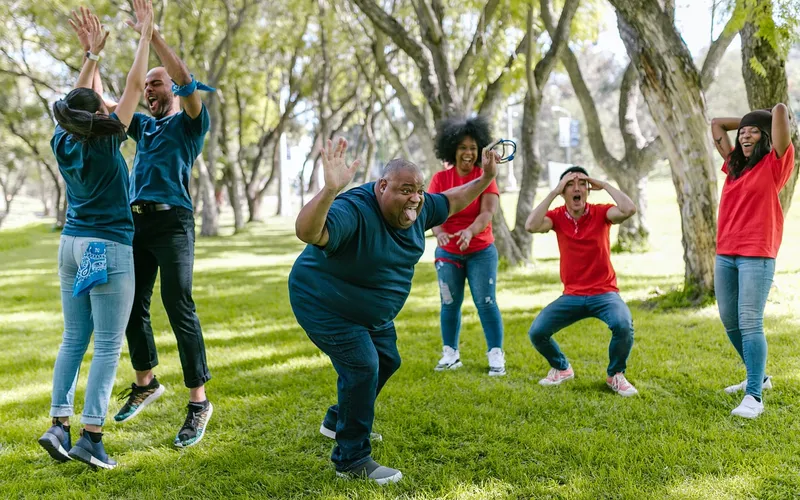
Most people with long-term conditions like high blood pressure, type 2 diabetes, osteoarthritis or osteoporosis can train, and many benefit. Talk to your doctor first, start lighter than you think you need, build up gradually, and learn the warning signs that mean stop.
On this page
Why this is worth the effort
If you live with a long-term condition, exercise can feel like one more thing that could go wrong. It is also, for many conditions, one of the things most likely to help.
The WHO guidelines recommend muscle-strengthening activity for all major muscle groups on 2 or more days a week, alongside 150 to 300 minutes of moderate aerobic activity, and stress that some activity is better than none 1.
A meta-analysis of 16 cohort studies found that people who did muscle-strengthening activity had a 10 to 17 percent lower risk of death from any cause, heart disease, cancer and diabetes, with the largest reduction at around 30 to 60 minutes a week 2. That is observational data: it shows a link, not proof that the training caused it. Still, it fits with what trials show for specific conditions, which we cover below. There is more on the study in is strength training linked to living longer?
Before your first session: talk to your doctor
Not to ask permission to live your life, but to get information you cannot get anywhere else. Take this list with you:
- Is there any type of exercise I should avoid, or any limit I should stay under?
- Do any of my medicines change how I should exercise, or what I should watch for?
- Are there symptoms that mean I should stop a session straight away?
- Should I check anything before or after training, like blood pressure or blood sugar?
- Would a physiotherapist, a supervised programme or a group class help me get started?
If your condition is stable and well managed, the answer will often be "go ahead, start gently". If it is not stable, or you have had a recent change, a new diagnosis or a hospital stay, the plan may need to be different for a while.
Four principles for any condition
Start low. Lower than feels necessary. One or two sets of 10 to 12 reps at a weight you could lift 4 or 5 more times. The first few weeks are about learning the movements and seeing how your body responds, not about the weight.
Build slowly. The NSCA position statement on older adults found strength training safe and effective, including for frail people, when it is supervised or well instructed and progressed gradually 3. "Gradually" is the important word. Add a little every week or two, not every session.
Keep it simple. Machines with a back pad, like a leg press, a machine row and a machine chest press, are easy to learn and easy to adjust. A chair squat works at home. The ACSM's 2026 review found that bands, bodyweight and home training give marked benefits, and that programmes should fit your goals, enjoyment and safety so you stick with them 4.
Breathe. Breathe out as you lift and in as you lower. Holding your breath while straining can raise blood pressure sharply for a moment, which matters for some conditions.
Know your stop signs
Stop the session and get medical advice if you have:
- Chest pain, pressure or tightness
- Unusual shortness of breath that does not settle with rest
- Dizziness, fainting or feeling faint
- A racing or irregular heartbeat
- Sudden severe headache
- New confusion, weakness or numbness
If any of these are severe or do not pass quickly, call emergency services.
Ordinary muscle soreness a day or two after training, by contrast, is normal and fades on its own.
Common conditions
Each of these has its own guide. Here is the short version.
High blood pressure
A meta-analysis of randomised trials found that aerobic, dynamic resistance and isometric training all lowered blood pressure 5. Check with your doctor first, especially if your blood pressure is not yet under control, and avoid holding your breath while straining. More in strength training and high blood pressure.
Type 2 diabetes
The American Diabetes Association recommends 150 minutes or more of moderate to vigorous aerobic activity a week, 2 to 3 resistance sessions a week on non-consecutive days, and breaking up long periods of sitting 6. If you take a medicine that can cause low blood sugar, ask your doctor how to plan around training. More in exercise and type 2 diabetes.
Osteoarthritis
A Cochrane review of 54 trials found that exercise reduced pain and improved function in knee osteoarthritis 7. Strength for the muscles around the joint plus some aerobic work is the usual recipe. More in exercise for knee osteoarthritis and training with knee pain.
Long-term back pain
A Cochrane review of 249 trials found exercise therapy probably reduces pain and improves function in chronic low back pain, with small to moderate effects 8. More in training with back pain.
Osteoporosis and low bone density
In the LIFTMOR trial, postmenopausal women with low bone mass who did 8 months of supervised high-intensity resistance and impact training improved bone density at the spine and hip 9. The supervision matters. More in strength training for osteoporosis.
Coming back from an injury or operation
Start with your physiotherapist's plan and build from there. More in returning after an injury.
Heart conditions, lung conditions, cancer and others
Many other conditions are compatible with training, but the details vary too much for a general page. Cardiac and pulmonary rehabilitation programmes exist for exactly this reason. Ask your doctor or specialist nurse whether one is right for you; they are supervised and built around your condition.
A first month
For someone with a stable condition whose doctor has said yes:
| Week | Strength (2 days a week) | Other days |
|---|---|---|
| 1 | 3 exercises, 1 set of 10 to 12 | Walk 10 minutes |
| 2 | 4 exercises, 1 to 2 sets | Walk 15 minutes |
| 3 | 5 exercises, 2 sets | Walk 15 to 20 minutes |
| 4 | 5 exercises, 2 sets, a little more weight where it felt easy | Walk 20 minutes, or bike |
A walk on a treadmill counts, and so does one outside. Keep a short note after each session: what you did, how you felt that day and the next. It gives you and your doctor something real to look at.
Your pace is the right pace
Living with a condition often means more bad days than other people have. That is not a failure of willpower. Plan for it. On a bad day, do the shortest version: one set of two exercises, or a ten-minute walk. Keeping the habit alive matters more than any single session.
Amble plans your week of training and food and can read Apple Health with your permission. The coach proposes changes and you confirm them. It does not replace your doctor. It is on iPhone, with 14 days free.
Questions
I have more than one condition. Where do I start?
Start with your doctor, who can look at the whole picture, including your medicines. Then begin with the gentlest version of everything and build one thing at a time, so you can tell what is helping and what is not.
Do I need a personal trainer?
Not necessarily, but some guidance helps. The NSCA position statement found strength training safe and effective for older adults when it is supervised or well instructed and progressed gradually 3. A physiotherapist, a trainer with experience of your condition, or a group class can all give you that.
Can I train while on medication?
Many people train while taking medicines for blood pressure, diabetes and other conditions. Some medicines change how your body responds to exercise, so ask your doctor or pharmacist what to watch for. Never stop or change a medicine to make exercise easier without talking to your doctor.
Sources
- Bull FC, Al-Ansari SS, Biddle S, Borodulin K, Buman MP, Cardon G et al.. World Health Organization 2020 guidelines on physical activity and sedentary behaviour. British Journal of Sports Medicine, 2020;54(24):1451-1462. doi:10.1136/bjsports-2020-102955 · PubMed
- Momma H, Kawakami R, Honda T, Sawada SS. Muscle-strengthening activities are associated with lower risk and mortality in major non-communicable diseases: a systematic review and meta-analysis of cohort studies. British Journal of Sports Medicine, 2022;56(13):755-763. doi:10.1136/bjsports-2021-105061 · PubMed
- Fragala MS, Cadore EL, Dorgo S, Izquierdo M, Kraemer WJ, Peterson MD et al.. Resistance Training for Older Adults: Position Statement From the National Strength and Conditioning Association. Journal of Strength and Conditioning Research, 2019;33(8):2019-2052. doi:10.1519/JSC.0000000000003230 · PubMed
- American College of Sports Medicine. Resistance Training Prescription for Muscle Function, Hypertrophy, and Physical Performance in Healthy Adults: An Overview of Reviews. Medicine and Science in Sports and Exercise, 2026. acsm.org/resistance-training-guidelines-update-2026
- Cornelissen VA, Smart NA. Exercise Training for Blood Pressure: A Systematic Review and Meta‐analysis. Journal of the American Heart Association, 2013;2(1). doi:10.1161/JAHA.112.004473 · PubMed
- Colberg SR, Sigal RJ, Yardley JE, Riddell MC, Dunstan DW, Dempsey PC et al.. Physical Activity/Exercise and Diabetes: A Position Statement of the American Diabetes Association. Diabetes Care, 2016;39(11):2065-2079. doi:10.2337/dc16-1728 · PubMed
- Fransen M, McConnell S, Harmer AR, Van der Esch M, Simic M, Bennell KL. Exercise for osteoarthritis of the knee. Cochrane Database of Systematic Reviews, 2015;2015(1). doi:10.1002/14651858.CD004376.pub3 · PubMed
- Hayden JA, Ellis J, Ogilvie R, Malmivaara A, van Tulder MW. Exercise therapy for chronic low back pain. Cochrane Database of Systematic Reviews, 2021;2021(10). doi:10.1002/14651858.CD009790.pub2 · PubMed
- Watson SL, Weeks BK, Weis LJ, Harding AT, Horan SA, Beck BR. High-Intensity Resistance and Impact Training Improves Bone Mineral Density and Physical Function in Postmenopausal Women With Osteopenia and Osteoporosis: The LIFTMOR Randomized Controlled Trial. Journal of Bone and Mineral Research, 2018;33(2):211-220. doi:10.1002/jbmr.3284 · PubMed