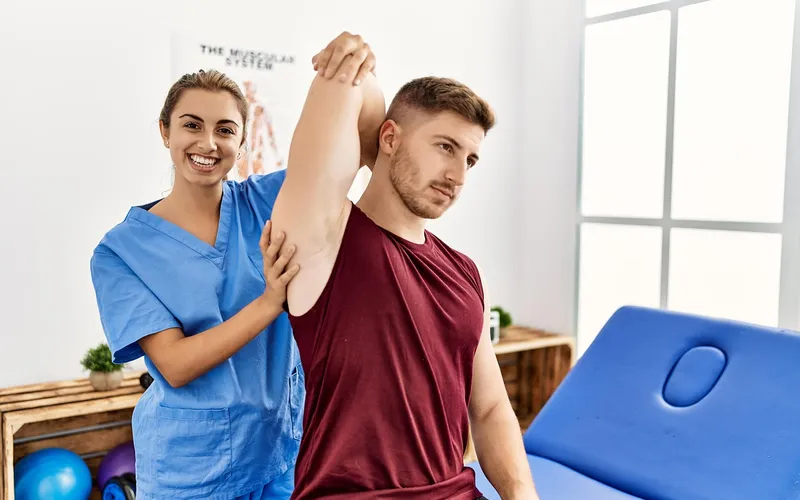
Start with a physiotherapist or doctor, who can tell you what the injury needs and what to avoid. Then come back in stages: get moving, rebuild strength around the injury, and only then return to your full training. Move to the next stage when the current one causes no lasting pain or swelling.
Stage 0: get it looked at
Before anything else, see a physiotherapist or doctor. This guide is general and every injury is different. A broken bone, a torn tendon and a pulled muscle all need different things, and some injuries need a scan or a specialist.
Go straight away, rather than waiting to see, if:
- You heard or felt a pop or snap at the time of injury.
- You cannot put weight on a leg or use an arm.
- There is a lot of swelling or bruising, or the area looks out of shape.
- You have numbness, tingling or weakness.
- The pain is getting worse rather than better after a few days.
If you have had an operation, follow your surgeon's and physiotherapist's plan. It beats any general advice, including this page.
Ask your physiotherapist three things: what you should avoid for now, what you can do, and what signs mean you should stop.
The stages
Most comebacks go through roughly the same stages. The timeline is yours alone. Some people move through them in two weeks, others take months.
| Stage | Goal | Typical activities | Move on when |
|---|---|---|---|
| 1. Move | Get gentle movement back | Range-of-motion work from your physio, easy walking or cycling | Everyday movement is comfortable |
| 2. Load | Rebuild strength around the injury | Light strength exercises, slowly heavier | You can do your rehab exercises with little or no pain |
| 3. Return | Get back to your old training | Your normal exercises at reduced weight and volume | Your old routine causes no lasting pain or swelling |
| 4. Stay | Keep it from coming back | Keep one or two rehab exercises in your routine | Ongoing |
Stage 1: move
The aim is to get the injured area moving again without irritating it. Your physiotherapist will usually give you specific exercises. Alongside them, gentle cardio keeps the rest of you ticking over. A recumbent bike supports your back and puts little load on most joints. A treadmill walk on the flat works for many upper-body injuries.
You can also keep training the parts of your body that are not injured. A sore shoulder does not stop you doing a leg press or a glute bridge. Keeping the habit going makes the comeback easier.
Stage 2: load
This is the stage people tend to skip, and the one that matters most. Pain usually fades before strength comes back. If you go straight from "it doesn't hurt any more" to your old training, the injured area may not be ready for it.
Start with light weights and higher reps, 2 sets of 12 to 15, and build the load up week by week. Slow, controlled movements are a good place to start.
Stage 3: return
Go back to your normal routine, but at about half your previous weight and volume. Add back about 10 to 20 percent a week if everything is settling well. If you feel a twinge, hold where you are for a week rather than pushing through.
Stage 4: stay
Keep one or two of your rehab exercises in your normal routine, once or twice a week. They take five minutes and may help you notice early if something is off.
Soreness or pain?
When you come back from an injury, it is easy to worry about every ache. It helps to know the difference.
Muscle soreness usually comes after unfamiliar exercise, especially the lowering part of a movement. It typically peaks 24 to 72 hours after training and fades within 5 to 7 days 1. It feels like general stiffness or tenderness in the muscle, on both sides if you trained both. It is normal and not a reason to stop. More in muscle soreness after training.
Injury pain tends to be sharper, in one specific spot, and often in the same place as the original injury. It might come with swelling, clicking, giving way or weakness. If it shows up, drop back a stage and let your physiotherapist know.
A useful rule while you are rebuilding: discomfort up to about 3 out of 10 during exercise is acceptable if it settles by the next day. If the area is more painful, stiffer or swollen the next morning, you did too much.
Expect a bumpy road
Comebacks rarely go in a straight line. A bad week does not mean you are back at square one. Look at the trend over a month rather than day to day.
Being patient here is not the same as being timid. The ACSM's 2026 review stresses programmes built around your goals, enjoyment and safety, because those are what people stick with 2. A comeback you can keep going beats an ambitious one that ends in a second injury.
For more specific guidance, see training with knee pain, training with back pain, or training with a health condition.
Questions
How long should I wait before training again?
There is no single answer. It depends on the injury, how bad it was and how it is healing. Your physiotherapist or doctor can give you a timeline. Meanwhile, you can usually keep training the parts of your body that are not injured.
Should I use heat or ice?
Either can make an injury feel better for a while. Ask your physiotherapist what they recommend for your injury. Neither replaces gradually loading the area again.
Sources
- Cheung K, Hume PA, Maxwell L. Delayed Onset Muscle Soreness. Sports Medicine, 2003;33(2):145-164. doi:10.2165/00007256-200333020-00005 · PubMed
- American College of Sports Medicine. Resistance Training Prescription for Muscle Function, Hypertrophy, and Physical Performance in Healthy Adults: An Overview of Reviews. Medicine and Science in Sports and Exercise, 2026. acsm.org/resistance-training-guidelines-update-2026