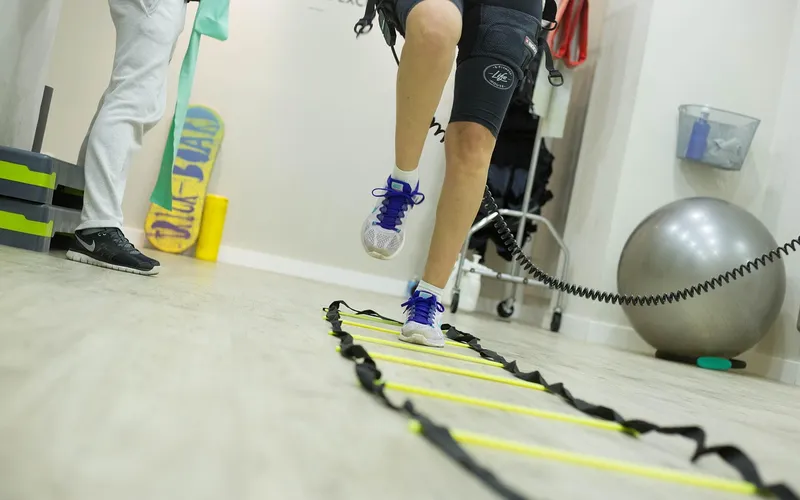
A Cochrane review of 54 trials found that land-based therapeutic exercise for knee osteoarthritis reduced pain and improved physical function and quality of life. The benefits lasted at least 2 to 6 months after treatment1.
On this page
What was studied
Fransen and colleagues wrote this review for the Cochrane Database of Systematic Reviews in 2015, under the title "Exercise for osteoarthritis of the knee". Cochrane reviews collect and assess trials on a question. This one covered 54 trials of land-based therapeutic exercise for knee osteoarthritis1. Which exercises were used and for how long are details we do not summarise here, so see the paper for the full methods.
What it found
Land-based therapeutic exercise reduced pain. It also improved physical function and quality of life. The benefits lasted at least 2 to 6 months after treatment1.
"Land-based" simply means exercise done on the ground, as opposed to in a pool.
What it means if you are starting out
If you have knee osteoarthritis, the finding speaks against the old instinct to rest the knee and avoid moving it. A UK clinical guideline reaches a similar view: it advises offering therapeutic exercise tailored to the person as a core treatment2.
For a first step, as coaching practice and not a finding from the review:
- Talk to your doctor or a physiotherapist first. They can check your knee and suggest what to do and what to avoid.
- Pick a few movements you can do without sharp pain, such as sitting down to and standing up from a chair, or a light leg press.
- Build gradually, and give the knee a day between sessions.
- Expect to keep going. The review reports benefits lasting at least 2 to 6 months after treatment, which suggests exercise is something to keep doing and not a short course.
Our leg press page shows one way to load the legs in a controlled range.
What it does not tell you
- It does not say which exercise is best. The summary gives no ranking of types.
- Benefit after treatment ended is reported for at least 2 to 6 months. It does not say how long beyond that.
- The result is an average. Some people will feel more benefit than others.
- It says nothing about knee pain from other causes, or about a knee after surgery or an injury.
- Pain that is sharp, that comes with swelling, or that wakes you at night needs a clinician, not a workout.
Amble plans a training week with exercise videos, and its coach proposes changes that you confirm. It does not diagnose and does not replace a physiotherapist.
Summary written by Amble from the published paper. Read the original for full methods and results.
Sources
- Fransen M, McConnell S, Harmer AR, Van der Esch M, Simic M, Bennell KL. Exercise for osteoarthritis of the knee. Cochrane Database of Systematic Reviews, 2015;2015(1). doi:10.1002/14651858.CD004376.pub3 · PubMed
- NICE. Osteoarthritis in over 16s: diagnosis and management (NG226), 2022. Accessed 23 October 2026.