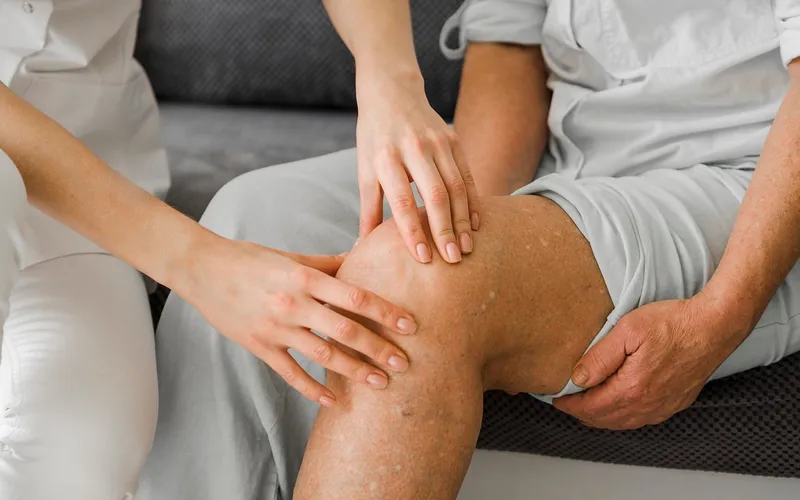
Most people with an aching knee can keep training if they choose exercises the knee tolerates and let pain guide the dose. Discomfort up to about 3 out of 10 that settles by the next day is usually fine. Sharp pain, swelling, locking or the knee giving way are reasons to stop and see a doctor or physiotherapist.
On this page
First: is this a knee to train, or a knee to have checked?
Most knee pain in adults is the slow, grumbling kind. It aches on stairs, stiffens after sitting, and feels better once you get moving. That kind of knee usually does well with sensible training.
Some knee pain is different. See a doctor or physiotherapist before you train if any of these are true:
- The knee swelled up quickly, or it is hot and red.
- You cannot put weight on the leg, or it gives way under you.
- The knee locks or catches and you have to wiggle it free.
- The pain started with a fall, a twist or a pop.
- You have pain at night that does not ease when you change position.
- You also feel unwell or have a fever.
If none of those apply and you have had the ache for a while, read on. If you are unsure, a physiotherapist visit is a good investment. They can tell you what is going on and which movements to start with.
Why moving usually helps
It is natural to want to rest a sore knee. A few days of rest after a flare can make sense. Weeks of it rarely does, because the muscles around the knee get weaker, the knee gets stiffer, and everyday things like stairs start to feel harder.
For knee osteoarthritis, the most common cause of a long-term achy knee after 40, the evidence is clear. UK clinical guidance offers exercise tailored to the person, such as strengthening the muscles around the joint and general aerobic fitness, as a core treatment 1. A Cochrane review of 54 trials found that land-based exercise reduced pain and improved function and quality of life in knee osteoarthritis, with benefits lasting at least 2 to 6 months after treatment ended 2.
That does not mean every exercise is fine. It means the right exercise, at the right dose, is part of the treatment.
The pain rule
Pain is your best feedback, as long as you read it the right way. A rule of thumb many coaches use:
| During and right after training | Next morning | What to do |
|---|---|---|
| 0 to 3 out of 10 | Same as usual or better | Carry on. You can add a little next time. |
| 4 to 5 out of 10 | Settles within 24 hours | Keep the exercise but make it easier: less weight, less depth, fewer reps. |
| Above 5, or sharp | Worse, stiffer or swollen | Drop that exercise for now. Try a gentler swap next session. |
Two things make this rule work. First, judge the knee the next morning, not only in the moment. Second, change one thing at a time, so you know what caused a bad day.
A dull ache that warms up and fades as you move is usually not a warning. A sharp, catching pain in one spot is.
How to make any leg exercise kinder to the knee
You rarely have to drop a movement completely. Usually you can change one of four things.
Depth. Most knees cope better with a partial bend than a deep one. Squat to a high box or a chair, and lower the seat as the knee settles.
Load. Use less weight and do more reps. A set of 15 at a light weight often feels better than a set of 6 at a heavy one.
Speed. Lower slowly, over 2 to 3 seconds. Fast, bouncing reps load the knee more.
Position. Keep the knee in line with the toes, and let the shin stay a bit more upright by sitting the hips back. Swapping a free squat for a machine where your back is supported can also help.
Swaps that often help
Amble rates every exercise for stress on each joint, from 0 (almost none) to 3 (a lot). Here is how some common leg exercises compare on the knee, with gentler options alongside.
| If this hurts | How Amble rates the knee | Try this instead | How Amble rates the knee |
|---|---|---|---|
| Lunges | 3 | Chair squat | 2 |
| Split squats | 3 | Leg press, short range | 2 |
| Leg extensions | 3 | Glute bridge | 1 |
| Deep squats | 2 to 3 | Seated band hamstring curl | 1 |
| Running | 3 | Stationary bike | 1 |
These ratings describe the movement in general. Your own knee may disagree. If a "1" hurts and a "2" does not, trust your knee.
For a longer list with how to do each one, see knee-friendly leg exercises. If you are deciding between a machine and a squat, leg press vs squat goes through it.
A sample week
This is a starting point for someone with a long-standing achy knee who has been cleared to exercise. Two strength days, two easy cardio days, and walking in between.
Monday: strength
- Chair squat: 2 sets of 10, to a seat height that feels comfortable
- Glute bridge: 2 sets of 12
- Seated band hamstring curl: 2 sets of 12
- An upper-body push and pull of your choice: 2 sets of 10 each
Tuesday: 20 minutes on a stationary bike, easy pace.
Wednesday: a walk, as long as feels comfortable.
Thursday: strength
- Leg press, short range: 2 sets of 12
- Glute bridge: 2 sets of 12
- Calf raises: 2 sets of 15
- Upper body: 2 sets of 10 each
Friday: bike or walk.
Weekend: something you enjoy. A walk with someone counts.
Pick a weight you could lift 3 or 4 more times at the end of each set. You do not need to go to your limit.
Training every major muscle group at least twice a week is what the recent ACSM review recommends for adults, and the biggest step is going from no strength training to some 3. Adding the aerobic days moves you toward the 150 minutes a week of moderate activity in the WHO guidelines 4. If 150 is far away, start where you are. Some activity is better than none.
Making progress
Once a session leaves the knee no worse the next morning, two weeks in a row, add one thing:
- Two more reps per set, up to about 15.
- Then a third set.
- Then a little more weight, and drop back to 10 reps.
- Then a little more depth.
Expect ups and downs. Knees often have bad days after poor sleep, a long day on your feet or a change in the weather. One bad day is not a setback. Look at the trend over a month.
When to get help
See a doctor or physiotherapist if the knee is getting steadily worse over 2 to 3 weeks of sensible training, if it swells after sessions, or if pain is waking you at night. A physiotherapist can also be useful even when things are going fine. One or two sessions to check your technique and set a starting point can save months of guessing.
If you want a plan that already accounts for a sore knee, Amble builds your training week around it. The coach proposes changes, like swapping lunges for a chair squat, and you confirm them. It is on iPhone, with 14 days free.
Questions
Should I wear a knee brace or sleeve when I train?
A sleeve can make the knee feel warmer and more supported, and some people like that. It does not replace strength work. If a professional has given you a brace for a specific reason, follow their advice on when to wear it.
Is walking good for a sore knee?
For many people, yes. Walking on flat ground is often one of the easiest things for an aching knee. Start with a distance that leaves the knee no worse the next morning and add a few minutes a week.
Can strength training make knee arthritis worse?
For most people with osteoarthritis, the opposite. UK guidance offers tailored exercise, including local muscle strengthening, as a core treatment for osteoarthritis 1. Ask your doctor or physiotherapist what suits your knee.
Sources
- NICE. Osteoarthritis in over 16s: diagnosis and management (NG226), 2022. Accessed 23 October 2026.
- Fransen M, McConnell S, Harmer AR, Van der Esch M, Simic M, Bennell KL. Exercise for osteoarthritis of the knee. Cochrane Database of Systematic Reviews, 2015;2015(1). doi:10.1002/14651858.CD004376.pub3 · PubMed
- American College of Sports Medicine. Resistance Training Prescription for Muscle Function, Hypertrophy, and Physical Performance in Healthy Adults: An Overview of Reviews. Medicine and Science in Sports and Exercise, 2026. acsm.org/resistance-training-guidelines-update-2026
- Bull FC, Al-Ansari SS, Biddle S, Borodulin K, Buman MP, Cardon G et al.. World Health Organization 2020 guidelines on physical activity and sedentary behaviour. British Journal of Sports Medicine, 2020;54(24):1451-1462. doi:10.1136/bjsports-2020-102955 · PubMed