Hyrox is 8 runs of 1 km, each followed by a station, from the SkiErg to wall balls 1. A sensible build is 12 to 16 weeks with 2 to 3 runs, 2 to 3 strength days and some station practice each week, plus a short taper. Combining running and lifting costs some strength gains 2. A newer 2022 meta-analysis found little to no effect on maximal strength and muscle size at ordinary amounts 3; the cost is mainly explosive power. The plan puts hard lifting and hard running on the same day, then an easy day.
On this page
What Hyrox is
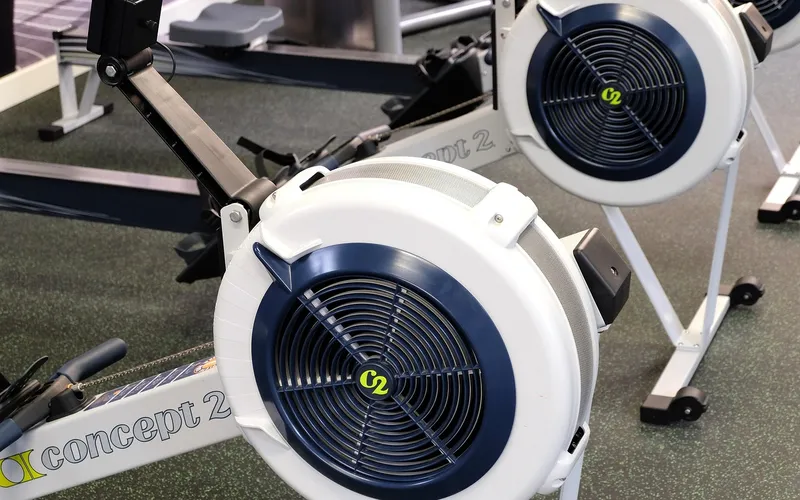
Hyrox is a fitness race with one format everywhere. You run 1 km, do one station, run another kilometre, do the next station, and keep going until you have done eight of each. The stations come in a fixed order: 1,000 m SkiErg, 50 m sled push, 50 m sled pull, 80 m burpee broad jumps, 1,000 m rowing, 200 m farmers carry, 100 m sandbag lunges and 100 wall balls 1. Divisions include Open, Pro, Doubles and a relay of four 1.
The format is the same each time, which is the useful part for training: you can practise the exact movements and rehearse the changeover from a station into running.
How many weeks and how many sessions
A sensible build is 12 to 16 weeks if you already run and lift a little, and longer if you do neither. It is practice, not a rule. Each week has three kinds of work:
- 2 to 3 runs: an easy run, an interval or tempo run, and a run straight after a station or two.
- 2 to 3 strength days: legs, pulling, and pressing, with lunges and carries in the mix.
- Station practice: sled, rowing, SkiErg, wall balls, burpee broad jumps, farmers carry and sandbag lunges, a few at the end of a session.
That is a lot of work. Combining endurance and resistance training still builds both strength and muscle, but a meta-analysis found the gains were smaller than with resistance training alone, and that running, more than cycling, was linked to smaller gains, with more frequent and longer endurance work giving smaller gains 2. A newer 2022 meta-analysis found little to no effect on maximal strength and muscle size at ordinary amounts 3; the cost is mainly explosive power. The practical answer is to put hard lifting and hard running on the same day, then make the next day easy, and not to add more of everything at once.
The 12-week plan
For someone who can run 20 to 30 minutes without stopping and has lifted before. Two runs, two strength days and one station session a week. Station work uses light weight in weeks 1 to 4 and moves toward your division's weights as you build. A pair is a 1 km run followed by one station. Easy running means you can talk but not sing 4. This is a plan layout and a rule of thumb, not a prescription 1.
| Week | Runs | Strength | Station session |
|---|---|---|---|
| 1 | 2 easy, 25 to 30 min | 2 full body days | Learn the eight stations at light weight, one round, no running between |
| 2 | 2 easy, 30 min | 2 full body days | Two rounds of four stations at light weight |
| 3 | 2 easy, 30 min, one with 4 x 1 min faster | 2 full body days | 4 pairs, light weight |
| 4 (easier) | 2 easy, 25 min | 2 days, a third fewer sets | 3 pairs, light weight |
| 5 | Easy 35 min, and 4 x 3 min hard with 2 min easy | 2 days, add legs and pulling | 4 pairs, heavier sled and carry |
| 6 | Easy 40 min, and 5 x 3 min hard | 2 days | 5 pairs |
| 7 | Easy 40 min, and 6 x 3 min hard | 2 days | 6 pairs |
| 8 (easier) | Easy 30 min, and 4 x 3 min hard | 2 days, a third fewer sets | 4 pairs |
| 9 | Easy 45 min, and 20 min tempo | 2 days | Full rehearsal: all eight pairs at about 80 percent effort, once |
| 10 | Easy 40 min, and 5 x 4 min hard | 2 days, keep the weights | 6 pairs at race effort |
| 11 (taper) | 2 easy, 25 min, with 4 x 1 min fast | 1 light day | 3 pairs, short |
| 12 (race) | 1 easy 20 min early in the week | None | Rest two days before the race |
Weeks 4 and 8 are easier on purpose. For the strength days use a mix of leg press, Romanian deadlift, lat pulldown, dumbbell shoulder press and farmer's walk, with the station session covering sled push, wall balls and burpee broad jumps.
How to adjust it:
- Short on time: keep the station session and one run, and drop a strength day.
- Miss a week: repeat it. After two weeks off go back one week.
- Not a runner yet: do Couch to 5K first, or enter Doubles, where a partner shares the stations 1.
- Heavy legs from the station session: swap the hard run for an easy one, never the other way around.
A sample week
This is a mid-build example, not a prescription. Durations are guides and depend on your level.
| Day | Session | What it looks like |
|---|---|---|
| Mon | Strength: pull and push | Wide-grip lat pulldown, seated cable row, dumbbell shoulder press, push-up |
| Tue | Easy run | 30 to 45 min where you can talk, then a few strides |
| Wed | Rest | Walk if you like |
| Thu | Hard run and legs | 20 to 30 min of intervals or tempo with easy running between, then leg press, Romanian deadlift, farmer's walk and walking lunge |
| Fri | Rest | Walk if you like |
| Sat | Station practice | Sled push, sled pull, rowing machine, wall ball, burpee broad jump, each followed by a 1 km easy to steady run |
| Sun | Long easy run or rest | 45 to 75 min, easy |
Thursday holds the hard run and the heavy leg work together, and Friday is easy. The Saturday session is the core of the plan: run, station, run, station. Start with two or three pairs and add one a week, and in the last few weeks do a full rehearsal once.
Pacing your first race
Start easier than feels right. You run eight times, and every run comes straight after a station that has already loaded your legs, shoulders and grip. An easy pace is one where you can talk but not sing, a rule of thumb for moderate intensity 4. Use it for the first two or three runs; you can always speed up later and you cannot get the first kilometres back.
At the stations, work at a steady rate rather than a sprint, and break the long ones (wall balls, lunges) into sets you decide on in advance. In Doubles, agree beforehand who takes which station. Do not try to catch up after a slow station: the next run is the place to settle.
Training around work and recovery
If you work long hours, protect two things: the long run or station session on the weekend, and your rest day. Skip an easy run before you skip a strength day. If you miss a week, restart with an easier version of the same week, not a rebuilt plan. Guidelines ask for all major muscle groups to be trained on at least two days a week 5, so even in a crammed week two strength days keep the base. Sleep matters more than another session; if you are tired for several days, take an easy week.
The taper
In the last two weeks, cut the volume by about 40 to 60 percent and keep a little speed. A meta-analysis of tapering found the best results came from a 2-week taper in which training volume fell by 41 to 60 percent, while intensity and frequency stayed the same 6. For Hyrox that means fewer sets, shorter runs, a few short fast efforts, and no heavy leg work in the last three days. Race week is for sleep, food and a rehearsal of your station plan, not for fitness. The research is on trained athletes, so scale it down if you are new.
How Amble builds it into your week
In Amble you add Hyrox as a challenge with your race date. The training plan, the meal plan and the coach follow it, with runs, strength days and station work arranged around your days, and a taper before the race. Challenges that fit together can run side by side. If Hyrox looks like too much for now, Amble can suggest a gentler version, such as doubles or a later date, and the coach proposes changes that you confirm before anything moves.
Questions
Do I need to be a runner to do Hyrox?
No, but you run 8 km in total between stations, so run 20 to 30 minutes without stopping first, or do Couch to 5K. Then start with 2 easy runs a week and build.
Can I do Hyrox in a pair?
Yes. Hyrox has Doubles, where two people run together and split the stations as they choose, and a relay of four 1. Doubles is a gentler first step.
How heavy are the sleds and carries?
The weights depend on your division, such as Open or Pro, and on whether you are a woman or a man. Check the current table on the Hyrox site before you pick your division.
Sources
- HYROX. The Fitness Race. Accessed 12 November 2026.
- Wilson JM, Marin PJ, Rhea MR, Wilson SMC, Loenneke JP, Anderson JC. Concurrent training: a meta-analysis examining interference of aerobic and resistance exercises. Journal of Strength and Conditioning Research, 2012;26(8):2293-2307. doi:10.1519/JSC.0b013e31823a3e2d · PubMed
- Schumann M, Feuerbacher JF, Sünkeler M, Freitag N, Rønnestad BR, Doma K, Lundberg TR. Compatibility of concurrent aerobic and strength training for skeletal muscle size and function: an updated systematic review and meta-analysis. Sports Medicine, 2022;52(3):601-612. doi:10.1007/s40279-021-01587-7 · PubMed
- Centers for Disease Control and Prevention. Measuring physical activity intensity. Accessed 12 November 2026.
- American College of Sports Medicine. Resistance Training Prescription for Muscle Function, Hypertrophy, and Physical Performance in Healthy Adults: An Overview of Reviews. Medicine and Science in Sports and Exercise, 2026. acsm.org/resistance-training-guidelines-update-2026
- Bosquet L, Montpetit J, Arvisais D, Mujika I. Effects of tapering on performance: a meta-analysis. Medicine & Science in Sports & Exercise, 2007;39(8):1358-1365. doi:10.1249/mss.0b013e31806010e0 · PubMed