Barbell reverse lunge
The barbell reverse lunge is an intermediate barbell compound exercise for the quads and glutes.
A lunge where you step back with a barbell on your upper back. Stepping back is easier on the knees than stepping forward and trains the quads and glutes one leg at a time.
- Main muscles
- Quads, Glutes
- Also works
- Hamstrings, Inner thighs
- Equipment
- Barbell
- Level
- Intermediate, one side at a time
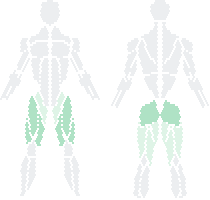
Muscles worked
The barbell reverse lunge mainly works the quads and glutes. It also works the hamstrings and inner thighs.
More exercises for: quads, glutes, hamstrings, inner thighs.
How to do it
- Stand tall with the bar resting on your upper back, hands holding it firmly, feet hip width apart and abs braced.
- Take a controlled step backward and place the ball of the back foot on the floor.
- Lower the back knee towards the floor with the chest up and the front shin nearly vertical.
- Press through the whole front foot to stand and bring the back foot to the start.
- Alternate legs or finish all reps on one side.
Where you should feel it: You should feel the front thigh and glute work hardest, with the hamstring and inner thigh helping. It should not feel like the front knee is carrying all the stress.
Coach's cues
- Rest the bar on the upper back and brace
- Step back and lower the back knee towards the floor with the upper body upright
- Push off with the front leg to stand
Try it: a working piece of Amble
Barbell reverse lunge
In your week
Pick your goal, days and time. The exercise lands where it belongs.
TueFull body A
- Barbell back squat3 × 8–12
- Barbell bench press3 × 8–12
- Bent-over barbell row3 × 8–12
- Romanian deadlift3 × 8–12
- Plank3 × 40 s
ThuFull body B
- Romanian deadlift3 × 8–12
- Bent-over barbell row3 × 8–12
- Barbell bench press3 × 8–12
- Barbell reverse lunge3 × 8–12
- Plank3 × 40 s
SatFull body A
- Barbell back squat3 × 8–12
- Barbell bench press3 × 8–12
- Bent-over barbell row3 × 8–12
- Romanian deadlift3 × 8–12
- Plank3 × 40 s
Each session: 5 exercises for 45 min
Common mistakes
How to start. Start with the bar alone or a light weight, 2 to 3 sets of 6 to 8 reps per leg. Add load once the balance is steady.
Who it suits
It suits lifters who are comfortable with a barbell squat and want leg work one side at a time. Use safety arms in a rack and take it lighter if you have knee pain, or choose dumbbells if the bar feels unstable. Clear the floor behind you.
Sets and reps by goal
- Strength: 3 to 4 sets of 5 to 8 reps per leg, 2 minutes rest.
- Muscle: 3 sets of 8 to 12 reps per leg.
- Balance and control: 2 sets of 10 slow reps per leg with a light bar.
Easier and harder versions
- Reverse lunge (easier): The bodyweight reverse lunge is the simple starting point.
- Dumbbell reverse lunge (easier): Dumbbells in the hands are easier on balance and the back.
- Barbell walking lunge (harder): Walking lunges add continuous balance and endurance.
- Bulgarian split squat (harder): The Bulgarian split squat loads the front leg even harder.
Load on your joints
How Amble rates this movement when it plans around sore joints.
Instead of the barbell reverse lunge
The same main muscles with different kit or a lower difficulty.
Similar exercises
Guides that use it
Common questions
What muscles does the barbell reverse lunge work?
The barbell reverse lunge mainly works the quads and glutes. It also works the hamstrings and inner thighs.
How many sets and reps of the barbell reverse lunge should I do?
Strength: 3 to 4 sets of 5 to 8 reps per leg, 2 minutes rest. Muscle: 3 sets of 8 to 12 reps per leg. Balance and control: 2 sets of 10 slow reps per leg with a light bar.
What can I do instead of the barbell reverse lunge?
Walking lunge, dumbbell lunge and Smith machine split squat work the same main muscles.
What are the most common mistakes in the barbell reverse lunge?
Front knee collapsing inward. Push the knee in line with the toes and use a shorter step if it drifts. Leaning forward. Keep the chest up and the bar over the middle of your foot. Stepping too short or too far. Take a step that lets the front shin stay near vertical at the bottom.