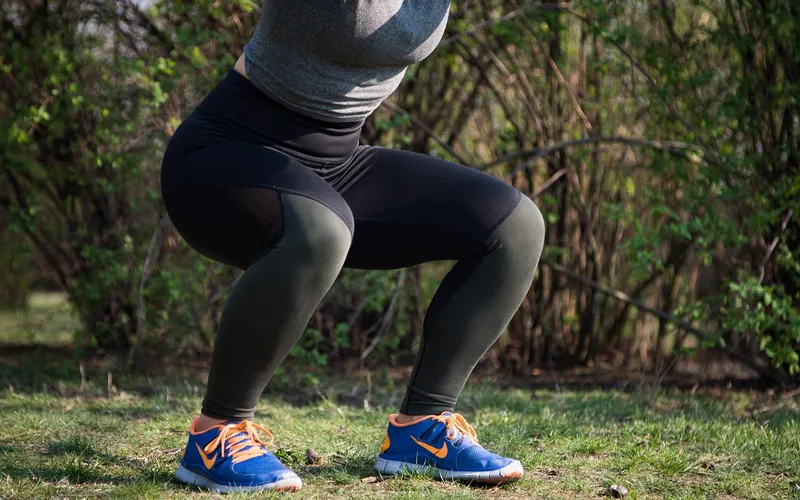
Exercises that move mainly at the hip or ankle, like glute bridges, hip extensions, hamstring curls with a band and seated calf raises, usually go easiest on a sore knee. A chair squat and a short-range leg press are good next steps once those feel fine.
On this page
How we picked these
Amble rates every exercise in its library for stress on each joint, on a scale from 0 (almost none) to 3 (a lot). For this list we started with leg exercises Amble rates at 0 or 1 for the knee, then added two rated 2 that most people with a sore knee can work toward.
A rating is a starting point, not a promise. Knees differ. If an exercise on this list hurts yours, skip it, and if you are not sure what is causing your knee pain, ask a doctor or physiotherapist first. Our guide to training with knee pain has a simple rule for judging how much pain is fine.
| Exercise | Knee rating | Main muscles | Equipment |
|---|---|---|---|
| Single-leg glute bridge | 0 | Glutes | None |
| Standing band hip extension | 0 | Glutes | Band |
| Side-lying leg raise | 0 | Side of the hip | None |
| Seated one-leg calf raise | 0 | Calves | Dumbbell |
| Glute bridge | 1 | Glutes | None |
| Seated band leg curl | 1 | Hamstrings | Band |
| Band monster walk | 1 | Side of the hip | Band |
| Recumbent bike | 1 | Thighs, heart and lungs | Machine |
| Chair squat | 2 | Thighs, glutes | Chair |
| Leg press | 2 | Thighs, glutes | Machine |
The hip group
Many people with a sore knee find that stronger hips make stairs and standing up feel steadier, and hip exercises are a common part of knee rehab plans. These four build the hips with the knee barely moving.
1. Glute bridge
Rated 1 for the knee. Lie on your back with your feet flat and close to your hips. Push through your heels and lift your hips until your body makes a line from knees to shoulders. Pause, then lower slowly. Start with 2 sets of 12. See the glute bridge.
2. Single-leg glute bridge
Rated 0. The same movement on one leg, with the other leg raised. It is harder than it looks. Keep your pelvis level; if one side drops, go back to two legs for a few more weeks. Try 2 sets of 8 per side. See the single-leg glute bridge.
3. Standing band hip extension
Rated 0. Loop a band around one ankle, hold a wall or chair for balance and push the leg straight back from the hip. Stand tall and do not arch your back to get the leg higher. 2 sets of 15 per side. See the band hip extension.
4. Side-lying leg raise
Rated 0. Lie on your side with your legs stacked. Lift the top leg with your toes pointing forward, then lower it slowly. If your hips roll back, the leg is going too high. 2 sets of 12 per side. See the side-lying leg raise.
The back of the leg and the calf
5. Seated band leg curl
Rated 1. Sit on a chair with a band anchored in front of you at foot height. Pull your heels back under the seat, then let the legs straighten slowly against the band. This trains the hamstrings, which help control the knee, without any weight on it. 2 sets of 15. See the seated band leg curl.
6. Seated one-leg calf raise
Rated 0. Sit with the ball of one foot on a step or plate and a dumbbell resting on that knee. Lift your heel as high as you can, then lower slowly. Strong calves make walking, stairs and hills feel easier. 2 sets of 15 per side. See the seated calf raise.
Moving and warming up
7. Band monster walk
Rated 1. Put a band around your knees or ankles, bend slightly, and step diagonally forward, keeping tension on the band. Keep your knees pushed out over your toes. It wakes up the side of the hip and makes a good warm-up. 2 rounds of 10 steps each way. See the monster walk.
8. Recumbent bike
Rated 1. The seat supports your back and your knee bends through a smaller, steady arc than on stairs. Set the seat so the knee stays slightly bent at full reach. Ten minutes makes a good warm-up; 20 to 30 minutes counts as your cardio for the day. See the recumbent bike.
Two to build toward
These two load the knee more, and Amble rates both at 2. They are also the most useful for daily life, because they train standing up and sitting down. Add them once the first eight feel easy.
9. Chair squat
Stand just in front of a chair, sit back slowly until you lightly touch the seat, then push through your whole foot to stand. A higher seat is easier on the knee; add a cushion if you need to. Lower the seat over the weeks as the knee allows. 2 sets of 10. See the chair squat.
10. Leg press
Your back is supported and you control the depth. Start with a short range, stopping well before the knees reach 90 degrees, and a light weight. Lower slowly and keep your lower back on the pad. 2 sets of 12. See the leg press. We compare it with squatting in leg press vs squat.
Putting it together
You do not need all ten. A good session picks one from each group:
- A hip exercise: glute bridge or single-leg bridge
- A back-of-leg or calf exercise: band leg curl or calf raise
- A standing exercise once you are ready: chair squat or leg press
- The bike or monster walk to warm up
Do that session twice a week, with an upper-body exercise or two added. The ACSM's 2026 review found that the biggest gain comes from going from no strength training to some, and that bands, bodyweight and home training give marked benefits 1. You do not need a gym to start.
Pick a weight or band where you could do 3 or 4 more reps at the end of each set. When the last set feels easy two sessions in a row, add reps, then a set, then load.
Sources
- American College of Sports Medicine. Resistance Training Prescription for Muscle Function, Hypertrophy, and Physical Performance in Healthy Adults: An Overview of Reviews. Medicine and Science in Sports and Exercise, 2026. acsm.org/resistance-training-guidelines-update-2026