Bear crawl
The bear crawl is an intermediate bodyweight compound exercise for the abs and shoulders.
A crawl on hands and toes with the knees just above the floor. It trains the abs, shoulders and legs together and teaches you to keep the body stable while it moves.
- Main muscles
- Abs, Front shoulder
- Also works
- Quads, Obliques, Triceps
- Equipment
- Bodyweight
- Level
- Intermediate
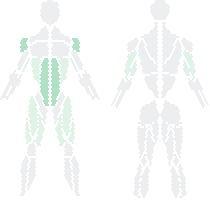
Muscles worked
The bear crawl mainly works the abs and front shoulder. It also works the quads, obliques and triceps.
How to do it
- Start on all fours with the hands under your shoulders, then lift the knees a few centimetres off the floor.
- Keep your back flat and the hips low, level with the shoulders.
- Move one hand and the opposite foot forward in a small step.
- Switch to the other hand and foot and keep a steady rhythm.
- Crawl forward for a set distance, then back or reverse if you have room.
Where you should feel it: You should feel the abs, shoulders and thighs work hard. It should not feel like the wrists or lower back are taking the strain.
Coach's cues
- Start on hands and toes with the knees just above the floor
- Move one hand and the opposite foot forward in short steps
- Keep the back level and the hips low
Try it: a working piece of Amble
Bear crawl
In your week
Pick your goal, days and time. The exercise lands where it belongs.
TueFull body A
- Goblet squat3 × 8–12
- Wide push-up3 × 8–12
- Single-arm dumbbell row3 × 8–12
- Stiff-leg dumbbell deadlift3 × 8–12
- Bear crawl3 × 40 s
ThuFull body B
- Stiff-leg dumbbell deadlift3 × 8–12
- Single-arm dumbbell row3 × 8–12
- Wide push-up3 × 8–12
- Dumbbell split squat3 × 8–12
- Bear crawl3 × 40 s
SatFull body A
- Goblet squat3 × 8–12
- Wide push-up3 × 8–12
- Single-arm dumbbell row3 × 8–12
- Stiff-leg dumbbell deadlift3 × 8–12
- Bear crawl3 × 40 s
Each session: 5 exercises for 45 min
Common mistakes
How to start. Crawl 10 to 20 metres for 3 rounds, resting 60 seconds between rounds.
Who it suits
It suits people who want a bodyweight core and conditioning exercise. Skip it if you have wrist or shoulder pain, or use the knees-down version first. Make sure the floor is clear and non-slip.
Sets and reps by goal
- Core and conditioning: 3 to 5 rounds of 10 to 20 metres.
- Warm-up: 2 rounds of 5 to 10 metres.
- Endurance: 20 to 40 seconds of steady crawling for 3 to 4 rounds.
Easier and harder versions
- Bird dog (easier): The bird dog trains the same stability with less load on the wrists.
- Mountain climbers (easier): Mountain climbers are simpler to learn from a plank.
- Plank (easier): The plank builds the basic position first.
- Burpee (harder): Burpees add jumping to your conditioning work.
Load on your joints
How Amble rates this movement when it plans around sore joints.
Instead of the bear crawl
The same main muscles with different kit or a lower difficulty.
Similar exercises
Guides that use it
Common questions
What muscles does the bear crawl work?
The bear crawl mainly works the abs and front shoulder. It also works the quads, obliques and triceps.
How many sets and reps of the bear crawl should I do?
Core and conditioning: 3 to 5 rounds of 10 to 20 metres. Warm-up: 2 rounds of 5 to 10 metres. Endurance: 20 to 40 seconds of steady crawling for 3 to 4 rounds.
What can I do instead of the bear crawl?
Ab wheel rollout, kneeling barbell rollout and dead bug work the same main muscles.
What are the most common mistakes in the bear crawl?
Hips rising. Keep the hips low and level with the shoulders. Steps too big. Take short, quick steps so you stay stable. Knees touching the floor. Keep them hovering a few cm above the floor.