Decline reverse crunch
The decline reverse crunch is an intermediate bench compound exercise for the abs.
A lower stomach exercise where you lift your hips, not your shoulders, on a decline bench. It suits people who want a different angle than a standard crunch.
- Main muscles
- Abs
- Also works
- Hip flexors
- Equipment
- Bench
- Level
- Intermediate
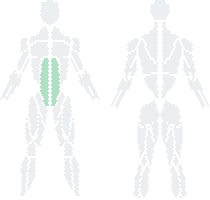
Muscles worked
The decline reverse crunch mainly works the abs. It also works the hip flexors.
More exercises for: abs.
How to do it
- Lie on the decline bench with your head at the high end and grip the bench behind your head.
- Bring your knees up over your hips.
- Curl your knees toward your chest so your hips lift off the bench.
- Hold for a moment with your knees close to your chest.
- Lower your legs slowly, with no swinging.
Where you should feel it: In the lower stomach, just below the navel.
Coach's cues
- Lie on a decline bench and hold the top behind your head
- Curl your knees toward your chest and lift the hips
- Lower the legs slowly without letting them swing
Try it: a working piece of Amble
Decline reverse crunch
In your week
Pick your goal, days and time. The exercise lands where it belongs.
TueFull body A
- Barbell back squat3 × 8–12
- Barbell bench press3 × 8–12
- Bent-over barbell row3 × 8–12
- Romanian deadlift3 × 8–12
- Decline reverse crunch3 × 40 s
ThuFull body B
- Romanian deadlift3 × 8–12
- Bent-over barbell row3 × 8–12
- Barbell bench press3 × 8–12
- Dumbbell lunge3 × 8–12
- Decline reverse crunch3 × 40 s
SatFull body A
- Barbell back squat3 × 8–12
- Barbell bench press3 × 8–12
- Bent-over barbell row3 × 8–12
- Romanian deadlift3 × 8–12
- Decline reverse crunch3 × 40 s
Each session: 5 exercises for 45 min
Common mistakes
How to start. 2 sets of 8 slow reps.
Sets and reps by goal
- Getting started: 2 to 3 sets of 5 to 10 reps, stopping with 2 reps left.
- Muscle size: 3 to 4 sets of 8 to 20 reps close to your limit. When 20 feels easy, move to a harder version.
- Endurance: 2 to 3 sets of 20 or more reps.
Common starting ranges, not rules. Adjust to how the sets feel. Source: ACSM position stand on progression in resistance training (2009). Sets and reps explained.
Load on your joints
How Amble rates this movement when it plans around sore joints.
Instead of the decline reverse crunch
The same main muscles with different kit or a lower difficulty.
Similar exercises
Guides that use it
Common questions
What muscles does the decline reverse crunch work?
The decline reverse crunch mainly works the abs. It also works the hip flexors.
How many sets and reps of the decline reverse crunch should I do?
Getting started: 2 to 3 sets of 5 to 10 reps, stopping with 2 reps left. Muscle size: 3 to 4 sets of 8 to 20 reps close to your limit. When 20 feels easy, move to a harder version. Endurance: 2 to 3 sets of 20 or more reps.
What can I do instead of the decline reverse crunch?
Flutter kicks, lying knee tuck and seated knee tuck work the same main muscles.
What are the most common mistakes in the decline reverse crunch?
Swinging the legs to build momentum. Slow the rep down and pause at the top. Yanking with your arms. Hold on lightly and lift with your stomach. Dropping the legs far past the hips at the bottom. Stop with your knees over your hips and keep the tension on.