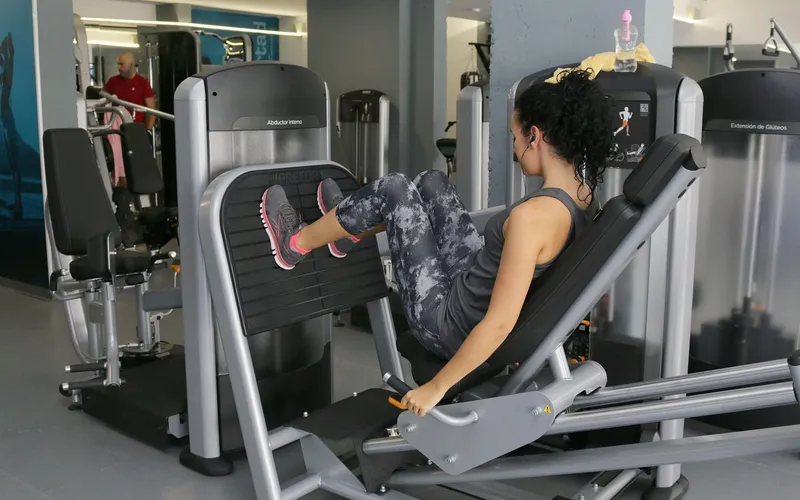
Neither is better for everyone. The leg press lets you control depth and load with your back supported, so it is often easier to start with if your knee or back is sore. The squat trains balance and standing up from a chair. For an average adult, machines and free weights give similar results.
On this page
The short version
If your knee is sore today, start with the leg press. If your knee is fine and you want to get better at getting up off the floor, out of a chair and up stairs, the squat earns its place. Many people end up doing both: the leg press for load, a lighter squat for balance and control.
What each one asks of the knee
Both are knee-bending, hip-bending exercises for the front of the thigh and the glutes. The difference is in everything around that.
| Leg press | Barbell squat | Goblet squat | |
|---|---|---|---|
| How Amble rates the knee | 2 | 3 | 2 |
| How Amble rates the lower back | 1 | 3 | 1 |
| Balance needed | None | A lot | Some |
| Easy to control depth | Yes, set the sled | Harder | Fairly easy with a box |
| Easy to add small amounts of weight | Yes | Yes | In steps |
| Needs a gym | Yes | Yes | No, one kettlebell or dumbbell |
| Learning time | A session or two | Several weeks | A few sessions |
The ratings are Amble's own, from 0 (almost no stress on that joint) to 3 (a lot). They describe the movement in general. Your knee may feel different.
The leg press scores lower mainly because your back is supported and you do not have to balance. That lets you put all your attention on the knee: how far it bends, how fast, how heavy. With a barbell on your back you are also managing your spine, your balance and your breathing at the same time.
Does a machine build less strength?
This is the worry many people have. The ACSM's 2026 review of the research looked at it and found that machines versus free weights did not consistently change results for average healthy adults 1. What mattered more was training at all, training each muscle group at least twice a week, and sticking with a programme you can keep up.
So if the leg press is what lets you train your legs without a sore knee, it is a good choice, not a lesser one.
What the leg press does not train is balance and the coordination of standing up with nothing to hold. Those matter more as we get older. A light squat to a chair covers that without much load on the knee.
How to choose
Pick the leg press if:
- Your knee hurts when you squat, even to a chair.
- Your lower back is the problem.
- You train at a gym and want to add weight in small, steady steps.
Pick a squat if:
- Your knee tolerates it without pain beyond about 3 out of 10.
- You train at home.
- Getting up from low chairs or the floor feels hard and you want to practise exactly that.
Do both if your knee allows. A common pairing is a heavier leg press set first, then a lighter goblet squat or chair squat for control.
Making either one kinder to the knee
- Shorten the range. On the leg press, stop before the knees reach 90 degrees at first. For squats, sit to a chair or a box.
- Slow down. Take 2 to 3 seconds to lower. No bouncing at the bottom.
- Feet position. On the leg press, placing the feet a little higher on the platform usually means less bend at the knee and more work for the hips.
- Knees follow toes. Let the knees track over the middle of the foot rather than collapsing inward.
- Leave reps in reserve. Stop each set when you could do 3 or 4 more.
A four-week progression
Here is one way to move from a sore-knee start toward a full squat, if that is your goal. Move to the next week only when the current one leaves your knee no worse the next morning.
| Week | Leg press | Squat |
|---|---|---|
| 1 | 2 sets of 12, short range | Chair squat, 2 sets of 8, high seat |
| 2 | 3 sets of 12, short range | Chair squat, 2 sets of 10 |
| 3 | 3 sets of 10, a little deeper, a little heavier | Chair squat, lower seat, 2 sets of 10 |
| 4 | 3 sets of 10 to about 90 degrees | Dumbbell squat or goblet squat to a box, 2 sets of 8 |
If any week makes the knee worse, go back one week and stay there longer. That is normal, not a failure. If the knee keeps getting worse, see a physiotherapist. And if you want the bigger picture, our guide to training with knee pain covers the pain rule and when to get help.
A barbell squat is optional. Plenty of people keep strong legs for life without ever doing one.
Questions
Is the leg press bad for your lower back?
It can be if the lower back peels off the pad at the bottom. Stop the movement just before that happens. Amble rates the leg press 1 out of 3 for the lower back, lower than a barbell squat at 3.
How deep should I go on the leg press?
Only as deep as your knee and lower back allow without pain. Many people start with the knees bent to about 60 degrees and work toward 90 over a few weeks.
Sources
- American College of Sports Medicine. Resistance Training Prescription for Muscle Function, Hypertrophy, and Physical Performance in Healthy Adults: An Overview of Reviews. Medicine and Science in Sports and Exercise, 2026. acsm.org/resistance-training-guidelines-update-2026