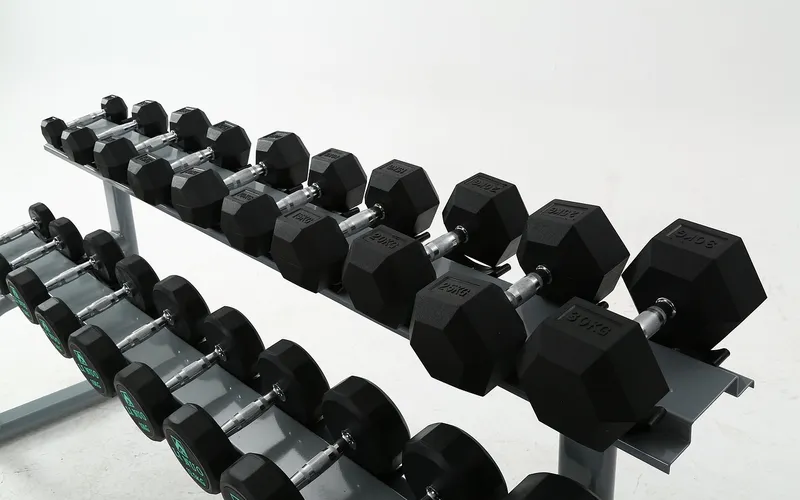
Lift a weight you can do for your target reps with good form while feeling you could do 2 to 4 more. That gap is called reps in reserve. You do not need to reach failure, and when you can do the top of your rep range on every set, add the smallest step of weight.
On this page
Reps in reserve, in one table
Reps in reserve (RIR) is the number of reps you could still have done when you stopped the set. It is the simplest way to judge weight without knowing your maximum.
| RIR | How the last rep feels | Use it for |
|---|---|---|
| 5 or more | Same as the first rep | Warm-ups, week 1 |
| 3 to 4 | Noticeable effort, form unchanged | Learning a new exercise |
| 2 to 3 | Hard, slower, still clean | Most working sets |
| 1 | Very hard, last rep is a grind | Occasional, on safe exercises |
| 0 | Could not do another | Not needed |
For most people, most of the time, the target is 2 to 3 reps in reserve.
Why you do not need failure
Going to failure means continuing until you cannot complete another rep. It feels productive, and for muscle growth it turns out not to add much. A meta-analysis found that training to complete failure was not needed: sets stopped short gave similar growth when the total amount of work was similar 1. The ACSM's 2026 position stand, which pooled 137 systematic reviews, also found that training to failure did not consistently change outcomes for average healthy adults 2.
Stopping a couple of reps short has real upsides for a beginner. Form stays clean, soreness is usually milder, and you recover faster for the next session.
A worked example
Here is how Mats, 52, found his weights in his first session at the gym. His target was 10 reps with 3 in reserve.
Leg press.
- 40 kg for 10: the tenth rep felt like the first. Too light.
- 60 kg for 10: some effort at the end, but he could have done many more.
- 75 kg for 10: reps 8 to 10 slowed down a little. He felt he had about 3 left.
- Starting weight: 75 kg.
Seated cable row.
- 25 kg for 10: easy.
- 35 kg for 10: hard at the end, and his back started to round on rep 9 to reach the last pull.
- Form broke before he hit his effort target, so he dropped back.
- Starting weight: 30 kg.
Dumbbell shoulder press.
- 6 kg each hand for 10: comfortable.
- 8 kg each hand for 10: the last two reps were slow, and he felt one or two were left.
- That is closer to 1 to 2 in reserve than 3, so he stayed lighter for the first week.
- Starting weight: 6 kg, going to 8 kg once 12 reps felt solid.
Three things to notice. He stopped climbing as soon as effort hit the target. Form decided the row, not effort. And when in doubt, he went lighter, because week 1 is for learning.
When to go heavier
Use a rep range rather than a fixed number. For most exercises, 8 to 12 works.
- Start at the bottom of the range: 10 reps if your range is 10 to 12, or 8 if it is 8 to 12.
- Each session, try to add a rep to each set at the same weight.
- When you hit the top of the range on every set, add the smallest step of weight available.
- Drop back to the bottom of the range at the new weight and repeat.
This is called double progression. It works on every exercise and you do not need to know your maximum lift.
The step matters. On a machine, it is the next pin. With dumbbells, the next pair, often 1 to 2 kg heavier per hand. On a barbell, 2.5 kg in total is enough. Small steps add up. Two and a half kilos a month is about 30 kg a year, and progress slows after the first months.
Should you lift heavier for strength
At some point, yes, on a few exercises. For strength, the ACSM recommends heavier loads, about 80 percent of the most you could lift once, for 2 to 3 sets 2. In practice that is a weight you can lift around 6 to 8 times. In adults over 50, higher-intensity training gave larger strength gains than lighter training 3.
None of that means starting heavy. It means that once your form is steady, usually after two or three months, it is worth having one or two exercises where you work in the 5 to 8 rep range. The leg press, a row and a chest press are good candidates because they are stable and easy to stop safely.
Signs you are lifting too heavy
- Your form changes in the last reps: hips shift, back rounds, elbows flare.
- You hold your breath for the whole set.
- You cannot do the same weight next session.
- Joints ache the next day, rather than muscles.
And the signs it is too light: you finish every set feeling you could do ten more, and nothing has changed in a month.
Next steps
Pick your weights for the plan in how to start strength training, and read sets and reps explained for how many sets to do. If you log your sets in Amble, the coach proposes changes to your weights and you confirm each one.
Questions
What if I cannot tell how many reps I have left?
Almost nobody can at first. Guess, then test it now and then by doing one more rep than planned on the last set. Your guesses get better within a few weeks.
Is lifting heavy dangerous for older adults?
Not when it is built up gradually with good form. In adults over 50, higher-intensity training gave larger strength gains 3. Start light and earn the heavier weights.
Sources
- Refalo MC, Helms ER, Trexler ET, Hamilton DL, Fyfe JJ. Influence of Resistance Training Proximity-to-Failure on Skeletal Muscle Hypertrophy: A Systematic Review with Meta-analysis. Sports Medicine, 2023;53(3):649-665. doi:10.1007/s40279-022-01784-y · PubMed
- American College of Sports Medicine. Resistance Training Prescription for Muscle Function, Hypertrophy, and Physical Performance in Healthy Adults: An Overview of Reviews. Medicine and Science in Sports and Exercise, 2026. acsm.org/resistance-training-guidelines-update-2026
- Peterson MD, Rhea MR, Sen A, Gordon PM. Resistance exercise for muscular strength in older adults: A meta-analysis. Ageing Research Reviews, 2010;9(3):226-237. doi:10.1016/j.arr.2010.03.004 · PubMed